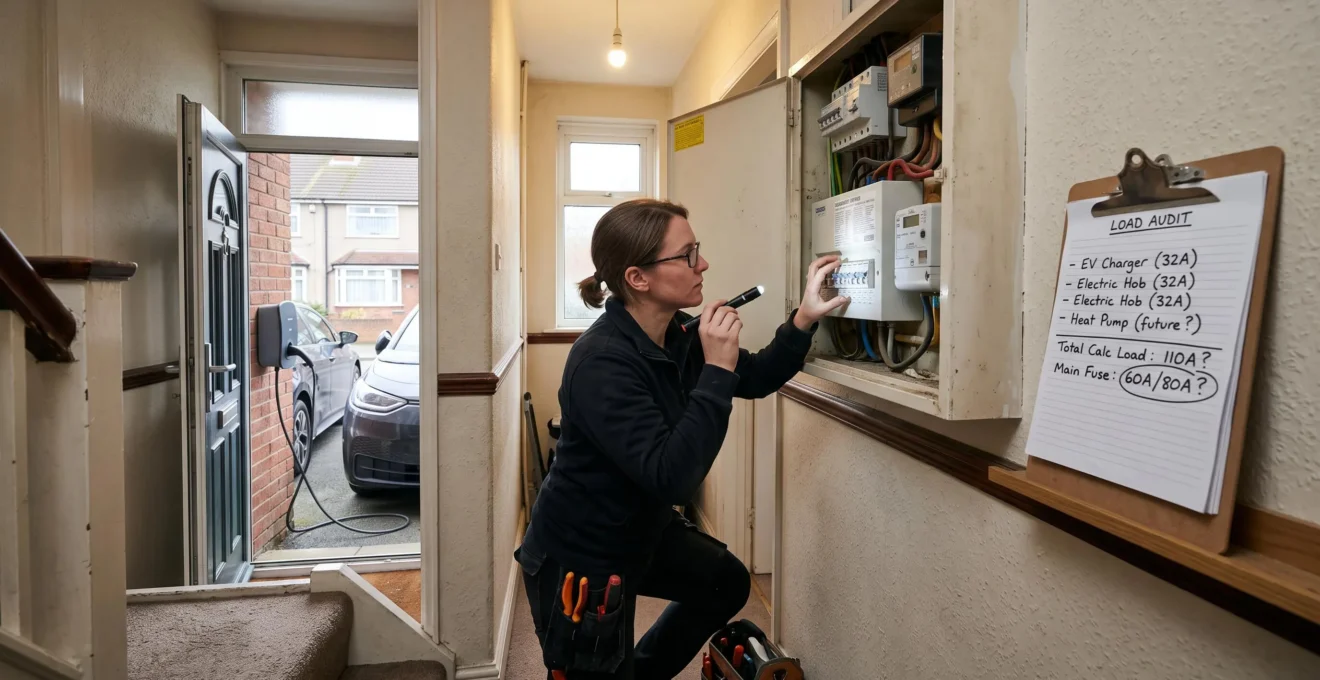
A home that has comfortably supported conventional appliances for decades may face a different electrical demand profile once an electric vehicle charger, air-source heat pump and induction hob are installed. The challenge is not simply whether the consumer unit has enough spare circuit positions. It is whether every part of the electrical supply can accommodate the additional demand safely.
In a typical UK property, capacity depends on several connected components: individual final circuits, the consumer unit, the incoming service cable, the main service fuse and the local distribution network. A limitation anywhere along that chain may affect an electrification project.
Repeated breaker trips, flickering lights or concerns about incoming supply capacity require different investigations. Some problems can be resolved by correcting circuit faults or implementing dynamic load management. Others require the distribution network operator (DNO) to assess the connection.
Understanding the distinction before commissioning work helps homeowners and installers avoid unnecessary upgrades, identify genuine safety concerns and coordinate equipment installations with network approval requirements.
Home electrification: the essential supply checks
- Capacity exists at multiple levels. A suitable consumer unit and service fuse do not guarantee sufficient capacity on the local distribution feeder.
- Simultaneous demand matters. Assess when EV charging, heating and cooking will operate together rather than simply adding appliance nameplate ratings.
- Assessment comes before installation. A qualified electrician should evaluate the existing installation, identify load-management options and establish whether DNO approval or supply work is necessary.
- Why Can Your Street Transformer Become the Bottleneck Even if Your Fuse Is Fine?
- How to Do a Basic Load Audit Before You Ask for a Supply Upgrade?
- Consumer Unit Upgrade or Supply Upgrade: Which Actually Fixes Repeated Trips?
- The DIY Distribution Board Mistake That Creates Hidden Overheating Risks at Night
- When Should You Schedule Electrical Upgrades So EV and Heating Installs Don’t Stall?
- How to Check if Your Home Can Support EV Charging and a Heat Pump Without Tripping Breakers?
- Why Do Smart Grids Need Flexible Homes to Prevent Peak-Time Stress?
- Will Smart Grids Lower Your Bills or Just Add Complexity?
Why Can Your Street Transformer Become the Bottleneck Even if Your Fuse Is Fine?
Your street transformer can limit an electrical supply upgrade even when your consumer unit, service cable and main fuse appear adequate. This happens because the distribution transformer and low-voltage feeder serve multiple properties. The DNO must consider the combined demand of neighbouring homes, not just the capacity available within your own installation.
Domestic electrical capacity operates at two interconnected levels. The first is the property’s individual connection, including its incoming service equipment and agreed supply characteristics. The second is the shared electricity distribution infrastructure supplying the neighbourhood.
A homeowner might have suitable electrical equipment for a planned installation but still need DNO approval because additional demand could exceed the capacity available on the local network.
Spare capacity inside the house is not the same as spare capacity on the street. A consumer unit rating cannot establish whether the feeder or distribution transformer has sufficient headroom.
DNOs assess network demand using diversity: the principle that not every connected customer is expected to consume their maximum potential power simultaneously. Ordinary household electrical demand varies across appliances and throughout the day.
Electrification changes that pattern. If multiple neighbours charge vehicles while their heat pumps operate during cold weather, demand may become more sustained and more closely aligned. The original diversity assumptions may no longer provide the same margin.
However, installing several electric appliances does not automatically mean a transformer is overloaded. Actual network constraints depend on customer demand profiles, feeder characteristics, voltage performance and the DNO’s engineering assessment.
It is also important to distinguish an open point in a network’s switching arrangement from a confirmed capacity constraint. The presence of a normally open point does not, by itself, establish that a particular home cannot receive additional capacity.
When one property receives approval for additional capacity, that demand becomes part of the network’s planning assumptions. Depending on local conditions, subsequent applications may require further assessment or reinforcement. Early enquiries therefore help identify constraints, although they do not necessarily reserve capacity for an applicant.
The practical conclusion is that only the relevant DNO can confirm whether the local network can accommodate a proposed increase in demand. Before requesting a larger service fuse, establish what the household actually needs.
How to Do a Basic Load Audit Before You Ask for a Supply Upgrade?
A basic electrical load audit identifies major appliances, records their electrical ratings, maps them to their circuits and estimates realistic simultaneous demand. For an EV charger, heat pump and induction hob, this reveals whether the proposed equipment might exceed existing capacity and whether load management could help. A homeowner can collect information, but a qualified electrician must validate the assessment.
Begin by making an inventory of substantial electrical loads. Focus on equipment capable of drawing significant power for prolonged periods, particularly EV charging equipment, electric heating, immersion heaters, electric showers, ovens and induction cooking appliances.
Record the manufacturer’s rated electrical input and the relevant circuit protective-device rating where these are known. A circuit-breaker rating identifies the protection provided to a circuit; it is not necessarily the normal operating current of the connected appliance.
The following example is an illustrative audit worksheet, not a measured installation or a statement that every listed appliance requires the same circuit arrangement.
| Appliance | Information to record | Likely operating overlap |
|---|---|---|
| EV charger | Maximum charging current, adjustable limit and circuit identification | Heating and overnight loads |
| Heat pump | Electrical input, maximum current and auxiliary heater details | EV charging and other heating demand |
| Induction hob | Rated input, configured power limit and circuit details | Evening heating and cooking |
| Electric shower | Rated electrical input and dedicated circuit details | Morning or evening peaks |
| Oven | Rated input and circuit arrangement | Cooking periods |
Next, identify which appliances could operate simultaneously. A household might charge its car overnight while the heat pump remains active, but experience a different peak when cooking, heating and charging overlap in the evening.
This introduces after-diversity maximum demand: an assessment of the demand likely to occur after accounting for realistic appliance use and diversity. It is different from simply adding every connected appliance’s maximum rating.
Any diversity assumptions must be suitable for the actual equipment. A vehicle charging for several hours cannot automatically be treated like an intermittently used cooking appliance.
Existing paperwork can provide useful evidence. An Electrical Installation Condition Report (EICR) may record observations about the installation, while consumer unit labels and equipment documentation help identify circuit arrangements.
Service-fuse ratings and the incoming supply arrangement should be confirmed through suitable records or by an authorised professional. Homeowners must not open sealed service equipment or remove the service fuse.
The consumer unit’s main switch rating also matters, but it must not be confused with the authorised supply capacity. A switch rated to carry a particular current does not establish the rating of the service fuse, the condition of the service cable or the permitted maximum demand.
A load audit ultimately supports a decision: can the existing installation accommodate the anticipated load, should charging current be managed, or is further DNO assessment required?
If realistic simultaneous demand can be kept within every relevant component’s verified capacity, an expensive service upgrade may be unnecessary. Where trips already occur, however, the next step is diagnosing what is actually operating.
Consumer Unit Upgrade or Supply Upgrade: Which Actually Fixes Repeated Trips?
A consumer unit upgrade can address defective or unsuitable circuit protection, insufficient circuit arrangements or ageing equipment, but it cannot increase the capacity of the incoming electricity supply. A supply upgrade addresses a different limitation involving the service connection or authorised capacity. Repeated trips require fault diagnosis before either option can be justified.
Different protective devices respond to different electrical conditions. Miniature circuit breakers provide overcurrent protection, while residual current devices detect an imbalance associated with leakage current. RCBOs combine residual-current and overcurrent protection.
Identifying exactly which device operates is therefore critical. A tripping RCD does not demonstrate that the street transformer is overloaded, and repeated operation of a circuit breaker does not automatically mean the main supply fuse needs upgrading.
The diagnostic comparison below illustrates why the correct remedy depends on the cause.
| Observed issue | Possible explanation | Appropriate investigation |
|---|---|---|
| RCD or RCBO residual-current trip | Earth leakage, appliance fault, accumulated leakage or unsuitable protection arrangements | Electrician tests circuits, connected equipment and protection compatibility |
| Individual circuit breaker trips | Circuit overload, fault or incorrect equipment selection | Check measured current, circuit design, condition and protection |
| Consumer unit has inadequate circuit provision | New equipment requires additional appropriately designed circuits | Assess consumer unit modification or replacement |
| Proposed maximum demand exceeds verified incoming capacity | Insufficient service headroom for the intended installation | Consider demand limiting, DNO assessment or service alteration |
| Voltage problems occur during high demand | Possible installation voltage drop, connection defect or network issue | Qualified testing and DNO involvement where appropriate |
A modern consumer unit may introduce different residual-current protection arrangements from an older installation. Previously undetected leakage or an unsuitable combination of connected equipment can then become apparent.
However, RCD sensitivity is not a measure of distribution-network overload. It would be technically incorrect to interpret a new RCD trip as evidence that the local transformer or incoming supply has insufficient capacity.
Responsibilities are also divided. A suitably qualified electrician can assess and carry out domestic installation work. Alterations to DNO-owned service cables, cut-outs and associated network equipment require the relevant authorised parties.
A higher-rated main service fuse must never be installed merely because the consumer unit can carry more current. The DNO must establish whether the service arrangement and relevant network capacity permit the change.
Before choosing between upgrades, consider an alternative: a compatible EV charger with dynamic load management may reduce charging current when other household loads increase. This can sometimes control maximum demand without changing the incoming supply.
Such equipment must be correctly designed and configured. Load management does not repair damaged wiring, eliminate earth faults or make an undersized circuit safe.
Accurate diagnosis prevents money being spent on the wrong component. It also avoids a more serious risk: adapting an existing distribution board for sustained high loads without verifying that its connections and ratings are suitable.
The DIY Distribution Board Mistake That Creates Hidden Overheating Risks at Night
Adding an EV charger or heat pump circuit to an existing distribution board without checking its ratings, connection requirements and condition can create overheating risks. Sustained electrical demand places prolonged stress on unsuitable or poorly terminated connections. A spare circuit position alone does not prove that a consumer unit can safely supply additional high-load equipment.
The critical mistake is assuming that an unused way in a consumer unit represents available electrical capacity. The unit’s main switch, busbar assembly, protective devices, neutral connections and terminals must all be suitable for the proposed installation.
Electrical connections can overheat when they are loose, damaged, incorrectly terminated or used beyond their permitted ratings. The resulting heat may damage insulation and equipment even without an obvious immediate protective-device trip.
Overnight EV charging deserves particular attention because the load can persist for several hours. Unlike appliances that cycle intermittently, a charger may maintain a substantial current throughout much of the charging session.
In an illustrative example, a charger operating at approximately 7 kW for a prolonged overnight period imposes a different duty cycle from brief cooking-related peaks. That does not mean a correctly designed consumer unit is inherently unsuitable for overnight charging. The risk arises when its installation and components are not appropriate for the duty.
Correct design and termination matter more than the presence of spare breaker positions. Heat pumps also require assessment of their normal and maximum electrical inputs, associated auxiliary heaters and any relevant starting characteristics.
Homeowners can recognise warning signs without opening electrical equipment. Electrical Safety First‘s home-office electrical safety advice identifies unusual heat, buzzing or crackling, burn marks and repeated protective-device operation as electrical warnings.
These symptoms should not be dismissed as ordinary consequences of installing more modern appliances. A burning smell, visible damage or abnormal heating warrants prompt professional attention. Where it is safe to do so, stop using the affected equipment and arrange an urgent assessment.
A suitably qualified electrician should check the manufacturer’s consumer unit documentation, the suitability of protective devices, circuit design, conductor sizes, connection integrity and any evidence of thermal damage.
Where overheating or defects involve the service head or other DNO-owned equipment, the DNO must be involved. The homeowner or installer should not attempt repairs to sealed incoming supply equipment.
In Great Britain, applicable electrical installation work must also comply with relevant safety and building requirements. Competent design, verification and certification are essential rather than optional administrative steps.
A properly assessed installation can support electrification safely. The important step is to identify any equipment changes early enough to incorporate them into the project schedule rather than improvising once installers arrive.
When Should You Schedule Electrical Upgrades So EV and Heating Installs Don’t Stall?
Electrical supply checks should take place during project planning, before firm installation commitments depend on unconfirmed capacity. Start with a load audit, establish whether the proposed equipment requires DNO notification or an application, and obtain the necessary network decision. Consumer unit work and equipment installation can then be coordinated around the confirmed electrical design.
EV chargers, heat pumps and related electrical upgrades often involve different contractors. If each installer considers only their own equipment, the combined maximum demand may be overlooked until late in the project.
The UK’s Energy Networks Association provides an EV charge point and heat pump connection flowchart distinguishing between Connect and Notify and Apply to Connect routes.
Its documented assessment includes whole-connection maximum demand and specific treatment of combined installations. For example, the referenced flowchart uses a 60 A, or 13.8 kVA per-phase, whole-connection demand criterion within its decision process. This is not a universal domestic supply limit.
The referenced version also directs combined EV charge point and heat pump installations through an Apply to Connect route. Because connection procedures can change, installers should verify the currently applicable ENA and DNO requirements before proceeding.
If network reinforcement is necessary, the project may depend on work beyond the property’s boundary. Lead times and costs vary, so neither should be assumed without a project-specific response.
Early coordination with neighbours may also be useful where several properties on the same feeder intend to electrify. A DNO may consider their combined future demand when planning network work, although coordinated enquiries do not guarantee a shared upgrade or a particular completion date.
It is similarly sensible to check eligibility for any applicable EV charging or heat pump funding before committing expenditure. Funding schemes have their own conditions and should not be treated as evidence that a proposed electrical connection has been approved.
A good schedule therefore separates preliminary assessments from irreversible commitments. Contractors can discuss provisional dates while the necessary supply approvals and electrical design are established.
Once the incoming supply question is resolved, the installer can complete a more reliable equipment design and avoid revisiting electrical work because an assumed capacity increase did not materialise.
How to Check if Your Home Can Support EV Charging and a Heat Pump Without Tripping Breakers?
To establish whether a home can support both EV charging and a heat pump, verify its incoming supply arrangement, assess the consumer unit and circuits, and calculate credible simultaneous electrical demand. Compare the result with the verified installation and connection limits. If demand is marginal, professionally configured dynamic load management may make the combination feasible without a supply upgrade.
The starting point is the supply assessment. Determine the confirmed main service fuse rating, relevant service cable information and existing connection characteristics through records and authorised assessment. These details cannot always be established reliably from visible labels alone.
Next, inspect the consumer unit’s documented rating and circuit arrangement. The presence of spare ways does not establish adequate current-carrying capacity, and individual protective-device ratings cannot simply be added to determine the maximum permissible household load.
For the heat pump, obtain the electrical input figures from the manufacturer’s documentation. A heat pump’s thermal output is not interchangeable with its electrical consumption. Auxiliary or backup electrical heating may materially affect maximum demand.
For the EV charger, establish the maximum configured charging current and whether the equipment supports automatic current limiting based on household demand.
The relationship between electrical power and current provides a useful starting point for a straightforward single-phase load estimate:
Electrical current (A) = electrical power (W) ÷ supply voltage (V)
For a simplified hypothetical illustration, a 7 kW single-phase EV charging load at a nominal 230 V corresponds to approximately 30.4 A. This describes that load alone, not the home’s total maximum demand or the current an installer should automatically configure.
As the UK government’s residential charge point technical specification explains, residential AC charging equipment is specified using nominal supply voltages including 230 V single-phase and 400 V three-phase.
Actual assessment must account for the relevant phases, equipment characteristics, diversity, circuit design and other household loads. A simple calculation cannot replace the electrical designer’s maximum-demand assessment.
The next question is whether those loads are genuinely simultaneous. Charging can often be reduced while cooking demand rises. Heat pump demand may also change with operating conditions, although essential heating and frost-protection functions must remain appropriately supported.
Dynamic load management is particularly useful where the connection has limited headroom. A compatible charging system can monitor demand and reduce EV charging current when other appliances need the available capacity.
A charger with basic scheduling is not necessarily equipped with whole-house dynamic load balancing. The installer must confirm how current is measured, what equipment is compatible and how the limiting arrangement behaves under fault conditions.
Equally, frequent protective-device trips should not automatically be attributed to simultaneous heating and charging. An electrician must identify the operating device and investigate faults, leakage current, circuit overload or other causes before concluding that overall capacity is inadequate.
Five checks to complete before installing an EV charger and heat pump
- Document the incoming supply. Obtain the confirmed service fuse rating and available supply details from appropriate records or an authorised assessment. Deliverable: a written supply-information record.
- Map the existing circuits. Ask the electrician to identify the consumer unit rating, relevant protective devices and proposed new circuits. Deliverable: an annotated circuit schedule.
- Collect equipment specifications. Record EV charging current, heat pump electrical input and any auxiliary heater demand. Deliverable: a manufacturer-backed equipment load list.
- Assess overlapping demand. Have the electrician calculate maximum demand and evaluate any compatible current-limiting arrangements. Deliverable: a documented demand and load-management assessment.
- Confirm the connection route. Establish whether the relevant DNO procedure requires an application or notification and obtain the required decision before connection. Deliverable: an applicable DNO response or notification record.
The result should be a verified design rather than a guess based on the size of the incoming fuse. Once individual homes understand and manage their demand, the same principle becomes relevant across the wider electricity network.
Why Do Smart Grids Need Flexible Homes to Prevent Peak-Time Stress?
Smart grids benefit from flexible homes because electricity networks must accommodate demand occurring at the same time, not simply the total energy used over a day. EV charging, electric heating and cooking can overlap during busy periods. Shifting controllable demand helps reduce coincident peaks, potentially easing pressure on local transformers, feeders and wider electricity infrastructure.
The connection begins with diversity. A local distribution system can serve many households because their electrical demands are not normally identical throughout the day. Electrification creates additional loads that may coincide, particularly during cold evenings.
If vehicles begin charging when occupants return home while heat pumps and cooking appliances are operating, the local demand peak can increase. Moving part of the EV charging demand to another period can reduce that overlap.
This is the purpose of electrical flexibility: adapting the timing or rate of selected electricity uses while maintaining acceptable household services.
An EV is often well suited to this approach because the driver typically needs sufficient charge by a departure time rather than maximum charging power immediately after plugging in.
Heat pumps offer a different kind of flexibility. Some systems and buildings can shift a portion of heating demand using thermal storage or controlled pre-heating. The available flexibility depends on the building’s heat retention, weather, controls and comfort requirements.
It would be misleading to assume that every heat pump can safely pause for an extended peak period. Heating performance, hot-water needs and manufacturer operating requirements must remain part of the control strategy.
Likewise, a smart meter alone does not create a flexible home. It provides consumption information and supports relevant metering functions, but responding to grid conditions requires additional control capability.
Useful technologies may include smart EV chargers, compatible heating controls and appropriately integrated home energy-management systems. Battery storage can provide another option where technically and economically justified.
Flexible demand can be an alternative to increasing physical capacity when the household’s maximum simultaneous consumption can be reliably constrained. It does not, however, eliminate the requirement to assess the underlying installation.
Reducing charging current also cannot repair poor connections, unsuitable circuit protection or a network voltage problem. Electrical flexibility works best when built on a safe and verified installation.
Flexibility therefore has value at two levels: it may help the individual property remain within its capacity and can contribute to managing aggregate network demand. Whether it saves the homeowner money is a separate question governed by tariffs, operating patterns and control preferences.
Key takeaways before choosing a smart energy tariff
- Verify the physical limits first. A favourable tariff does not make an overloaded circuit or unsuitable connection safe.
- Identify loads that can genuinely move. EV charging may be flexible, while heating demand requires greater attention to comfort and operating conditions.
- Compare the complete arrangement. Consider energy prices, equipment compatibility, automated control and household convenience together.
Will Smart Grids Lower Your Bills or Just Add Complexity?
Smart grids and flexible electricity tariffs can reduce household running costs when substantial demand can be moved to lower-priced periods. However, savings are not guaranteed. They depend on the tariff, how much electricity can be shifted, equipment compatibility and whether automated scheduling suits the household. Greater flexibility can also introduce additional setup, monitoring and control requirements.
An EV charger provides an understandable example. If a household can charge primarily during cheaper overnight hours, the same amount of vehicle energy may cost less than charging during higher-priced periods.
The financial outcome depends on the full electricity tariff, not only the advertised off-peak unit rate. Standing charges, peak-period rates, eligible hours and the household’s remaining electricity consumption all affect the comparison.
Heating is more complicated. Some homes can use controlled pre-heating to move part of their heat pump demand. Others may have limited flexibility because of building performance, occupancy requirements or the heating system’s operating characteristics.
A poorly configured schedule could also reduce efficiency or comfort, undermining the intended benefit. The lowest-priced hour is not automatically the most efficient hour for every heating system.
In Great Britain, the Electric Vehicles (Smart Charge Points) Regulations 2021 established smart functionality requirements for relevant charge points, including the capability to adjust charging times or rates through communications.
The regulations also address default off-peak charging settings and user control. Their existence does not mean that every smart charger provides whole-house load management or that consumers must join a commercial flexibility programme. Current requirements should be checked against applicable amendments and provisions.
Smart charging also introduces questions about communications, account access and third-party services. Depending on the chosen equipment and tariff, the system may rely on an internet connection, a manufacturer’s application or a service provider’s scheduling controls.
Households should establish what happens if those services are unavailable, who can change a charging schedule and whether essential functions continue safely without connectivity.
Some flexibility programmes may offer rewards for reducing or shifting demand at particular times. Participation conditions, eligibility and control arrangements vary. A homeowner should examine these terms rather than assume a standard smart tariff includes additional payments.
Compatibility and interoperability also deserve attention. Equipment that can work with alternative suppliers or control platforms may provide more options over its operating life. Nevertheless, a claim of smart functionality is not the same as a guarantee of compatibility with every energy-management service.
The practical choice is therefore not necessarily between buying more network capacity and buying smarter equipment. A property may require electrical work to make the installation safe while also benefiting from controls that keep routine demand below an agreed or verified limit.
That combined approach addresses both the physical constraint and the ongoing operating pattern.
The next step is to ask a qualified electrician or electrical designer for a documented capacity assessment, then compare suitable charging controls and tariffs using the household’s actual consumption patterns. Confirm any necessary DNO approval before connecting new equipment, and make the final decision on safety, installation requirements and whole-house costs rather than a headline savings claim.
Can a home with an existing 60 A service fuse install an EV charger?
Possibly. The decision depends on the property’s assessed maximum demand, the existing supply arrangement, the proposed charging current and any suitable load-limiting equipment. A 60 A fuse rating alone is not enough to determine whether the charger can be connected. The installer must follow the applicable DNO connection procedure and obtain approval where required.
Does a consumer unit rated at 100 A mean the house has a 100 A electricity supply?
No. The consumer unit or main switch rating indicates the relevant equipment’s rating, not necessarily the rating or authorised capacity of the incoming electricity supply. The service fuse, cable, connection arrangements and DNO requirements must be assessed separately.
Can dynamic EV charging prevent a main fuse overload?
Compatible dynamic load-management equipment can reduce EV charging current when other household loads rise, helping keep demand within a configured limit. Its effectiveness depends on appropriate measurement, installation, settings and equipment compatibility. It cannot correct electrical faults or compensate for unsafe wiring.
Who should investigate flickering lights when a heat pump starts?
A qualified electrician should assess the installation and investigate potential causes, including voltage drop, equipment characteristics and connection defects. If the evidence suggests a supply quality or network issue, the relevant DNO should be contacted. Repeated or severe symptoms should not be assumed to be harmless.
Can a smart electricity tariff replace the need for a supply upgrade?
Not by itself. A tariff changes the financial incentives for using electricity at different times; it does not change the physical ratings of the installation. Compatible automated controls may help reduce simultaneous demand enough to avoid some upgrades, but this must be established through a proper capacity assessment and any necessary DNO approval.