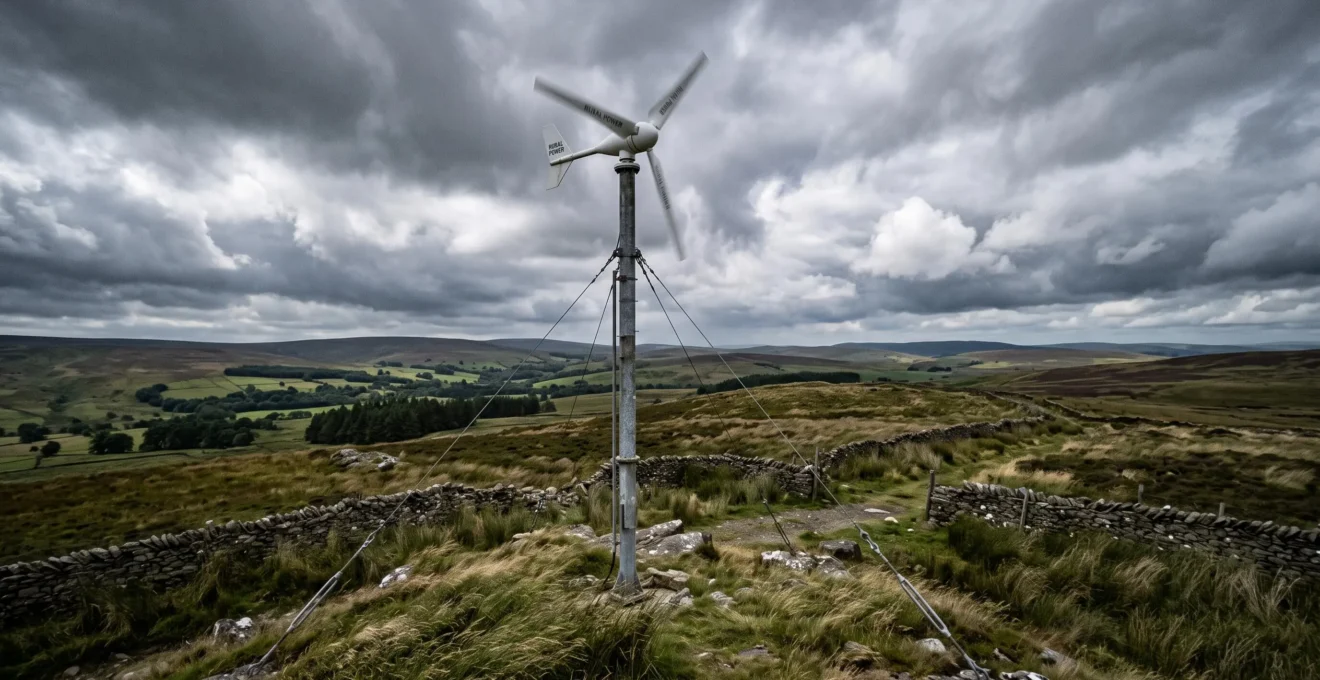
A rural property can feel relentlessly windy and still be a poor location for a domestic wind turbine. Trees shake, garden furniture blows over and winter storms rattle the roof, yet a small turbine installed nearby may generate disappointingly little electricity.
The explanation is that wind exposure is not the same as usable wind energy. Small turbines need sufficiently strong, reasonably consistent airflow at rotor height. Buildings, hedgerows, trees and nearby slopes can disrupt that airflow, while short-lived gusts create a misleading impression of the site’s annual potential.
For a UK homeowner, the decision is therefore not whether the countryside feels windy. It is whether a turbine can reach clean wind, obtain the necessary planning approval and generate enough electricity over its lifetime to justify installation and maintenance costs.
A sensible assessment starts with terrain and historical weather information, then examines the proposed turbine’s actual power curve and compares the result with alternatives such as solar PV. A promising site may warrant professional measurement; a sheltered garden may be ruled out much earlier.
Small wind feasibility: the essentials
- Strong gusts at ground level do not prove that a turbine will receive productive airflow at hub height.
- Obstacle clearance, wind-speed distribution and realistic turbine performance matter more than the rated power advertised.
- For many small or sheltered UK properties, solar PV and energy-efficiency improvements deserve priority over a domestic turbine.
- Why Do Trees and Rooflines Kill Wind Output Even When It Feels Gusty?
- How to Vet Your Wind Resource Over 30 Days Without Buying Sensors?
- Small Wind or Extra Solar: Which Gives More kWh for £5,000 on a Rural Home?
- The Siting Mistake That Triggers Noise Complaints and Cuts Output by 50%?
- When Should You Measure Wind on Your Land to Avoid Misleading ‘Storm Week’ Data?
- How to Read a Turbine Power Curve So You Don’t Fall for ‘Rated kW’ Marketing?
- How to Shortlist Renewables for Your Home Using 5 Site Questions?
- Is a Domestic Wind Turbine Worth It if You Only Have 0.2 Acres of Land?
Why Do Trees and Rooflines Kill Wind Output Even When It Feels Gusty?
Trees and rooflines reduce small-wind generation because they slow and disturb the airflow reaching a turbine. Gusts felt in a garden often result from air accelerating around obstacles rather than a consistently strong wind resource. A turbine positioned within this disturbed flow can produce far less electricity than its rated capacity suggests, even in a windy district.
Wind generally travels faster and more smoothly above ground-level obstacles. Near the surface, friction with vegetation, buildings and terrain slows it down. This vertical variation is called wind shear, and its size depends on the surrounding landscape and atmospheric conditions.
As wind crosses a roof ridge or passes through a line of trees, it also creates turbulent wakes. Within these wakes, wind speed and direction fluctuate, forcing a small turbine to operate in unstable conditions. The result can be reduced generation, increased mechanical loading and more frequent changes in rotor orientation.
The aerodynamic stakes are substantial: the power available in wind is proportional to the cube of its speed. In a simplified comparison, reducing otherwise identical airflow from 6 m/s to 4 m/s reduces the available wind power to roughly 30% of its former level. That is a physical illustration, not a prediction of a particular turbine’s annual electricity production.
The US Department of Energy Small Wind Guidebook recommends positioning the bottom of the rotor blades at least approximately 9 metres above obstacles within roughly 90 metres of the tower. This is a general engineering rule of thumb, not a UK planning requirement.
Consider two homes in the same nominally windy postcode. One overlooks open moorland with an unobstructed approach to the prevailing wind. The other sits in a village behind mature trees, barns and pitched roofs. Even if regional wind maps assign similar conditions to both, their turbine-height airflow may be dramatically different.
Exposed coastal land, elevated fields and open hilltops are often better candidates than sheltered gardens, although hilltop turbulence and local terrain still require assessment. A turbine cannot compensate for poor exposure simply by having an impressive nameplate rating.
Once the surrounding obstacles are mapped, the next question is whether the wind resource appears promising enough to justify formal measurement.
How to Vet Your Wind Resource Over 30 Days Without Buying Sensors?
You can screen a rural property’s wind potential over 30 days by combining historical wind information, nearby weather-station records and a structured visual observation diary. This free exercise helps identify obvious sheltering, recurring calm periods and prevailing directions. It cannot establish a bankable annual energy yield or replace wind measurements at the proposed turbine height.
Start with the property’s location on an elevation map and review nearby buildings, woodland, exposed slopes and prevailing wind approaches. Historical UK wind datasets, including legacy NOABL estimates where accessible, can help provide regional context. However, coarse map estimates cannot establish the wind speed experienced by a turbine behind a particular hedge or roofline.
Use Met Office weather observations and available nearby station histories to understand general conditions. The Met Office Weather Observations Website (WOW) and airport METAR reports may provide additional reference points, although some stations are located in environments very different from rural gardens.
A site’s long-term mean wind speed is useful for initial screening, but no universal minimum wind speed guarantees that a small turbine will be economical. Sites with persistently low wind speeds are less promising; sites showing sustained, stronger exposure warrant closer investigation. Any numerical screening threshold should be justified against a specific turbine, installation cost and expected energy distribution.
Then keep a simple observation record at consistent times, including morning and evening. Note the direction and visible strength of the wind using the Beaufort scale as a descriptive reference, rather than pretending visual observations provide precise metres-per-second readings.
Record whether exposed trees move differently from those beside the intended turbine location. A flag fluttering above a clear field while vegetation near the proposed mast remains relatively still suggests local sheltering. Conversely, irregular whipping movements near roofs may indicate turbulence rather than high-quality wind.
Your five-step, no-sensor wind screening checklist
- Mark the proposed turbine position and surrounding obstacles on a property sketch; produce an annotated site map.
- Identify the nearest relevant long-term wind datasets and observation stations; save a reference list with their measurement locations and heights where available.
- Record wind direction, approximate Beaufort conditions, time and visible obstacle effects at regular intervals for 30 days; produce a dated observation diary.
- Compare your diary with nearby station records for the same dates and longer-term seasonal patterns; produce a short note identifying potentially unusual weather.
- Summarise exposure, recurrent lulls, planning uncertainties and missing evidence; produce a preliminary proceed-or-stop decision before requesting turbine quotations.
Station readings need careful interpretation. A measurement taken over an open airfield cannot simply be transferred to a garden enclosed by trees. Differences in measurement height, terrain, distance and surrounding obstructions can all invalidate a direct comparison.
Thirty days is best treated as a feasibility filter. Even an unusually energetic month cannot tell you how a turbine will perform through an entire year, while a quiet month does not necessarily disqualify an otherwise exposed site.
If the initial evidence is promising, the financial question becomes whether small wind offers better value than spending the same money on an established alternative.
Small Wind or Extra Solar: Which Gives More kWh for £5,000 on a Rural Home?
For many UK rural homes, an additional solar PV installation is the more predictable use of a £5,000 renewable-energy budget. Solar generation can be modelled from long-term irradiation data, while small-wind output is highly sensitive to turbine height, obstacles and local airflow. A well-exposed site with verified strong winds may favour wind, but neither technology has a guaranteed cost-per-kWh advantage.
The comparison must cover complete installed systems, not just turbine or panel prices. A domestic wind installation may require a mast, foundations, electrical equipment, planning work, grid-connection arrangements and continuing mechanical maintenance. Solar PV has its own mounting, electrical and installation requirements, but typically involves fewer routine mechanical interventions.
The European Commission’s PVGIS grid-connected solar estimation documentation explains how its modelling tool estimates monthly and annual PV electricity generation using meteorological data and installation parameters. A UK homeowner can use those estimates as a solar baseline, provided roof shading, orientation and other assumptions are realistic.
A wind estimate needs comparable diligence: hub-height wind information, the distribution of wind speeds and a defensible turbine power curve. Comparing a detailed solar model against a turbine’s advertised maximum wattage would substantially favour the turbine on paper without measuring real performance.
For a useful comparison, build a grid using the same budget and assessment period for both options.
| Decision criterion | Additional solar PV | Domestic small wind |
|---|---|---|
| Annual electricity | Estimate with PVGIS and site-specific shading inputs | Estimate from hub-height wind distribution and power curve |
| Complete £5,000 budget | Check what installed capacity the quote actually covers | Include mast, foundations, electrical equipment and installation |
| Ten-year ownership costs | Allow for inspections, repairs and component replacement if needed | Allow for mechanical servicing, repairs and component replacement |
| Planning and neighbour impact | Review roof suitability, appearance and applicable permissions | Assess height, boundaries, noise, visual impact and permissions |
| Generation timing | Typically strongest during brighter months and daylight hours | Potentially useful outside daylight and during windy winter periods |
| Self-consumption | Compare daylight production with electricity demand | Compare hourly and seasonal production with electricity demand |
The table deliberately avoids invented generation figures. Actual kWh per £5,000 depends on the quoted equipment, site conditions and electricity usage. Additional solar capacity may also be limited by roof space or electrical constraints, and neither option should be assumed to fit the budget without written quotations.
Wind becomes more attractive on an elevated, unobstructed site where reliable measurements demonstrate substantial usable generation during periods of household demand. Winter-heavy wind production can complement electrically heated homes, although it should not be confused with guaranteed electricity during every cold spell.
The fairest economic measure is lifetime electricity value after installation, servicing, replacement and relevant export arrangements, not the lowest upfront headline cost. Solar’s relative simplicity often reduces uncertainty, whereas mechanical wear and site-dependent generation can make small wind’s financial outcome harder to predict.
Even a potentially attractive wind investment can fail when the chosen mounting location simultaneously reduces electricity output and creates avoidable neighbour problems.
The Siting Mistake That Triggers Noise Complaints and Cuts Output by 50%?
The classic siting mistake is placing a turbine on a building, immediately beside a roofline or close to neighbouring homes without checking airflow and noise. Building-induced turbulence can reduce generation while vibration and changing mechanical loads increase disturbance. However, a 50% reduction is not a universal or verified consequence: the actual loss depends on the turbine, surrounding obstacles and wind conditions.
Roof-mounted turbines are particularly vulnerable because the wind passing over pitched roofs can separate into irregular, rotating flows. Rather than receiving a consistent wind direction, the rotor encounters rapid changes in speed and angle. A machine repeatedly correcting its orientation may harvest less energy and experience additional mechanical stress.
A building can also transmit vibration into occupied rooms, while nearby homes may hear aerodynamic or mechanical sound under particular wind directions. Noise concerns therefore cannot be assessed only from the manufacturer’s headline sound specification or the distance visible on a property map.
The preferred location combines clean exposure with appropriate separation from dwellings, boundaries and noise-sensitive areas. It should also offer a realistic mast height and workable access for installation and maintenance.
In England, the domestic wind provisions in the England’s permitted development legislation for domestic wind turbines set conditions for qualifying installations. In the cited 28 May 2025 version, a stand-alone domestic turbine falls under Class I, with an overall height limit of 11.1 metres, minimum blade-tip clearance of 5 metres above ground, maximum swept area of 3.8 square metres and boundary separation of at least 110% of its overall height.
Those provisions also include other eligibility conditions, including compliance with applicable microgeneration planning standards or equivalent requirements. They are not a blanket permission to install every turbine meeting the numerical dimensions. The applicable legislation must be checked at the time of installation, and Scotland, Wales and Northern Ireland have their own planning frameworks.
Before ordering, document the intended mast position, the prevailing wind approaches, neighbouring buildings, nearest property boundaries and potential noise receptors. Ask the local planning authority whether the specific installation qualifies for permitted development or requires an application, and whether additional restrictions apply.
Discussing a proposed installation with adjacent residents can also reveal concerns before equipment is purchased. That does not replace a technical noise assessment or statutory permission, but it can prevent a poorly explained proposal from becoming an avoidable dispute.
Good siting removes major obstacles to success, but evaluating the resource over an unrepresentative period can still produce an expensive misjudgement.
When Should You Measure Wind on Your Land to Avoid Misleading ‘Storm Week’ Data?
Measure wind across contrasting seasonal conditions rather than relying on a stormy week or an unusually calm fortnight. Ideally, a proper feasibility study uses sufficiently long, representative measurements at or near the intended hub height and compares them with established climate records. If a full-year campaign is impractical, sample more than one season and disclose the remaining uncertainty.
UK wind conditions vary through the year. The Met Office’s 1991–2020 climate averages report a UK mean wind speed at 10 metres of 10.78 knots in January compared with 7.87 knots in July. These figures demonstrate seasonal differences at a national scale; they do not tell you the wind speed above a particular garden.
10.78 knots vs 7.87 knots
UK January and July mean wind speeds at 10 metres, respectively, for the 1991–2020 climate reference period. These are national historical averages, not domestic turbine-height measurements.
Met Office long-term climate averages, 1991–2020.
Imagine a hypothetical homeowner recording wind during a succession of winter storms. The measured mean might appear encouraging, yet represent weather that occurs relatively infrequently. A different homeowner testing during a settled high-pressure period could dismiss an otherwise promising site. Neither observation should be treated as a typical year.
A more defensible approach compares simultaneous data from the proposed location and a suitable reference station, then places that reference period within longer-term local or regional conditions. If the reference station was unusually windy during the campaign, the short-term site data should not be used without qualification as an annual average.
The choice of reference station matters. Its surroundings, observation height and exposure must be understood before drawing conclusions about the property. A technically valid long-term adjustment requires appropriate data and methodology; simply multiplying measured values by an arbitrary seasonal correction would create false precision.
There is a further complication: the mean wind speed does not describe the full wind-speed distribution. Two locations can share the same average while experiencing different frequencies of calm conditions, productive moderate winds and strong gusts.
Those differences affect generation because turbines produce varying amounts of electricity at different speeds. Averages alone therefore cannot establish annual yield. Measurements need to be matched with a real power curve and the frequency of wind-speed intervals.
For an exposed site progressing toward purchase, request a feasibility assessment that documents measurement dates, observation height, local obstructions, data quality, seasonal representativeness and uncertainty. Short-term visual screening should remain a preliminary step rather than the basis for guaranteed financial projections.
Once the wind-speed distribution is understood, the next challenge is translating it into actual electricity production without relying on a turbine’s marketing headline.
How to Read a Turbine Power Curve So You Don’t Fall for ‘Rated kW’ Marketing?
A turbine power curve shows how much electrical power a machine delivers at different wind speeds. Its rated kilowatt figure describes output under specified conditions, not continuous generation. To judge whether a turbine suits a UK rural property, compare the entire curve with the wind speeds your site actually experiences, paying particular attention to frequently occurring moderate winds.
The horizontal axis of a power curve normally represents wind speed, typically in metres per second, while the vertical axis shows electrical power. The important features are the cut-in speed, the rising output region, rated operating conditions and any cut-out or shutdown behaviour.
Cut-in is the wind speed at which the turbine starts generating useful electricity according to its specification. It does not mean production immediately reaches an economically significant level. Between cut-in and rated conditions, output can change sharply with wind speed, making this region particularly important for annual energy calculations.
Rated power is usually achieved only around the manufacturer’s specified rated wind speed. If such winds occur infrequently at the installed hub height, a turbine promoted as several kilowatts may spend most of its operating life producing a much smaller output.
Annual energy production should be estimated by combining the power available at each wind-speed interval with the time the site experiences that interval, accounting for applicable losses and availability. In simplified form:
Annual energy = sum of power at each wind speed × annual hours at that speed.
This calculation is why two turbines with the same rated power can have markedly different annual generation at the same location. Their cut-in behaviour, rotor diameters, power curves and electrical efficiency may differ.
Rotor dimensions also deserve scrutiny. A larger swept area intercepts more moving air under comparable conditions, so rotor diameter can be more informative than an aggressively advertised rated output. This does not mean every larger rotor will outperform every smaller one; aerodynamic design, generator characteristics and real operating conditions still matter.
Ask the supplier how the power curve was obtained. Independently verified field measurements are more persuasive than undocumented marketing graphs or results from conditions that do not resemble the proposed installation.
Look for relevant MCS certification and independently supported performance documentation where applicable, but verify exactly what the certification covers. Certification does not guarantee a specific annual yield on your land.
Finally, request an annual generation estimate using an explicit site wind-speed distribution, proposed hub height and stated allowances for downtime and electrical losses. Reject a calculation that simply multiplies rated power by the number of hours in a year.
Once equipment performance is separated from marketing assumptions, it becomes easier to decide whether wind deserves a place on the property’s broader renewable-energy shortlist.
How to Shortlist Renewables for Your Home Using 5 Site Questions?
Shortlist renewable technologies by asking five questions about your property: how exposed it is, how much usable space it has, when electricity is needed, what grid connection is available and what planning constraints apply. These answers can eliminate unsuitable technologies before expensive surveys or quotations. Start by reducing avoidable energy demand, then compare the remaining options using realistic production estimates.
A rural property’s renewable-energy decision should begin with insulation, heating efficiency and electricity consumption patterns. Lower demand can reduce the amount of generating capacity needed, improving the affordability and practicality of whichever technology follows.
Then apply the five site questions as a decision funnel.
- How exposed is the site? Open, elevated land with limited obstacles may justify a wind-resource assessment. Sheltered plots surrounded by trees or buildings are usually poor initial wind candidates.
- How much usable space exists? Assess roof size, orientation and shading for solar, alongside available land, obstacle clearance and suitable mast locations for wind. Do not treat plot acreage as a substitute for checking geometry.
- When does the household need energy? Review daily electricity consumption and seasonal heating needs. Daytime demand may match solar output, while a genuinely windy site could offer complementary winter or overnight generation.
- What are the grid and export arrangements? Check connection capacity, installation requirements, self-consumption opportunities and any applicable export arrangements. Generation that cannot be used or exported economically has reduced financial value.
- What planning and neighbour constraints apply? Consider building status, permitted development eligibility, boundary separation, noise, landscape sensitivity and local objections before selecting equipment.
For a sheltered small plot, energy-efficiency work and appropriately designed solar PV generally merit investigation ahead of small wind. For an exposed rural holding with adequate separation from obstacles and neighbours, a wind survey may be justified.
A household with high winter electricity demand should not automatically choose wind. Its seasonal generation might be useful, but heating-system efficiency, heat-pump suitability, solar output, storage and grid electricity costs all require consideration.
Each shortlisted option should reach the same basic evidence standard: realistic generation, full installed cost, expected maintenance, regulatory feasibility and a demand-matching assessment. If wind has only a rated-power claim while solar has a defensible annual energy model, the wind proposal is not yet ready for a fair comparison.
One final constraint can settle the issue for many rural homeowners before any further modelling: the physical size and layout of the available land.
Key takeaways before choosing a domestic turbine
- A turbine needs enough unobstructed space to reach useful airflow; a windy postcode cannot compensate for poor clearance.
- Plot dimensions, boundary restrictions and achievable mast height may rule out a practical installation before wind measurements become worthwhile.
- When on-site wind is unsuitable, energy efficiency, solar PV and participation in larger renewable projects remain realistic alternatives.
Is a Domestic Wind Turbine Worth It if You Only Have 0.2 Acres of Land?
For most UK homeowners with only 0.2 acres of land, a domestic wind turbine is unlikely to be worthwhile. The main problem is not the plot area alone, but the limited space available for safe separation, obstacle clearance and a sufficiently tall mast. A small, exceptionally exposed property might still warrant investigation, but most sheltered plots will struggle to support productive generation.
A 0.2-acre plot provides approximately 809 square metres. The useful question is how those square metres are arranged. A narrow plot bordered by houses and mature trees presents very different constraints from an open field with minimal surrounding obstructions.
In England, the 28 May 2025 version of the permitted development provisions discussed earlier required a qualifying stand-alone domestic turbine to be separated from the property boundary by at least its overall height plus 10%.
For a hypothetical turbine standing 10 metres high, that formula gives a minimum boundary separation of 11 metres. A square 0.2-acre plot would have sides of approximately 28.4 metres. Even in that idealised shape, only a central area roughly 6.4 metres wide would satisfy the boundary-distance calculation, before considering any buildings, existing obstructions or other requirements.
Illustrative example: a small rural garden
Imagine a square 0.2-acre property with a house near one boundary and mature trees beyond another. A homeowner proposes a 10-metre stand-alone turbine in the centre of the plot.
Although the central position might satisfy the illustrative boundary calculation under the cited historical English rules, the rotor could still sit within turbulent airflow created by the house and trees. Planning eligibility would depend on every applicable condition, and the site’s actual wind resource would remain unverified. This hypothetical example does not establish that such an installation would be permitted or economically viable.
Obstacle clearance creates another problem. The general engineering guidance discussed earlier recommends placing the lowest rotor blade substantially above nearby obstacles. Reaching that height above surrounding roofs or trees may be incompatible with the mast height allowed under permitted development.
Applying for full planning permission may sometimes make a taller installation possible, but planning permission does not remove the aerodynamic or economic limitations. Nor does a small plot automatically prohibit a turbine: UK rules differ by nation, and the precise legal and physical circumstances matter.
For constrained properties, realistic alternatives include maximising suitable rooftop or ground-mounted solar PV, reducing electricity and heating demand, investigating community wind ownership schemes, or choosing a renewable electricity tariff. These alternatives can provide renewable-energy benefits without requiring a productive turbine location on the property itself.
A useful final self-assessment is to draw the proposed turbine position on a scaled site plan, mark surrounding buildings and trees, then check whether acceptable airflow and separation are achievable together. If the turbine cannot reach clear wind without creating unacceptable planning, boundary or neighbour constraints, the attractive idea of a domestic turbine should not override the physical evidence.
Before committing any money, prepare a scaled site plan and seek an initial view from the relevant local planning authority. If the layout appears feasible, request a site-specific wind assessment and an independently supported annual generation estimate. If it does not, redirect the budget towards energy-efficiency measures or renewable options with a more defensible return.
Can a small wind turbine generate electricity during strong gusts?
Yes, provided wind speeds fall within the turbine’s operating range and the machine is functioning correctly. However, short gusts do not necessarily contribute much to annual generation. Turbulent gusts can also increase mechanical loads, while sufficiently strong winds may trigger protective shutdown. Annual energy depends on how frequently productive wind speeds occur, not just the strongest winds recorded.
Does a domestic wind turbine need planning permission in the UK?
Not every domestic wind installation necessarily requires an individual planning application. Some installations may qualify for permitted development if they satisfy all applicable conditions. Requirements differ between England, Scotland, Wales and Northern Ireland, and additional restrictions can apply to particular properties or locations. Check the rules currently in force with the relevant local planning authority before purchasing equipment.
Can a nearby weather station accurately predict my turbine’s annual output?
Not by itself. Weather-station records provide useful regional and seasonal context, but their observation height, surrounding terrain and exposure may differ significantly from the proposed turbine location. A defensible generation estimate requires suitable site wind information, a wind-speed distribution, the turbine’s power curve and explicit allowances for losses and uncertainty.
Will a taller mast always make a small wind turbine more productive?
A taller mast can improve access to stronger, less turbulent airflow, particularly where trees or buildings shelter the lower rotor position. However, the improvement is site-specific and cannot be guaranteed. Additional mast height can increase installation costs, structural requirements and planning complications. The benefit must be assessed against those constraints.
Is it worth buying a wind turbine before measuring the wind on my land?
Usually not. Start by checking surrounding obstacles, available space, planning constraints and historical wind conditions. A free preliminary screening can eliminate unsuitable locations, but it cannot prove annual output. For a promising site, obtain an appropriately supported wind-resource assessment and turbine-specific generation estimate before committing to installation costs.