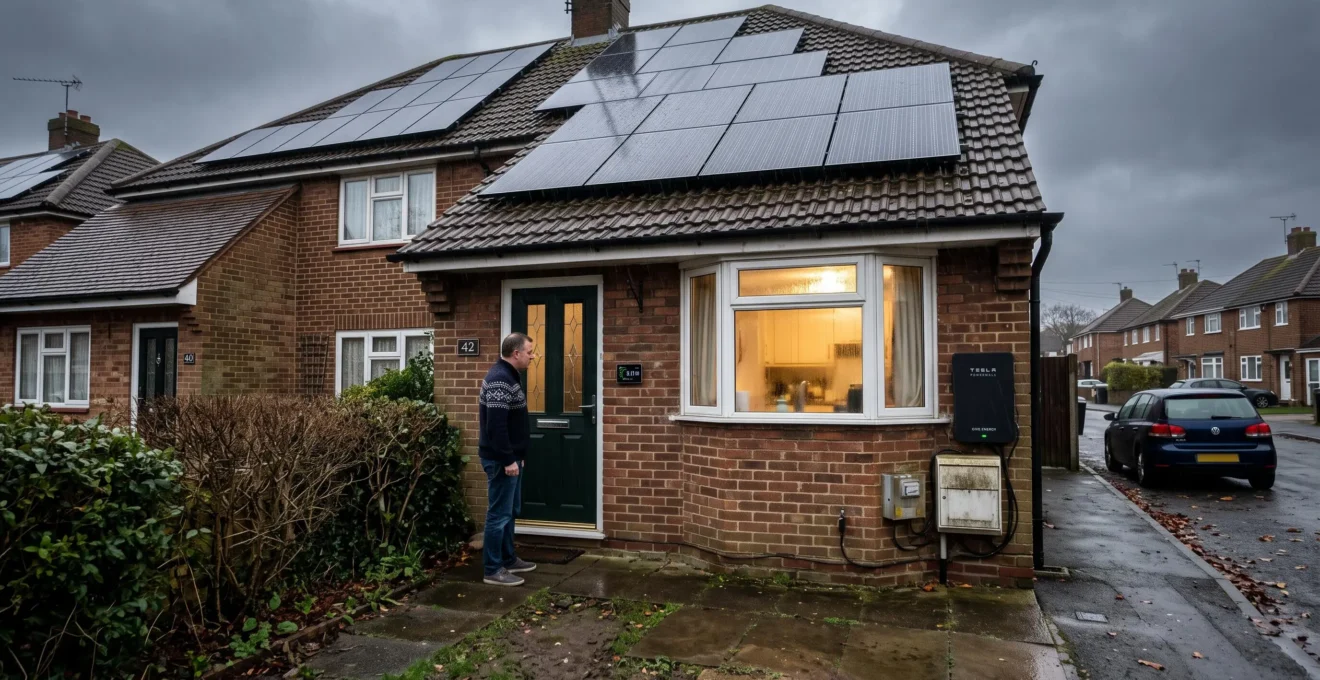
Yes, a UK home can become substantially more energy self-sufficient without cutting electricity consumption by 50%. But there is a significant difference between generating much of your annual electricity and operating completely independently of the National Grid.
A well-designed combination of rooftop solar, battery storage, intelligent appliance scheduling and properly configured backup power can reduce grid dependence while preserving everyday comforts. A fully off-grid house, however, must also survive several consecutive dark winter days, when generation is weak and heating-related demand may be high.
The solution is not necessarily to buy more panels or the biggest battery available. It is to understand when electricity is generated, when your household uses it, which appliances must remain operational during outages, and how much independence is worth paying for.
That approach replaces an arbitrary 50% consumption reduction with a system designed around actual demand, seasonal limitations and a realistic definition of autonomy.
UK home energy independence: the essentials
- Annual solar generation can offset substantial consumption without eliminating winter grid imports. Energy balance is not continuous independence.
- Battery capacity must be calculated from measured essential loads, the required backup duration and the inverter’s power rating.
- Load shifting, correctly sized generation and verified backup circuits usually provide a more practical route to resilience than pursuing complete disconnection.
- Why Is UK Winter the Dealbreaker for “100% Self-Sufficient” Plans?
- How to Calculate How Many Battery kWh You Need for 24–72 Hours of Autonomy?
- Home Battery or Backup Generator: Which Keeps You Running During a 12-Hour Cut?
- The Backup Power Mistake That Leaves You in the Dark Even With a Full Battery
- In What Order Should You Add Solar, Batteries, and Load Shifting for Best Results?
- How to Convert “2 Days of Backup” Into kWh and kW Without Guesswork?
- How to Match Home Generation to Your Actual Daily Load Curve in 4 Steps?
- What’s the Most Reliable Way to Generate Electricity at Home in the UK Without Regret?
Why Is UK Winter the Dealbreaker for “100% Self-Sufficient” Plans?
UK winter is the principal obstacle to complete solar self-sufficiency because electricity generation falls precisely when many households need more energy. Short daylight hours, weaker sunlight and cloudier weather restrict solar output, while heating, lighting and evening demand continue. A system that produces enough electricity across a year may still need substantial grid support in December.
The fundamental distinction is between annual energy self-sufficiency and continuous power independence.
Annual energy self-sufficiency describes how much electricity a property generates compared with its total consumption over a year. Continuous independence requires enough electricity to meet demand at every moment, including winter evenings and extended periods of poor weather.
According to Energy Saving Trust’s expert answers on heat pumps, annual solar generation can match substantial electricity consumption without occurring when that electricity is needed. In particular, ordinary domestic batteries cannot store summer surpluses for winter heating.
Consider a hypothetical household consuming 12 kWh per day in winter. If its solar installation generates only 2 kWh on a particular December day, the remaining 10 kWh must come from another source, assuming no other on-site generation. A battery charged from previous solar production may temporarily help, but it cannot repeatedly replace energy that never arrives.
Roof suitability matters as much as installed capacity. A shaded or poorly oriented roof may produce less electricity than an unobstructed roof with a comparable number of panels. Limited roof area also restricts how far a homeowner can compensate by installing additional modules.
Before accepting a claim of 80% or 100% self-sufficiency, ask the installer for:
- Estimated electricity generation for December, not just the annual total.
- Calculations using the property’s actual roof pitch, orientation and shading.
- The percentage of household consumption expected to be supplied directly or through storage.
- A clear definition of whether the estimate includes grid imports, exports or backup during outages.
There is also an overlooked winter opportunity: shifting flexible consumption into daylight hours. Running a dishwasher, washing machine or appropriately controlled immersion heater when solar electricity is available can use generation directly instead of exporting it and buying electricity later. This does not create extra sunlight, but it can reduce the energy that must pass through a battery.
Winter is therefore not simply a season to compensate for with additional batteries. It establishes the practical limit of solar-only autonomy and determines which household loads are worth supporting when generation is scarce.
How to Calculate How Many Battery kWh You Need for 24–72 Hours of Autonomy?
Calculate battery capacity by measuring the electricity your chosen appliances consume each day, multiplying that demand by the number of backup days, and allowing for usable battery capacity and conversion losses. Separately, verify that the inverter can supply the appliances’ simultaneous power demand. A battery suitable for overnight use may be far too small for three days of autonomy.
Start by separating electricity demand into two categories: essential loads, such as refrigeration, communications, lighting and heating controls; and discretionary loads, such as laundry, cooking appliances and EV charging.
Use appliance energy labels, plug-in monitors or suitable consumption measurements rather than relying on household averages. Energy is measured in kilowatt-hours (kWh), while instantaneous power is measured in kilowatts (kW).
For a hypothetical household with 6 kWh of essential daily electricity consumption, the arithmetic is:
| Autonomy scenario | Energy required | Nominal capacity at 80% usable energy |
|---|---|---|
| 24 hours of essentials | 6 kWh | 7.5 kWh |
| 48 hours of essentials | 12 kWh | 15 kWh |
| 72 hours of essentials | 18 kWh | 22.5 kWh |
| 72 hours of full household use at 14 kWh/day | 42 kWh | 52.5 kWh |
These figures are hypothetical calculations, not standard requirements for UK homes. They assume no battery recharging during the outage and an illustrative usable-capacity factor of 80%. Actual sizing must use the manufacturer’s specifications, conversion efficiency, operating limits and any reserved capacity.
For context, Energy Saving Trust’s battery storage advice describes 10 kWh as an example of typical domestic storage capacity and notes that a battery management system may retain a reserve rather than discharge completely.
However, stored energy is only half the decision. A battery holding 20 kWh may still be unable to operate a collection of appliances whose combined instantaneous demand exceeds its inverter’s output rating.
Choose an autonomy target before deciding what to purchase. Overnight solar buffering, 24-hour essential backup and 72-hour whole-house independence solve different problems.
Finally, check how the proposed battery would recharge after a winter outage. If daily essential demand exceeds daily solar generation, a larger battery extends the time before depletion but does not make the system continuously sustainable.
Once the required kWh and kW are known, the next question is whether a battery is actually the right technology for the outages the property experiences.
Home Battery or Backup Generator: Which Keeps You Running During a 12-Hour Cut?
A correctly configured home battery is often better suited to short outages requiring quiet, rapid backup of essential circuits. A generator can be more suitable for prolonged interruptions or higher sustained power demands, provided fuel is available and the equipment is safely installed. Neither automatically guarantees uninterrupted supply: the deciding factors are output capacity, changeover arrangements, runtime and maintenance.
For a 12-hour outage, calculate the energy requirement before comparing equipment. A hypothetical essential load averaging 400 W over 12 hours consumes 4.8 kWh. That does not establish the required inverter or generator rating, because appliances may briefly demand far more power than their average consumption suggests.
The practical differences extend beyond purchase price.
| Decision factor | Home battery | Backup generator |
|---|---|---|
| Response to outage | Can be automatic with suitable backup equipment; changeover may involve an interruption. | Manual or automatic depending on installation and transfer equipment. |
| Runtime | Limited by stored usable energy and available recharging. | Limited by fuel supply, equipment rating and operating conditions. |
| Power delivery | Limited by inverter continuous and surge ratings. | Limited by generator continuous and starting-load ratings. |
| Noise and placement | Generally quiet in operation; needs appropriate installation conditions. | Produces noise and exhaust; requires safe outdoor siting. |
| Ongoing obligations | Capacity degradation, battery management and warranty conditions. | Servicing, testing, fuel management and safe storage. |
| Solar integration | May integrate with compatible solar and island-capable equipment. | Requires a properly engineered arrangement for interaction with other power sources. |
A hybrid configuration can combine short-duration battery backup with a generator for exceptional outages. That improves flexibility but introduces more components, integration requirements and maintenance obligations. It should not be assumed that any existing generator can safely charge or operate alongside a particular home battery.
Generator exhaust presents a serious carbon monoxide risk. A generator must never operate inside a home, garage or other enclosed or inadequately ventilated space, even with doors open. Grid-connected electrical installations also require an appropriate transfer arrangement to prevent dangerous backfeeding.
Cost comparisons should include battery replacement or capacity fade, generator servicing, fuel availability, installation work and the frequency of actual outages. Energy Saving Trust‘s battery guidance describes a typical battery lifespan of approximately 10–12 years, but this is not a guarantee for any individual product.
A household experiencing occasional short interruptions may reasonably prioritise silent essential-circuit backup. A rural property facing extended outages may need a different solution.
Whichever technology is selected, the installation must actually be capable of supplying the house when the grid disappears. That requirement is often more important than nominal storage capacity.
The Backup Power Mistake That Leaves You in the Dark Even With a Full Battery
The critical mistake is assuming that stored electricity automatically becomes usable backup power during a grid outage. Many grid-connected solar and battery systems disconnect when the public supply fails. Unless the installation includes suitable islanding protection, changeover equipment and designated backup circuits, even a fully charged battery may leave the house without electricity.
This is a configuration issue, not simply a storage issue.
Normal grid-connected generation must not energise the distribution network during an outage. Anti-islanding protection is essential for safety. To continue powering domestic circuits independently, a system needs equipment specifically designed and installed for backup operation.
Energy Saving Trust’s solar power fact check confirms that ordinary domestic battery installations do not normally provide power during a cut without additional equipment and configuration.
Backup capability must be specified before installation. Ask which circuits remain operational, whether changeover is automatic or manual, what interruption is expected and whether solar generation can recharge the battery while disconnected from the grid.
A dedicated backup consumer unit might supply refrigeration, selected lights, broadband equipment and boiler controls. It may not supply every kitchen socket, the heat pump, an immersion heater or the EV charger.
A second failure occurs when the backup inverter cannot deliver sufficient instantaneous power. For example, an illustrative 3 kW backup output cannot continuously support a simultaneous 4 kW load, regardless of how much energy remains stored. Motor starting surges and manufacturer-specific limits require separate checks.
Five checks to complete before relying on home battery backup
- Walk through the house and identify appliances that must operate during an outage. Deliverable: a written essential-load list.
- Identify the consumer unit circuits supplying those appliances. Deliverable: a circuit-to-appliance schedule for the installer.
- Obtain confirmation of the inverter’s backup output and starting-load limits. Deliverable: a specification sheet showing continuous and surge ratings.
- Ask the installer to document the changeover arrangement, covered circuits and solar recharging capability. Deliverable: a backup configuration diagram.
- Arrange a controlled outage simulation with the installer or another competent electrician, following the manufacturer’s instructions. Deliverable: a record of which circuits remained live and any observed interruptions.
Do not attempt to simulate a power cut by opening electrical equipment, bypassing protective devices or improvising a generator connection. A qualified installer should determine and demonstrate the safe test procedure.
Only after backup operation has been verified does it make sense to optimise how solar panels, storage and everyday electricity use work together.
In What Order Should You Add Solar, Batteries, and Load Shifting for Best Results?
For most UK homeowners, the sensible starting sequence is to measure consumption, shift flexible electricity use into available generation hours, size solar panels against the resulting load profile, and add battery storage where a genuine timing gap remains. This avoids purchasing unnecessary capacity. However, electricity tariffs, existing solar installations, EV charging and future heat pumps can justify a different investment order.
Start with information rather than equipment. A smart meter or suitable consumption monitor can reveal how much electricity the household uses during daylight, during the evening peak and overnight.
Moving a dishwasher cycle from the evening to a solar-producing period does not require a reduction in comfort. It simply changes when electricity is consumed.
That makes load shifting a practical substitute for some battery storage. Electricity used directly when generated does not need to be stored and recovered later, avoiding storage losses. The financial benefit nevertheless depends on export payments, import tariffs and the amount of solar electricity actually available.
Once the demand profile is understood, evaluate the usable roof area, orientation, shading and seasonal generation forecasts. Then estimate whether enough surplus electricity remains to justify a battery.
The sequence also depends on the property’s starting position:
| Household circumstances | Practical starting point | Next decision |
|---|---|---|
| No solar, flexible daytime loads | Measure demand and adjust appliance schedules. | Size solar against the revised consumption profile. |
| Existing solar with substantial exports | Measure exports and evening imports. | Assess battery economics and compatibility. |
| Cheap overnight electricity tariff | Compare peak and off-peak consumption costs. | Test whether battery-only storage is financially useful. |
| Planned EV or heat pump | Estimate additional consumption and operating times. | Allow for future loads before finalising system capacity. |
| Frequent power cuts | Specify essential loads and backup requirements. | Select compatible storage, inverter and changeover equipment. |
For retrofits, inverter choice can shape future options. An AC-coupled battery may be appropriate for an existing solar installation, while a compatible hybrid inverter may offer a different integration pathway. Neither arrangement should be assumed universally superior.
Ask installers to explain expansion limits, compatibility with future batteries and the applicable Distribution Network Operator (DNO) connection process. UK solar installations must be registered with the relevant DNO, and connection arrangements depend on the installation’s technical characteristics.
Energy Saving Trust’s guidance on domestic storage also recognises that batteries can operate without solar panels and can store electricity purchased during cheaper tariff periods. This makes rigid installation sequences potentially misleading.
The result should be a system that addresses measured consumption at the lowest reasonable complexity. To evaluate longer backup periods, however, the household still needs a precise statement of how much electricity must remain available.
How to Convert “2 Days of Backup” Into kWh and kW Without Guesswork?
Convert two days of backup into two separate specifications: usable stored energy in kWh and available simultaneous power in kW. Measure what the household must consume during each outage day, add those energy requirements, and adjust for usable battery capacity and losses. Then calculate the maximum combination of appliances that may run together. Both figures are necessary for a credible backup quotation.
Begin by defining what “two days” actually means. Forty-eight hours of ordinary household operation is not equivalent to one day of essential services followed by a second day with selected loads switched off.
Hypothetical example: 48 hours of household backup
Assume a household normally consumes 14 kWh per day but can maintain essential services with 6 kWh on the first outage day and 4 kWh on the second day by postponing discretionary appliances.
Total backup energy is 6 + 4 = 10 kWh. At an illustrative usable-capacity factor of 80%, the nominal battery capacity would be 10 ÷ 0.8 = 12.5 kWh, before separately allowing for conversion losses and other system constraints.
If the household instead expects to maintain its full 14 kWh daily demand for 48 hours, the calculation becomes 28 ÷ 0.8 = 35 kWh of nominal battery capacity, again before additional losses.
Both answers describe the same hypothetical property. The difference comes entirely from the required level of service.
Next, calculate the power requirement. Suppose the appliances expected to operate simultaneously are a 150 W refrigerator while its compressor is running, 100 W of lighting, a 200 W collection of communications and electronic equipment, and a 2,000 W kettle.
Their combined illustrative demand is 2,450 W, or 2.45 kW. The inverter must support that load under the conditions specified by its manufacturer, with sufficient allowance for starting surges and other loads.
A system with adequate kWh but insufficient kW may shut down or disconnect loads during a peak-demand event. Conversely, a powerful inverter connected to a small battery can supply substantial power only for a limited period.
To replace guesswork with measured inputs, monitor essential appliances over a representative week. For appliances that cannot safely or conveniently be measured with plug-in equipment, use suitable monitoring data or professional assessment. Compare the observations with smart-meter consumption records where available.
Keep a written calculation containing daily energy needs, the reserve allowance, inverter output and any expected contribution from solar generation. During winter, treat solar recharging conservatively rather than assuming every day will deliver useful surplus.
Once backup has been translated into kWh and kW, the same consumption measurements can help determine how closely ordinary solar generation matches the household’s daily demand.
How to Match Home Generation to Your Actual Daily Load Curve in 4 Steps?
Match home electricity generation to demand by collecting half-hourly consumption data, comparing it with expected solar production, calculating when generation and demand overlap, and testing how load shifting or batteries reduce the remaining gap. Repeat the process in winter and summer. Annual electricity totals alone cannot reveal whether a solar installation will actually supply the household when electricity is needed.
A daily load curve records how demand changes through the day. Two properties consuming identical annual electricity can have very different energy independence outcomes if one uses most electricity during daylight and the other consumes it after sunset.
The following four-step process turns that difference into numbers.
- Capture the consumption curve. Collect seven days of half-hourly electricity readings from a suitable smart-meter service or monitoring system. Record the energy used in every interval and calculate average daily consumption in kWh.
- Map expected generation. Obtain an installation-specific solar forecast showing estimated production across the day for the relevant season. Compare generation and demand over corresponding half-hour intervals. Record expected daily solar production in kWh.
- Calculate direct-use overlap. For each interval, take the smaller of household consumption and available solar generation. Sum those values to estimate direct solar consumption before considering battery storage. Record both the total direct-use kWh and the share of daily demand covered.
- Test changes to the remaining gap. Move flexible loads to periods of predicted surplus where practical, then recalculate direct consumption, exports and imports. Evaluate whether additional battery storage would usefully transfer surplus energy to later demand periods.
The essential distinction is between generating enough energy across an entire day and generating it when electricity is consumed.
For example, consider a deliberately simplified hypothetical day with 12 kWh of household demand and 10 kWh of solar production. If only 4 kWh of production coincides with demand, the home initially uses 4 kWh directly, exports 6 kWh and imports 8 kWh, ignoring storage and other on-site sources.
If shifting appliance operation increases direct solar consumption to 6 kWh, imports fall to 6 kWh and exports fall to 4 kWh under the same assumptions. Total household consumption remains 12 kWh.
This demonstrates why timing changes can reduce grid dependence without reducing total usage. The precise financial outcome depends on the value of imported versus exported electricity.
Repeat the analysis for both July and January. A summer profile with significant midday surplus may justify storage for evening consumption, while winter data may show little surplus available to charge that storage.
Data quality matters. Holidays, unusual guests, exceptional weather and malfunctioning appliances can distort the results. A representative week is a useful starting point, not a substitute for seasonal measurements or a properly modelled annual forecast.
With both the consumption profile and backup requirement established, the remaining decision is which electricity-generation technology offers the most dependable performance for the property’s actual conditions.
Key takeaways before choosing a generation system
- Request generation estimates for the actual roof or installation site, including realistic winter performance.
- Check whether proposed generation improves direct self-consumption or mainly creates surplus electricity that must be exported or stored.
- Require explicit confirmation of backup configuration, equipment compatibility and responsibilities for future maintenance.
What’s the Most Reliable Way to Generate Electricity at Home in the UK Without Regret?
For many UK homes with a suitable roof, solar photovoltaic panels provide a relatively predictable and practical starting point for domestic electricity generation. However, reliability depends on site-specific output, installation quality and compatibility with demand and backup equipment. Small wind turbines, ground-mounted solar and micro-combined heat and power may suit particular properties, but none guarantees independence without careful assessment.
A useful definition of reliability includes more than whether a generator operates. It covers the predictability of energy production, installation feasibility, maintenance obligations and the extent to which performance can be checked before investment.
Rooftop solar is often an attractive option because output can be estimated using roof orientation, pitch, shading and location. Nevertheless, those estimates must be seasonal and property-specific. A dependable annual forecast does not imply dependable electricity generation during a particular winter evening.
Ground-mounted solar can offer additional siting flexibility where suitable land is available. Its practicality depends on space, site conditions, installation costs and applicable planning requirements.
Domestic wind generation deserves particular scrutiny. A turbine’s rated output does not establish expected production at a particular address. Wind availability at the proposed hub height, nearby obstructions and turbulence all affect its usefulness. Built-up residential sites may be unsuitable, while an exposed rural location could offer materially different conditions.
Micro-combined heat and power produces electricity alongside useful heat, so its suitability depends on heating demand, equipment characteristics and the fuel or energy source involved. It should not be treated as equivalent to renewable solar generation or as an automatic route to complete energy independence.
The decision framework is therefore straightforward:
| Technology | Main advantage to investigate | Principal risk to verify |
|---|---|---|
| Rooftop solar PV | Site-specific generation forecasting and use of existing roof space. | Winter shortfall, shading and limited usable roof area. |
| Ground-mounted solar PV | Greater flexibility in orientation and installation layout. | Land requirements, site works and planning constraints. |
| Small wind turbine | Potential generation outside daylight hours at a suitable windy site. | Actual wind conditions, turbulence, noise and maintenance. |
| Micro-CHP | Combined provision of useful heat and electricity. | Fuel dependence, heating-demand matching and equipment complexity. |
Before signing an installation agreement, request a complete set of verifiable information:
- A generation forecast based on the property’s actual conditions, including monthly estimates.
- A defined self-sufficiency metric distinguishing annual energy balance from reduced grid imports and true outage autonomy.
- Equipment specifications, warranty conditions, workmanship coverage and any exclusions affecting expected performance.
- A clear explanation of battery compatibility, inverter limits and available backup circuits.
- Written confirmation of relevant DNO processes, installation responsibilities and any applicable planning requirements.
- A financial assessment using realistic consumption, import tariffs, export payments, maintenance costs and future electricity demand.
Energy Saving Trust’s overview of domestic energy storage options identifies household consumption, existing generation and potential future additions such as EVs and heat pumps as important planning considerations. It also recommends obtaining quotations from at least three installers.
A proposed solar installation producing an impressive annual total may still deliver disappointing independence if the household imports heavily during winter evenings. Conversely, a smaller system with appropriately timed consumption, useful storage and functioning backup could meet the owner’s actual objectives more effectively.
Near self-sufficiency is a systems-design outcome, not a product specification. Generation must match a measured load curve, batteries must serve a defined storage or autonomy purpose, and backup equipment must work when the grid is unavailable.
The practical next step is to collect recent electricity-consumption data, identify essential outage loads and request installation proposals that separately specify monthly generation, expected grid imports, usable battery capacity, maximum backup power and covered circuits. Compare those proposals against the independence you actually want, rather than purchasing enough hardware to pursue a percentage that may never be achievable year-round.
Can a UK house remain connected to the grid while generating most of its own electricity?
Yes. A grid-connected solar and battery system can reduce imported electricity while retaining the grid as a supply when on-site generation and stored energy are insufficient. The degree of independence depends on generation conditions, consumption timing, storage capacity and household demand. Producing a large annual share of consumption does not mean the property can operate without the grid throughout winter.
Can solar panels recharge a home battery during a power cut?
Only if the installation is specifically designed and configured to support that operation. Standard grid-connected solar systems generally shut down during a power cut for safety. Compatible island-capable equipment, an appropriate changeover arrangement and suitable controls are necessary. Even then, winter weather may provide insufficient solar generation to meaningfully recharge the battery.
Does a bigger battery always mean a more self-sufficient home?
No. A larger battery can store more electricity and potentially extend backup duration, but only if sufficient energy is available to charge it. Where winter generation consistently falls below household consumption, additional storage cannot eliminate the ongoing energy deficit. Battery size should reflect usable surplus, tariff opportunities or explicitly defined outage requirements.
Can a heat pump operate from a home battery during an outage?
Potentially, but compatibility must be assessed rather than assumed. The backup inverter must support the heat pump’s electrical input, including relevant starting and peak demands, and the battery must contain enough usable energy for the intended operating period. The circuit must also be included in the backup installation. Cold-weather heating demand and limited solar generation can make prolonged battery-only operation challenging.
Is complete off-grid living in the UK impossible without major electricity savings?
Not necessarily, but complete off-grid operation requires sufficient generation, storage and potentially alternative backup sources to cover extended low-generation periods. The feasibility depends on consumption, available installation space, winter conditions and budget. Reducing discretionary demand can improve system economics, but a universal 50% consumption cut is neither a technical requirement nor a guarantee of success.