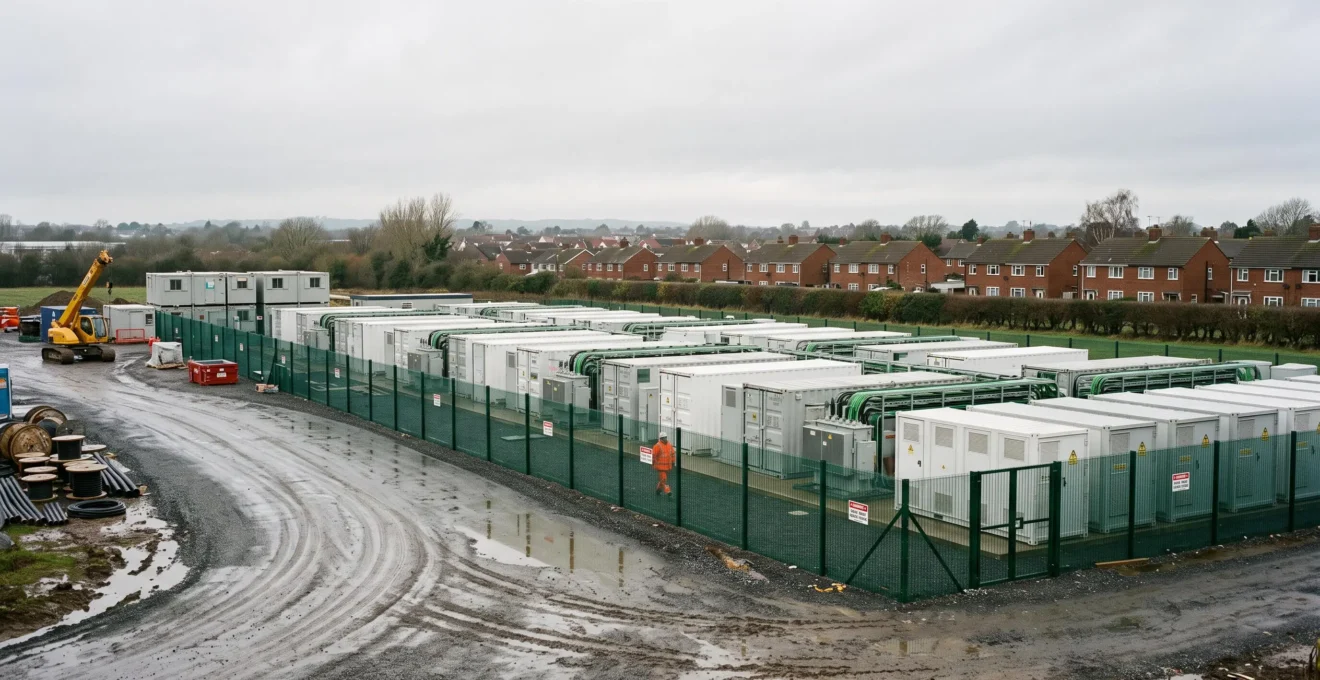
Battery energy storage systems (BESS) are appearing beside UK towns, industrial estates and electricity substations because the grid increasingly needs somewhere to store electricity and release it at precisely the right moment. These installations do not generate power. Instead, they help electricity networks manage changes in demand, renewable generation and system frequency.
For a developer, a site near an existing substation may offer a practical grid connection and access to electricity markets. For residents, however, the same location can raise questions about fire safety, cooling equipment, construction traffic, land use and whether the surrounding community receives any direct benefit.
The distinction matters. A battery can provide valuable services to the wider electricity system without supplying a neighbouring housing estate directly or guaranteeing lower local energy bills. Its usefulness depends on its capacity, storage duration, connection arrangements and operating strategy.
Understanding those characteristics makes it easier to assess whether a proposed development is technically sensible, commercially justified and appropriately designed for its surroundings.
UK battery storage: the essential facts
- Location is largely about grid access. Sites near substations and suitable industrial land can connect storage to electricity networks, although connection costs and constraints vary.
- MW and MWh describe different capabilities. Power determines how quickly a battery can deliver electricity; energy capacity determines how long it can sustain that output.
- Local impacts require project-specific scrutiny. Fire protection, cooling noise, access, drainage and decommissioning should be assessed rather than assumed acceptable or unacceptable.
- Why Do Grid Batteries Make Renewables Work Better Even Without New Generation?
- How to Read a BESS Proposal: MW, MWh, and “2-Hour Duration” Explained Simply
- 1-Hour or 4-Hour Grid Battery: Which Solves Price Spikes Better?
- The Risk Misread That Makes Every BESS Sound Dangerous
- When Do Grid Batteries Charge and Discharge, and Why Does It Change by Season?
- Pumped Hydro or Battery Storage: Which Handles Peak Demand Better at Scale?
- Why Does “Reliable Power” Depend on Flexibility, Not Just Big Power Stations?
- Are Conventional Energy Sources Still the Most Reliable Option During Cold Snaps?
Why Do Grid Batteries Make Renewables Work Better Even Without New Generation?
Grid batteries make renewable electricity more useful by storing energy when generation is abundant and releasing it when demand is higher. They cannot create additional electricity, but they can change when existing solar and wind output reaches consumers. This helps reduce the mismatch between variable renewable generation and the electricity people actually need at a particular time.
Consider a hypothetical wind farm producing substantial electricity overnight, when demand is relatively low. Without sufficient transmission capacity or demand, some output might be curtailed. A suitably located battery could charge during that period and discharge later, provided it has the necessary connection capacity and access to the available electricity.
The same principle applies to solar generation. Electricity produced around midday may be more valuable if part of it can be delivered during the evening demand peak.
Installed generating capacity is not the same as usable electricity delivered when needed. Additional renewable capacity increases potential production, whereas storage can improve the timing and usefulness of production already available.
According to NESO’s explanation of battery storage, batteries can provide fast frequency response, reserve services and support for congestion management. These services are valuable even when the batteries are not simply moving renewable electricity from one period to another.
Britain’s electricity network has geographical constraints. Wind generation is concentrated in some areas, while major demand centres are elsewhere. If electricity cannot be transported through a constrained part of the network, operators may need to reduce generation in one location and arrange alternative supply in another.
Constraint management can involve payments to generators and other market participants. These costs contribute to wider electricity system balancing expenditure, although a particular battery does not automatically eliminate them.
Importantly, a battery helps with congestion only where its location, connection and dispatch can relieve the relevant constraint. Installing storage beside an arbitrary substation does not necessarily address transmission bottlenecks elsewhere.
Storage also has conversion losses. Electricity delivered after charging is less than the electricity originally consumed, so its value depends on whether better timing and network services outweigh those losses and associated costs.
The central limitation is duration. Lithium-ion batteries are well suited to short-term balancing, but an installation designed for two hours cannot independently compensate for several consecutive days of unusually weak wind generation.
That distinction becomes particularly important when examining a planning application, because the advertised power rating alone reveals little about how much energy the proposed battery can actually deliver.
How to Read a BESS Proposal: MW, MWh, and “2-Hour Duration” Explained Simply
A BESS proposal describing a 100 MW / 200 MWh installation identifies two different capabilities: 100 megawatts of rated power and 200 megawatt-hours of nominal energy capacity. Dividing energy by power gives a two-hour duration at rated output under simplified conditions. Actual usable energy and discharge duration depend on operating limits, efficiency and the project’s technical specifications.
MW measures the rate of electricity transfer. MWh measures the quantity of energy stored or delivered over time. A 100 MW grid connection describes a potential rate of import or export, not a permanent demand of 100 MW.
The relationship can be understood through a hypothetical comparison:
| Battery specification | Nominal duration | What the figures imply |
|---|---|---|
| 100 MW / 100 MWh | 1 hour | High output for a comparatively short period |
| 100 MW / 200 MWh | 2 hours | The same rated power sustained for longer |
| 100 MW / 400 MWh | 4 hours | Greater energy capacity for an extended discharge |
These are nominal examples rather than guaranteed operational outputs. The usable capacity may be lower because of state-of-charge restrictions, equipment performance and reserve requirements.
It is tempting to translate a battery’s MW rating into an exact number of homes powered. That comparison can be misleading. Domestic demand varies considerably by household, season and time of day, and a grid-connected battery normally serves the wider electricity system rather than a dedicated group of properties.
A more reliable approach is to ask how much energy the project can export over a defined period, and what assumptions underpin that figure.
The duration also indicates likely commercial applications. Shorter-duration batteries may focus on rapid balancing and brief price variations, while longer-duration assets can sustain output across more of an evening peak. Most projects can participate in several markets.
For local residents, the published energy figures should be read alongside the physical design. A larger MWh capacity may require additional battery modules, but the site’s footprint also depends on enclosure design, access roads, spacing, transformers and safety arrangements.
England’s government planning guidance on renewable and low-carbon energy provides specific advice on battery storage proposals, including engagement with fire and rescue services for qualifying developments. Planning frameworks differ across the UK’s nations, so the applicable local requirements must also be checked.
Five checks to make before commenting on a BESS application
- Record the electrical ratings: extract the declared MW connection capacity, MWh storage capacity and duration into a short project summary.
- Check the site boundary: mark the battery enclosures, transformers, access routes and nearest homes on an annotated layout.
- Examine the noise assessment: identify the assumed cooling and inverter operating conditions, receptors and predicted sound levels in a comparison sheet.
- Review the emergency arrangements: note the proposed battery chemistry, access provisions, water strategy and available fire-service consultation evidence.
- Check end-of-life responsibilities: identify the proposed operational lifetime, removal arrangements and site-restoration commitments in a written checklist.
These checks allow objections and supporting comments to focus on verifiable design information rather than the project’s headline capacity alone.
Once the power rating and duration are understood, the next question is why a developer would choose one hour of storage rather than four.
1-Hour or 4-Hour Grid Battery: Which Solves Price Spikes Better?
A one-hour battery is generally better suited to short bursts of high-value electricity delivery, while a four-hour battery can sustain output across a longer period of elevated demand or prices. Neither is universally more profitable or more useful. The preferred duration depends on electricity price patterns, balancing-service opportunities, equipment costs and how the grid operator dispatches the asset.
Electricity prices can rise sharply when demand increases, renewable generation falls or available supply becomes constrained. A short-duration battery can respond quickly to a brief price spike, but it has a limited quantity of energy available at its rated output.
A four-hour battery stores more energy relative to the same MW rating. It may deliver electricity throughout a longer evening peak instead of exhausting its available energy during the first part of the event.
For a simplified example, compare two hypothetical installations that both export at 100 MW. One stores 100 MWh; the other stores 400 MWh. The second has four times the nominal energy capacity, but it does not have four times the power output.
More duration means more energy capacity, not automatically more revenue. Four hours of profitable discharge require sufficiently favourable market or contractual conditions to justify the additional investment.
Battery operators in Great Britain may trade electricity through wholesale markets, including markets served by N2EX and EPEX SPOT, while also participating in balancing arrangements and other services where eligible.
The economic calculation considers charging costs, discharge revenue, round-trip losses, degradation, network charges and the opportunity cost of holding energy for another market.
NESO’s June 2026 announcement concerning GC0166 introduced additional Balancing Mechanism parameters to provide clearer information about the energy that limited-duration assets can deliver over time. This reinforces the importance of assessing both MW and MWh rather than treating all batteries with the same power rating as interchangeable.
Operating patterns can also differ locally. A shorter-duration battery might undertake multiple charging and discharging cycles in a day, while a longer-duration installation might concentrate more energy delivery into extended periods. Those are possible strategies, not fixed operating rules.
Neither duration alone establishes whether cooling fans will be louder or run more often. That requires a project-specific acoustic assessment considering cooling demand, equipment characteristics and operating conditions.
The developer ordinarily carries substantial exposure to the investment’s market performance, subject to its financing and contractual arrangements. Residents should not assume that a commercially successful battery will deliver corresponding reductions in their own electricity bills.
However, duration and economics are only part of a planning decision. Neighbouring communities also need a realistic understanding of the technology’s physical risks.
The Risk Misread That Makes Every BESS Sound Dangerous
The most common mistake in discussions about BESS safety is treating every installation as though it has the same probability of failure and the same potential consequences. Battery risks depend on chemistry, enclosure design, system integration, spacing, maintenance and emergency preparedness. Modern safeguards can reduce risk, but no battery chemistry or installation design makes fire, gas release or other hazards impossible.
Highly publicised incidents such as the Moss Landing battery fire in California have increased public concern about large storage facilities. Such incidents deserve serious examination, but their characteristics should not automatically be attributed to every proposed UK containerised battery installation.
Some older battery facilities used different chemistries and building configurations from many modern projects. Lithium iron phosphate (LFP) is frequently selected for stationary storage and has different thermal characteristics from nickel manganese cobalt (NMC) chemistries.
Nevertheless, LFP is not non-flammable or risk-free. Thermal runaway, hazardous gases and difficult emergency conditions remain relevant to safety assessment.
Risk should be separated into two questions:
- Likelihood: how likely is an initiating fault to escalate despite battery management, temperature monitoring, isolation and other protective systems?
- Consequences: if an incident occurs, what could happen to adjacent enclosures, responders, nearby properties, air quality, drainage and the environment?
Technical measures such as fault detection, appropriately designed ventilation, electrical isolation and compartmentation may reduce specific risks. Their actual effectiveness must be demonstrated for the equipment and configuration proposed.
The DESNZ technical guidance on grid-scale battery safety emphasises early risk assessment and emergency planning, including appropriate involvement of local fire and rescue services.
“Emergency response arrangements and preparedness plans should be developed as early as possible in the system lifecycle”
Residents can use this principle to ask whether fire-service engagement occurred early enough to influence the layout, rather than merely reviewing an already finalised design.
Relevant questions include the battery chemistry, the applicable edition and scope of IEC or other technical standards, whether NFPA 855 has been used as a design reference, separation distances, emergency access, firefighting-water arrangements and contaminated-runoff management.
NFPA 855 is a US standard and should not automatically be described as a mandatory UK planning requirement. Likewise, setback distances need to be justified by the relevant design, risk assessment and applicable requirements rather than a supposedly universal number.
Public consultations should also address ordinary local impacts. Cooling and power-conversion equipment can produce noise, while construction may involve heavy vehicle movements, temporary disruption and changes to the landscape.
These impacts are often easier to assess through measurable planning evidence than through arguments about hypothetical worst-case events. That does not make emergency risks unimportant; it means routine environmental effects and low-frequency, potentially serious hazards require different forms of assessment.
Those safeguards must remain appropriate throughout the facility’s working life, including the changing charging patterns, operating temperatures and maintenance activities associated with different seasons.
When Do Grid Batteries Charge and Discharge, and Why Does It Change by Season?
UK grid batteries often charge when electricity is relatively cheap or abundant and discharge when it becomes more valuable or the system needs support. In summer, solar output can create attractive daytime charging opportunities. In winter, windy overnight periods may provide alternatives, while evening demand can create discharge opportunities. Actual schedules are not fixed because batteries also respond to balancing instructions and changing market conditions.
A common illustrative summer pattern involves charging during periods of substantial midday solar generation and exporting electricity later, when household and commercial demand increases.
During the winter, shorter daylight hours and different renewable generation patterns can shift charging opportunities towards windy periods, including overnight. Demand may also be elevated during colder evenings.
The period between approximately 16:00 and 20:00 can be important for evening demand, but a battery is not required to discharge continuously throughout that window.
Electricity market conditions determine opportunities, not a universal battery timetable. A site might charge, discharge, remain idle or change its operating plan in response to prices, contractual obligations and instructions from the electricity system operator.
A battery could even charge during a period of relatively high demand if doing so serves a specific system need or commercial strategy. Conversely, it may refrain from discharging during an evening peak if conserving energy for a later event offers greater value.
Battery facilities can remain commercially inactive for extended periods when expected trading revenue is insufficient to cover the costs and losses associated with cycling. Such inactivity does not, by itself, indicate a technical problem.
Some systems also earn revenue for making capacity or flexibility available, so their economic value cannot always be inferred from how frequently they visibly charge and discharge.
For neighbouring properties, activity does not translate directly into noise. Cooling equipment may operate during charging, discharging, standby or thermal management, depending on the technology and ambient temperature.
A facility can therefore produce measurable sound even when it is not exporting significant electricity. Equally, electrical activity may be difficult to distinguish from ordinary background conditions outside the boundary.
Local acoustic assessments should account for realistic operating scenarios, including potentially sensitive night-time conditions. Developers should explain how their assumptions relate to the proposed control systems, equipment and expected operating envelope.
Operating strategies may also evolve as electricity markets change. A battery originally optimised for short balancing services could subsequently devote more capacity to wholesale trading, subject to its technical and contractual constraints.
Understanding those patterns also reveals why several storage technologies are needed: a battery optimised for rapid, daily adjustments does not necessarily provide the prolonged electricity supply required during extended national shortages.
Pumped Hydro or Battery Storage: Which Handles Peak Demand Better at Scale?
Pumped-storage hydropower is particularly useful for large-scale energy shifting over extended periods, while grid batteries are highly responsive and can be installed in comparatively modular configurations. Both can support peak demand, but their suitability depends on required power, discharge duration, geography, project costs and operational needs. They are complementary technologies rather than interchangeable solutions.
Pumped hydro stores energy by moving water into an elevated reservoir. When electricity is required, the water flows downhill through turbines to generate power. Batteries store energy electrochemically and deliver electricity through power-conversion equipment.
The differences extend beyond how energy is stored.
| Criterion | Pumped-storage hydro | Grid-scale batteries |
|---|---|---|
| Storage duration | Can provide extended multi-hour storage, depending on reservoir capacity | Often designed for shorter durations, with longer-duration configurations available |
| Response | Fast operational response from appropriately configured equipment | Very fast electrical response, well suited to frequency services |
| Round-trip efficiency | Subject to pumping, generating and hydraulic losses | Subject to electrochemical, inverter and auxiliary losses |
| Physical requirements | Suitable elevation difference, water storage and substantial civil engineering | Suitable land, grid connection, equipment space and safety provisions |
| Asset lifetime | Major civil structures can have very long operational lives, with refurbishment | Battery components degrade and may require augmentation or replacement |
| Deployment | Major infrastructure development with complex construction | Modular installation, potentially faster where connection and permissions are available |
Round-trip efficiency differs between specific projects and technologies; neither category has one universally applicable figure. A valid comparison should use documented performance assumptions, including auxiliary consumption.
Britain’s Dinorwig pumped-storage power station in Wales demonstrates the established role of large hydro storage in meeting rapidly changing electricity requirements.
Coire Glas, a proposed pumped-storage development in Scotland, illustrates the continuing interest in expanding longer-duration storage capacity. A proposed scheme should not, however, be counted as operational national storage.
Pumped hydro can offer substantial energy capacity, but creating new facilities requires suitable topography, environmental assessment, complex engineering and major capital investment.
Battery projects can often be developed on smaller parcels of suitable industrial or agricultural land, especially where an economically viable electrical connection is achievable.
That explains their visibility near towns. Substation-adjacent sites may be more numerous and geographically dispersed than the limited locations suitable for major pumped-hydro schemes.
A smaller battery can also provide useful frequency response and local network services without matching the total stored energy of a national-scale hydro facility.
Neither technology can automatically supply electricity for several days: the decisive factor is the available stored energy relative to the discharge requirement. Some pumped-hydro designs may support much longer operation than typical lithium-ion batteries, but their endurance remains finite.
Both technologies support a more flexible electricity system, where reliability increasingly depends on how quickly resources can respond as well as how much generating capacity exists.
Why Does “Reliable Power” Depend on Flexibility, Not Just Big Power Stations?
Reliable electricity depends on keeping generation, storage, imports and consumption balanced continuously, not simply installing enough power stations to cover maximum demand. Even a system with substantial generating capacity can experience difficulties if available resources cannot respond when conditions change. Batteries improve flexibility by increasing or reducing electricity flows rapidly, although their limited stored energy restricts how long they can sustain support.
Britain’s electricity system operates at a nominal frequency of 50 Hz. When electricity demand and supply become imbalanced, frequency can move away from its intended operating level.
A battery can respond by exporting power when additional supply is needed or importing electricity when the system needs to absorb power, within its connection limits and available state of charge.
Such rapid control is particularly valuable because not every conventional generating unit can change output equally quickly or economically.
NESO procures balancing and system services to help maintain secure operation. Batteries can participate in frequency-response services, including Dynamic Containment where eligible, as well as other balancing arrangements.
They may also support reserve provision and, with appropriate equipment and control arrangements, certain voltage-management functions.
Power-system stability and energy adequacy are different requirements. A battery can help correct a short-term disturbance without possessing enough stored electricity to sustain national demand for a prolonged period.
Fast battery response can reduce the need for some conventional generation to remain online solely to deliver particular balancing services. However, it does not remove the broader requirements for adequate energy supplies, system strength, restoration capability and dispatchable capacity.
Gas-fired generators may remain important for sustained electricity production and for services that batteries cannot supply economically or for sufficient duration.
Flexibility also comes from elsewhere. Interconnectors can move electricity between countries, demand-side services can alter consumption, and flexible generators can increase or reduce output when called upon.
These resources have distinct operational constraints. Interconnector imports depend on available capacity and conditions in connected markets. Demand response depends on participating users and the duration of reductions they can provide.
For local battery proposals, the implication is that geographical proximity to electricity demand can be useful, but does not by itself establish system benefit. The strength and configuration of the connection and the services actually provided matter more than a simple claim that the battery will keep the nearby town powered.
A battery next to a housing estate may improve national balancing while offering no dedicated emergency supply to those homes if the grid fails.
The toughest test of those limits occurs during prolonged winter conditions, when electricity demand can remain high while renewable generation is unusually low.
What matters before judging a local battery project
- Ask what problem the battery is designed to solve. Frequency response, short-term energy shifting and prolonged supply shortages require different capabilities.
- Separate local benefits from system-wide benefits. A project may support national electricity reliability without acting as an emergency power source for its immediate neighbours.
- Assess the full reliability portfolio. Batteries are valuable alongside dispatchable generation, interconnectors, demand flexibility and longer-duration storage, not necessarily instead of them.
Are Conventional Energy Sources Still the Most Reliable Option During Cold Snaps?
Conventional dispatchable generation, particularly gas-fired power stations, remains important for managing prolonged UK winter periods when electricity demand is high and wind generation is low. Batteries can reduce short-term peaks and provide rapid balancing support, but most cannot deliver continuous power for several days. Winter reliability therefore depends on a combination of generation, storage, interconnection, demand flexibility and sufficient available energy.
A difficult scenario occurs when cold weather coincides with an extended period of weak wind and limited solar production. Sometimes described as a Dunkelflaute, this combination challenges electricity systems with significant weather-dependent generation.
In such conditions, gas generation can provide substantial dispatchable output while fuel supplies, plant availability, system constraints and market conditions permit.
Batteries serve a different purpose. They can discharge during the highest-demand hours, help manage sudden changes in supply and provide breathing space for other resources to respond.
Consider a hypothetical four-hour battery required to deliver its full rated output throughout a prolonged low-wind event. It can sustain that output only for its available duration before needing to recharge. It cannot simply repeat the discharge without obtaining more electricity.
Storage duration is a fundamental limit on energy security claims. A nationally significant battery fleet can offer valuable flexibility while still being incapable of independently meeting multiple days of electricity demand.
Winter security arrangements therefore rely on a portfolio of resources. These can include dispatchable gas generation, other available generators, electricity imports, storage and arrangements that reward eligible electricity consumers for reducing demand when called upon.
Britain’s Capacity Market is intended to help secure sufficient capacity by providing payments to eligible providers that accept associated obligations. Participation and performance requirements depend on the relevant rules and agreements.
Demand flexibility can also reduce system stress. Industrial and commercial consumers may be able to move certain activities away from periods of scarcity, subject to their operational needs and the terms of applicable programmes.
Interconnectors add another potential source of electricity, although neighbouring countries may experience similar cold or low-wind conditions. Imports should therefore not be treated as guaranteed under every possible scenario.
The contribution of a local BESS is best understood within this wider arrangement. A battery may reduce the intensity of a peak, provide fast reserve or reduce the need for some costly balancing actions. It cannot promise that neighbouring businesses will continue operating during a widespread outage unless specifically designed and connected for that purpose.
Likewise, reductions in gas generation or consumer costs depend on actual dispatch and system circumstances. Those outcomes require evidence and cannot be inferred solely from the installation of storage capacity.
For councillors and residents, the most useful question is not whether batteries can replace all conventional power stations. It is whether a specific project supplies a useful service at a justifiable cost and with proportionate local impacts.
Before responding to a proposal, compare its published operating claims with the technical specification, noise and environmental assessments, emergency arrangements and grid-connection details. Where explanations are unclear, ask the developer or planning authority for the supporting evidence rather than accepting either broad assurances or worst-case assumptions.
Does a battery storage site supply electricity directly to nearby homes?
Usually not. Most grid-scale BESS installations import and export electricity through a network connection and participate in wider electricity markets. Their proximity to housing does not mean those homes have a dedicated electricity supply or automatic backup during an outage. Dedicated local supply arrangements would need to be specifically designed and documented.
Will a BESS development reduce household electricity bills?
Not necessarily. Storage can help reduce some balancing costs and improve the use of electricity generation, but financial outcomes depend on project location, operation, investment costs and electricity market conditions. A particular installation cannot guarantee lower bills for neighbouring households.
Can a battery storage facility make noise at night?
Yes. Inverters, transformers and cooling systems can produce sound during certain operating conditions, potentially including night-time periods. The relevant question is the predicted and monitored noise at neighbouring properties, supported by an acoustic assessment that reflects realistic operating and environmental conditions.
Who should residents contact about fire safety concerns?
During a planning consultation, residents can raise project-specific questions with the relevant planning authority and developer. In England, national planning guidance encourages engagement with fire and rescue services for qualifying lithium-ion battery developments of at least 1 MWh. The applicable procedures elsewhere in the UK should be checked locally. Immediate emergencies should be reported through the emergency services.
What happens when a grid battery reaches the end of its working life?
Battery components may be replaced, refurbished or removed, depending on the project’s design, commercial circumstances and applicable requirements. Residents should look for a documented decommissioning and restoration plan explaining responsibility for equipment removal, waste management, recycling arrangements and the future condition of the site.