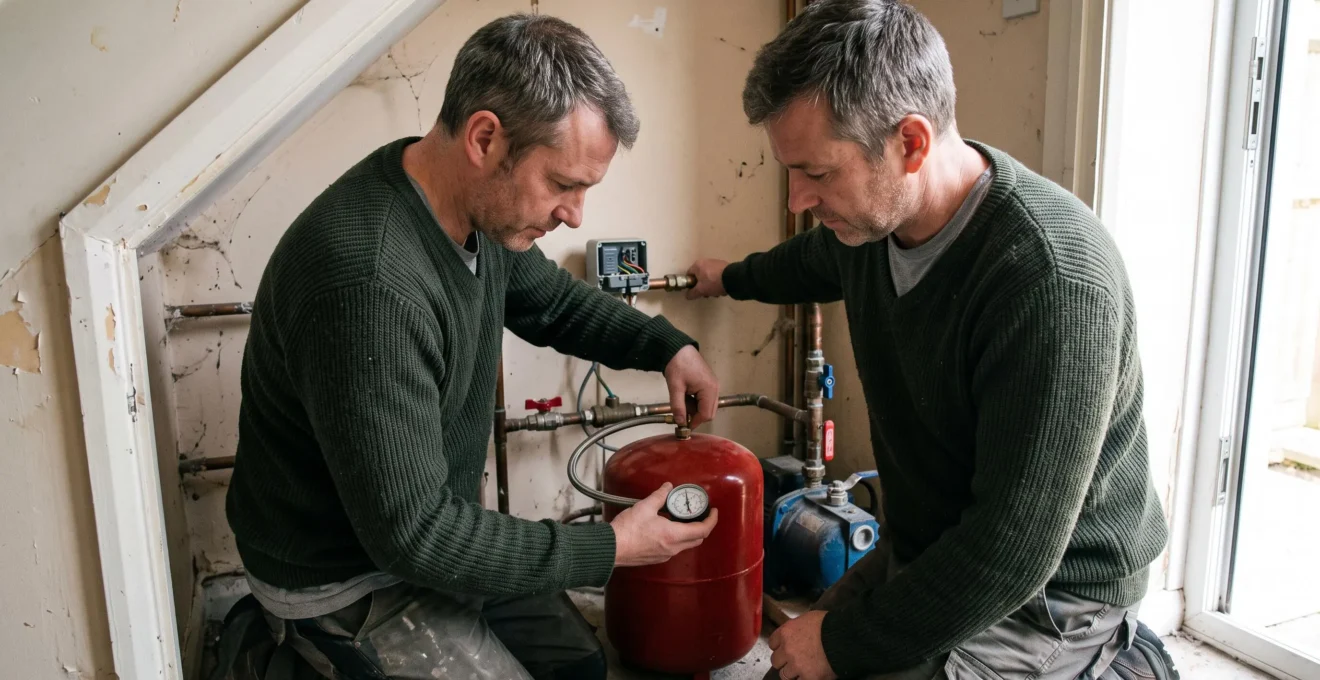
A water pump that starts every 30 seconds is signalling a problem worth investigating. In a conventional pressure-controlled system, frequent starts can indicate inadequate pressure vessel precharge, insufficient storage capacity, a leaking non-return valve or an unnoticed water leak. The resulting electrical and mechanical stress may shorten equipment life, while inefficient operation can increase electricity consumption.
But does cycling every 30 seconds really add £20 to a UK household’s monthly electricity bill? Not necessarily. That figure cannot be assumed without knowing the pump’s power consumption, actual running time, cycling frequency and electricity tariff. Short-cycling can increase losses and maintenance costs, but a brief starting-current surge does not automatically translate into a large additional energy charge.
For homeowners using private wells, rainwater harvesting or domestic booster pumps, the priority is to establish why the system restarts, measure how it behaves under demand and choose a remedy suited to its controls. A simple pressure vessel adjustment may solve the problem; a damaged motor, unsuitable installation or electrical supply limitation requires a different response.
Water pump short-cycling: the essentials
- A pump restarting every 30 seconds may have a pressure vessel, pressure-control or leakage problem. Measure the cycle before replacing equipment.
- Check pressure vessel precharge and usable storage capacity first, then investigate valves, leaks, inlet restrictions and electrical faults safely.
- A larger pressure vessel reduces starts, while variable-speed control can improve pressure consistency. The best solution depends on water demand, installation conditions and electrical capacity.
- Why Does a Water Pump Short-Cycle and Wear Out Twice as Fast?
- How to Stop Pump Short-Cycling in 6 Checks Without Replacing the Pump?
- Pressure Vessel Upgrade or Variable-Speed Pump: Which Fixes Low Pressure Best?
- The Installation Mistake That Causes Cavitation and Destroys Pumps in Months
- When Should You Service a Booster Pump to Avoid a Weekend Failure?
- Why Do Hydraulic Systems Fail After a Sudden Pressure Spike?
- How to Do a Basic Load Audit Before You Ask for a Supply Upgrade?
- What Limits Your Home’s Electrical Supply When You Add an EV, Induction, and Heat Pump?
Why Does a Water Pump Short-Cycle and Wear Out Twice as Fast?
A water pump short-cycles when it repeatedly starts and stops at intervals too short for its intended operating conditions. Common causes include insufficient pressure vessel precharge, a waterlogged vessel, undersized storage or small leaks. Frequent motor starts introduce electrical and mechanical stress, but the claim that short-cycling halves pump life is not established by the available manufacturer evidence.
When a conventional fixed-speed pump starts, its motor can draw substantially more current than during steady operation. That starting event heats the motor windings and stresses switching components. Repeated starts without adequate cooling can accumulate thermal stress, even when the pump’s total running time appears modest.
The pressure vessel acts as a buffer between the pump and household demand. Its compressed air cushion stores energy as the pump pressurises the system. When someone opens a tap, the vessel releases a usable volume of water before pressure falls to the pump’s start threshold, known as the cut-in pressure.
If the air precharge is incorrect, the diaphragm is damaged or the tank is too small, the useful stored volume falls. A small water draw can then cause a rapid pressure drop and an immediate restart.
Grundfos identifies inadequate precharge, insufficient tank capacity and minor water leaks among the possible causes of repeated starting and stopping in its Grundfos pump troubleshooting instructions. These findings apply to the equipment covered by those instructions; they are not proof of a universal failure rate.
To distinguish excessive but predictable cycling from an underlying fault, record how long the pump runs, how long it stays off and what happens to the pressure gauge when no water is being used. A pressure drop with every outlet closed suggests leakage or pressure loss. Rapid cycling only during consumption may instead indicate insufficient vessel drawdown or unsuitable control settings.
The electricity calculation also needs care. For a clearly hypothetical example, imagine a 1 kW pump running for 15 seconds every 30 seconds, continuously over a 30-day month. Its running energy would be 360 kWh. At an illustrative tariff of £0.25 per kWh, that would cost £90. This is not the extra cost caused by short-cycling: the comparison requires measuring how much energy a properly functioning system would use to deliver the same water.
The additional starting losses can be estimated from the energy associated with each start multiplied by the number of starts, but starting-current measurements alone are insufficient to establish that energy. Metered consumption provides a stronger basis for calculating actual costs.
Once the pattern is documented, the next step is to investigate the least expensive likely causes before considering a replacement pump.
How to Stop Pump Short-Cycling in 6 Checks Without Replacing the Pump?
Most conventional water pump short-cycling investigations should begin with six checks: pressure vessel precharge, pressure-switch settings, non-return valves, water leaks, inlet filters and electrical starting components. These checks can separate inexpensive pressure-management faults from serious mechanical or electrical damage. Homeowners should restrict their work to safe external inspections and manufacturer-approved maintenance procedures.
Before touching the installation, identify the pump model and control arrangement. A conventional pressure-switch system does not necessarily use the same precharge procedure as an electronically controlled booster. Isolate electrical power and follow the manufacturer’s instructions for depressurising the water side before measuring vessel air pressure.
- Check pressure vessel precharge. With the pump electrically isolated and the water side depressurised, measure air pressure at the Schrader valve using a suitable gauge. Compare it with the equipment’s specified setting. Conventional cut-in/cut-out systems commonly require precharge slightly below cut-in, but the exact relationship depends on the vessel and controls.
- Review the pressure switch. Note the actual cut-in and cut-out readings during operation. An incorrect differential can reduce usable drawdown or allow pressure to exceed the intended operating range. Do not adjust live contacts or settings without the relevant competence.
- Investigate non-return valves. A leaking check valve may allow water to flow backwards towards a well or supply tank, reducing system pressure without anyone opening a tap. Inspection or replacement may require a qualified installer.
- Look for downstream leaks. Check dripping taps, running toilet cisterns, external pipework and underground supply lines. A small continuous leak can produce repeated pump starts.
- Examine filters and inlet restrictions. A blocked strainer or unsuitable suction arrangement can reduce flow and create unstable pump operation. Clean accessible filters according to the manufacturer’s procedure.
- Assess electrical starting behaviour. Delayed starts, repeated protective trips, burnt smells or abnormal motor sounds can indicate damaged contacts, a capacitor fault or motor deterioration. Electrical diagnosis belongs to a suitably qualified professional.
A particularly useful distinction is whether the vessel still has an intact air chamber. If water emerges from an air valve that is intended to communicate only with the dry side of a diaphragm vessel, the internal membrane may have failed. Simply adding more air will not permanently repair a ruptured membrane.
Grundfos provides a model-specific example in its Grundfos SCALA2 pressure-tank precharge instructions. For that product, the manufacturer specifies precharge at 70% of the selected discharge-pressure setpoint and recommends periodic checks. This is not a universal setting for traditional pressure-switch installations.
Recharging an intact vessel to the manufacturer’s specified pressure may restore useful drawdown. However, replacing a pressure switch without correcting a waterlogged or undersized vessel often leaves the underlying problem untouched.
Five records to prepare before arranging a pump repair
- Photograph the pump, controller and vessel identification plates; keep a record of their model details.
- Time several complete operating cycles during ordinary use; write down each run and rest interval.
- Record pressure-gauge readings at pump start and stop, without opening electrical covers.
- After safe isolation and depressurisation, record the vessel precharge reading if the manufacturer permits homeowner testing.
- List visible leaks, filter condition, abnormal noises and any protective-device trips; provide this written fault summary to the installer.
If the pump trips its electrical protection repeatedly, struggles to start or produces a burning smell, stop attempting restarts and arrange professional inspection. Replacing the motor or entire pump becomes a consideration when confirmed electrical or mechanical damage makes repair uneconomical, not merely because the system has been cycling frequently.
Where the pump itself remains healthy but frequent cycling persists, the next decision concerns system design: increase stored water volume or introduce variable-speed pressure control.
Pressure Vessel Upgrade or Variable-Speed Pump: Which Fixes Low Pressure Best?
A larger pressure vessel is usually better for reducing starts on a fixed-speed pump, while a correctly specified variable-speed pump is better for maintaining steadier delivery pressure as water demand changes. Neither automatically cures an undersized pump, an inadequate water source or a restrictive supply pipe. The right choice depends on whether the primary problem is frequent cycling, pressure variation or insufficient flow.
A pressure vessel stores a usable quantity of pressurised water between the pump’s cut-in and cut-out thresholds. Increasing that usable volume can lengthen the time between starts. It does not raise the pump’s achievable pressure or flow beyond the pump’s performance capability.
A variable-speed drive, or VSD, instead adjusts motor speed to respond to demand. With suitable controls and an appropriately sized pump, it can maintain a selected pressure over a defined operating range. Controlled acceleration can also reduce abrupt starting-current peaks, although actual electrical behaviour depends on the drive and installation.
The distinction is easier to see when comparing the two approaches.
| Decision factor | Larger pressure vessel | Variable-speed pump |
|---|---|---|
| Main benefit | Fewer pump starts through additional stored water | More consistent pressure as demand varies |
| Pressure behaviour | Pressure still varies between cut-in and cut-out | Can maintain a pressure setpoint within operating limits |
| Starting behaviour | Reduces starting frequency | Often provides controlled motor acceleration |
| Electrical complexity | Generally low for a passive vessel | Electronic controls require suitable protection and servicing |
| Common limitation | Does not correct inadequate pump head or flow | Cannot overcome inadequate source capacity or incorrect hydraulic sizing |
| Best application | Fixed-speed system with excessive starts | Household with varying simultaneous water demand |
Vessel sizing should begin with the required drawdown volume, pump delivery rate and acceptable starting frequency. Drawdown is not identical to the vessel’s nominal volume: it depends on the relationship between air precharge and the operating pressure range. A plumbing designer can compare candidate vessels using manufacturer-specific performance data.
For example, a pump serving only an occasional garden tap may benefit from additional passive storage. A home using a shower while a washing machine fills may need more responsive pressure regulation. If the pump cannot deliver the simultaneous flow at the required head, however, variable-speed control alone will not create that missing capacity.
A combined arrangement can be appropriate. Some variable-speed systems incorporate a small pressure vessel that accommodates minor draws and helps prevent starts for tiny demands. The vessel and drive must be compatible with the controller’s intended operation rather than assembled as unrelated components.
Energy savings also deserve qualification. Variable speed can improve efficiency where demand varies and the pump operates efficiently at reduced speed. Savings are not guaranteed when static head dominates, the pump is poorly sized or its operating profile offers limited scope for speed reduction.
Neither upgrade will perform reliably if the suction arrangement is restrictive, so installation geometry deserves attention before investing in new controls.
The Installation Mistake That Causes Cavitation and Destroys Pumps in Months
A centrifugal pump can suffer cavitation when its inlet conditions allow the local water pressure to fall below the liquid’s vapour pressure. Vapour bubbles form and subsequently collapse in higher-pressure regions, potentially damaging the impeller. Excessive suction lift, undersized pipework and blocked inlet components can contribute. Serious damage may develop, but failure within a fixed number of months is not inevitable.
Domestic installations with a surface-mounted pump drawing from a well or rainwater tank deserve particular attention. The pump must overcome the vertical distance from the water level, friction in the suction pipe and losses through valves and fittings.
Every unnecessary restriction consumes part of the available inlet pressure. If the available net positive suction head becomes insufficient for the pump’s operating conditions, cavitation may occur.
The US Department of Energy pumping-system performance sourcebook explains how vapour bubble collapse can erode impellers, reduce performance and accelerate component deterioration. Although written mainly for industrial pumping systems, the underlying physical mechanism also applies to centrifugal pumps used in domestic installations.
A characteristic warning is a crackling or gravel-like sound from the running pump. Depending on severity, cavitation may also cause vibration and reduced hydraulic performance. Similar symptoms can arise from entrained air, worn bearings or other mechanical faults, so sound alone is not a definitive diagnosis.
Typical installation mistakes include tight bends close to the suction inlet, unnecessary pipe diameter reductions, excessive vertical suction lift and improperly sealed or primed suction pipework. The corresponding corrections are to improve pipe routing, use appropriately sized suction lines, reduce lift where practicable and eliminate air leaks.
A submerged or suitably positioned pump may avoid some suction-lift problems encountered by surface-mounted units. The choice depends on the source, pump design and installation constraints.
Some technicians investigate suspected cavitation by carefully changing discharge conditions and observing whether noise changes. However, partially closing a discharge valve is not a universal homeowner test: its suitability depends on the pump type, operating limits and manufacturer’s instructions. It should be performed only where permitted and by someone competent to assess the consequences.
It is also important to distinguish cavitation from short-cycling. Suction restrictions can reduce flow and contribute to unstable pressure performance, but reduced flow does not necessarily increase starting frequency. Actual cycling depends on water demand, vessel drawdown and controller behaviour.
Fixing a damaged pressure vessel will not cure a pump that cavitates under sustained demand. Conversely, correcting suction pipework may restore hydraulic performance while leaving a separate pressure-control fault unresolved.
Once inlet conditions and cycling behaviour are stable, preventive maintenance becomes the most practical defence against unexpected failure.
When Should You Service a Booster Pump to Avoid a Weekend Failure?
A domestic booster pump should be serviced according to its manufacturer’s instructions and whenever its behaviour changes noticeably. Falling pressure, new vibration, unusual bearing noise, difficult starting or increasingly frequent cycling justify early investigation. There is no single maintenance interval suitable for every pump, but keeping baseline operating records makes deterioration easier to recognise before a breakdown.
Maintenance should follow the actual installation and its usage pattern. A rainwater pump serving irrigation, a private-well system supplying an entire household and an electronically controlled domestic booster may require different procedures and inspection schedules.
For the Grundfos SCALA2, the manufacturer’s pressure vessel guidance recommends checking precharge annually. This provides a useful model-specific example rather than a maintenance rule for all booster pumps.
Safe preventive work may include visually examining accessible pipe joints, checking for water stains, inspecting external equipment condition and cleaning user-serviceable strainers after proper isolation. Vessel precharge checks require electrical isolation and water-side depressurisation in accordance with the relevant instructions.
Homeowners should not remove electrical covers, test energised motor terminals or attempt capacitor replacement without appropriate electrical competence. A damaged electrical enclosure, repeated tripping or evidence of overheating requires professional assessment.
A practical maintenance record should capture normal cut-in and cut-out pressures, pump run time, noise level and performance at a familiar water outlet. Later readings can then be compared with the established baseline rather than relying on impressions.
Demand peaks offer a useful opportunity to identify weaknesses. For example, a household expecting guests can observe how the system normally supports simultaneous showers and appliance use, without deliberately forcing the pump outside its operating limits. In the UK, winter preparation may also involve checking frost protection around exposed equipment and pipework.
Special care is required where a booster is connected to a stored hot-water arrangement or a header tank. Incorrect isolation or draining can affect other parts of the plumbing system. Connections involving stored hot water, backflow protection or multiple water sources should be assessed against the installation design before maintenance.
Early intervention cannot guarantee that a pump will never fail at a weekend. Some failures occur without obvious warning, and not every abnormal sound predicts failure on a particular timescale. The purpose of maintenance is to identify correctable conditions before they become more damaging.
Maintenance should also extend beyond the motor and vessel, particularly when sudden pressure changes are affecting joints, valves or household appliances.
Why Do Hydraulic Systems Fail After a Sudden Pressure Spike?
Hydraulic and water supply systems can fail after a sudden pressure spike because a rapid change in water velocity creates a travelling pressure wave. This phenomenon, commonly called water hammer, can place substantial transient loads on pipes, fittings, seals and pressure vessels. Repeated or sufficiently severe events may damage components even when normal operating pressure remains within their rated limits.
Water has momentum as it flows through a pipe. If a valve closes rapidly or the pump’s flow changes abruptly, that moving water cannot stop everywhere simultaneously. The resulting pressure disturbance travels through the system and reflects from boundaries and fittings.
The magnitude of the pressure spike depends on flow velocity, closure time, pipe properties and system layout. In some circumstances the transient pressure can substantially exceed normal operating pressure, but its size must be calculated or measured rather than assumed.
Short-cycling and water hammer are related possibilities, not interchangeable diagnoses. An incorrectly adjusted pressure controller may contribute to high operating pressures or abrupt starts and stops. However, a pump restarting every 30 seconds does not itself prove that damaging pressure waves are present.
Rapidly closing solenoid valves in washing machines or other appliances can also initiate water hammer independently of the pump’s pressure switch.
The remedy therefore depends on identifying the event that causes the pressure surge:
- A suitable water hammer arrester can absorb transient pressure near a rapidly closing appliance valve.
- Where compatible with the equipment, slower valve closure can reduce abrupt changes in flow.
- Appropriately selected flexible connections may reduce transmission of vibration, although they are not substitutes for proper surge control.
- Correcting pressure-switch settings or pump stopping behaviour may help where the pressure-control system is responsible.
Pressure vessels and surge arresters serve related but distinct roles. A conventional pressure vessel primarily manages system pressure and stored water volume over pumping cycles. A water hammer arrester is designed to address rapid transient events. Their effectiveness depends on positioning, sizing and operating conditions.
Repeated shocks can loosen or damage connections, accelerate wear in seals and affect appliance valves. Repairing only a leaking joint without investigating the transient event may allow the same problem to recur elsewhere.
Where loud pipe bangs, visible pipe movement or repeated leaks are present, a competent plumbing professional should investigate pressure behaviour and pipe restraint. Persistent overpressure can also indicate a control or safety-device fault requiring immediate attention.
Hydraulic pressure is only one part of system reliability. A domestic pump also shares the household electrical supply with other equipment, making electrical load assessment important when new high-demand appliances are added.
How to Do a Basic Load Audit Before You Ask for a Supply Upgrade?
A basic household electrical load audit begins by identifying major appliances, recording their rated electrical input and estimating which loads may operate simultaneously. The objective is to understand realistic maximum demand before requesting additional supply capacity. A preliminary audit helps an electrician investigate potential constraints, but it does not replace a professional maximum-demand assessment or a distribution network operator’s connection decision.
Start with the largest electrical consumers: immersion heaters, water pumps, EV chargers, induction hobs and heat pumps. Use electrical input ratings rather than assuming that an appliance’s heating or hydraulic output equals its electrical consumption.
For an illustrative audit, consider a household with an EV charger, induction hob, heat pump and water booster. Each appliance contributes differently to demand. An EV charger can operate for an extended period, while an induction hob varies its input with cooking activity. A heat pump’s electrical demand depends on operating conditions and auxiliary equipment. A fixed-speed pump also produces a starting transient.
A simple inventory should distinguish continuous demand, intermittent loads and short-duration starting events.
| Equipment | Information to record | Demand consideration |
|---|---|---|
| Water pump | Rated electrical input and starting characteristics | Running demand and start-up transient |
| EV charger | Maximum charging power and control settings | Duration and scheduling flexibility |
| Induction hob | Rated input and available power limiting | Variation with cooking zones in use |
| Heat pump | Electrical input, compressor type and auxiliary heaters | Operating demand and starting behaviour |
| Immersion heater | Rated electrical power and timer settings | Potential overlap with other major loads |
The arithmetic begins with the demand of loads operating together, not a blind addition of every appliance nameplate rating. Diversity reflects the fact that not all connected equipment necessarily runs at maximum output simultaneously. Appropriate diversity assumptions require professional judgement and knowledge of how the installation is actually used.
Once the likely maximum demand is identified, compare it with the installation’s documented electrical characteristics. The electrician should consider the service fuse, consumer unit, cable arrangements and any supply limitations that require confirmation with the relevant distribution network operator, or DNO.
Load management may offer alternatives to upgrading. A compatible EV charger can reduce or pause charging when household demand increases. Timed water heating and thermal storage can shift suitable loads away from peak periods, subject to comfort and equipment requirements.
These measures are most promising when the potential overload is driven by flexible demand. Where essential simultaneous loads exceed an installation’s safe capability even after practical management, a supply or installation upgrade may be necessary.
The audit should document both the current arrangement and planned changes. An installer can then distinguish between a consumer-unit limitation, an internal circuit issue and a possible network-connection constraint.
That assessment becomes particularly important when electrified transport, heating and cooking equipment are added to a home that already relies on electrically powered water supply.
Key takeaways before adding more electrical loads
- Separate sustained appliance demand from short motor-starting transients; they do not have identical implications for supply capacity.
- Verify the existing service arrangement and assess realistic simultaneous demand before assuming that an expensive connection upgrade is required.
- Consider automatic load management for flexible equipment, but have a qualified electrician confirm that the complete installation remains suitable.
What Limits Your Home’s Electrical Supply When You Add an EV, Induction, and Heat Pump?
A UK home’s ability to support an EV charger, induction hob, heat pump and water booster depends on several connected constraints: the electricity network connection, service fuse, incoming cables, consumer unit and individual circuits. Adding multiple high-demand appliances does not automatically require a supply upgrade, but their simultaneous operation must be assessed against the installation’s safe capacity.
A common mistake is to treat the rating of the consumer unit as proof of the property’s available electrical supply. The consumer unit, individual protective devices and upstream service equipment perform different functions. A large consumer-unit rating does not increase the capacity of the incoming service.
Domestic UK installations may have service fuses marked 60 A, 80 A or 100 A, but these are examples rather than a universal specification. The actual installation must be checked, and a homeowner should never remove or interfere with a sealed service fuse.
The DNO is responsible for relevant distribution-network and service-connection matters, whereas the electrical installer assesses the household installation and proposed equipment. A proposed change may require notification, approval or network work depending on the equipment and local circumstances.
For example, National Grid Electricity Distribution heat-pump connection guidance explains that its connection assessment can identify the need for equipment work, including a fuse upgrade. The guidance applies to that operator’s network area and should not be treated as the complete procedure for every UK DNO.
The combined demand profile matters more than considering each appliance in isolation. EV charging can create sustained loading. Induction cooking can introduce relatively high but varying demand. Heat pumps contribute compressor and potentially auxiliary-heating loads, while pumps serving wells or rainwater supplies introduce their own running and starting requirements.
Not every heat pump creates a large direct-on-line starting surge: inverter-driven compressors may manage acceleration electronically. Likewise, the instantaneous current associated with a pump start must be assessed separately from its longer-term running demand.
For a household using a variable-speed water booster, supply quality also matters. Voltage disturbances, unsuitable protective arrangements or other electrical installation issues can interfere with sensitive electronic drives. However, the presence of an EV charger does not automatically imply damaging voltage dips at the pump.
A registered or appropriately qualified electrician should assess proposed major additions against BS 7671, the UK wiring requirements, together with relevant installation instructions and network connection procedures. NICEIC- or NAPIT-registered contractors are examples of professionals homeowners may consider when seeking suitable expertise.
Where load management is appropriate, the electrician can assess whether coordinated EV charging, heating schedules or other controls preserve sufficient capacity for essential equipment. A pump supplying the household’s water should not be casually disconnected by a load controller without considering water availability, motor protection and system behaviour.
The most useful next step is to record pump cycling and pressure readings, document the household’s major electrical loads and share both sets of information with a qualified installer. That evidence helps distinguish a simple pressure vessel fault from a hydraulic design problem or a genuine electrical supply limitation, without replacing equipment unnecessarily.
Is it safe to leave a water pump cycling every 30 seconds overnight?
Repeated short-cycling should not be ignored because it can increase starting stress and may indicate pressure loss, a defective vessel or another fault. The urgency depends on the pump’s condition and manufacturer’s operating limits. If the pump is overheating, repeatedly tripping, leaking dangerously or making severe mechanical noises, isolate it safely and arrange professional attention. Otherwise, investigate the cycling promptly rather than assuming continued operation is harmless.
Can a waterlogged pressure vessel be repaired without replacing it?
If the problem is simply inadequate air precharge and the internal membrane is intact, following the manufacturer-approved recharging procedure may restore normal operation. If the membrane has ruptured, adding air will not provide a lasting solution. Some vessel designs permit replacement of the internal bladder, while others require replacement of the vessel or assembly.
How can I confirm whether pump cycling is increasing my electricity bill?
Record the pump’s energy consumption over representative periods using a suitable meter or installed monitoring equipment, and apply the electricity unit rate from your tariff. Where possible, compare consumption before and after correcting the fault under similar water demand. A starting-current spike alone cannot establish the cost increase, and an extra £20 per month should not be assumed without measurements.
Should a private-well pump and a rainwater booster use the same pressure settings?
Not necessarily. Settings depend on the pump design, controller, vessel, available water source and the pressure required at the outlets. A conventional pressure-switch well system can have a different precharge relationship from an integrated electronic booster such as the Grundfos SCALA2. Always use instructions specific to the installed equipment.
Will installing a larger water pump solve short-cycling and low pressure together?
A larger pump is not automatically the right solution. If frequent cycling results from insufficient vessel drawdown, increasing pump capacity without correcting storage or controls may worsen the starting pattern. Low pressure can also result from restricted pipework, inadequate source capacity or excessive simultaneous demand. Determine the required flow and pressure and investigate the existing system before selecting a replacement.