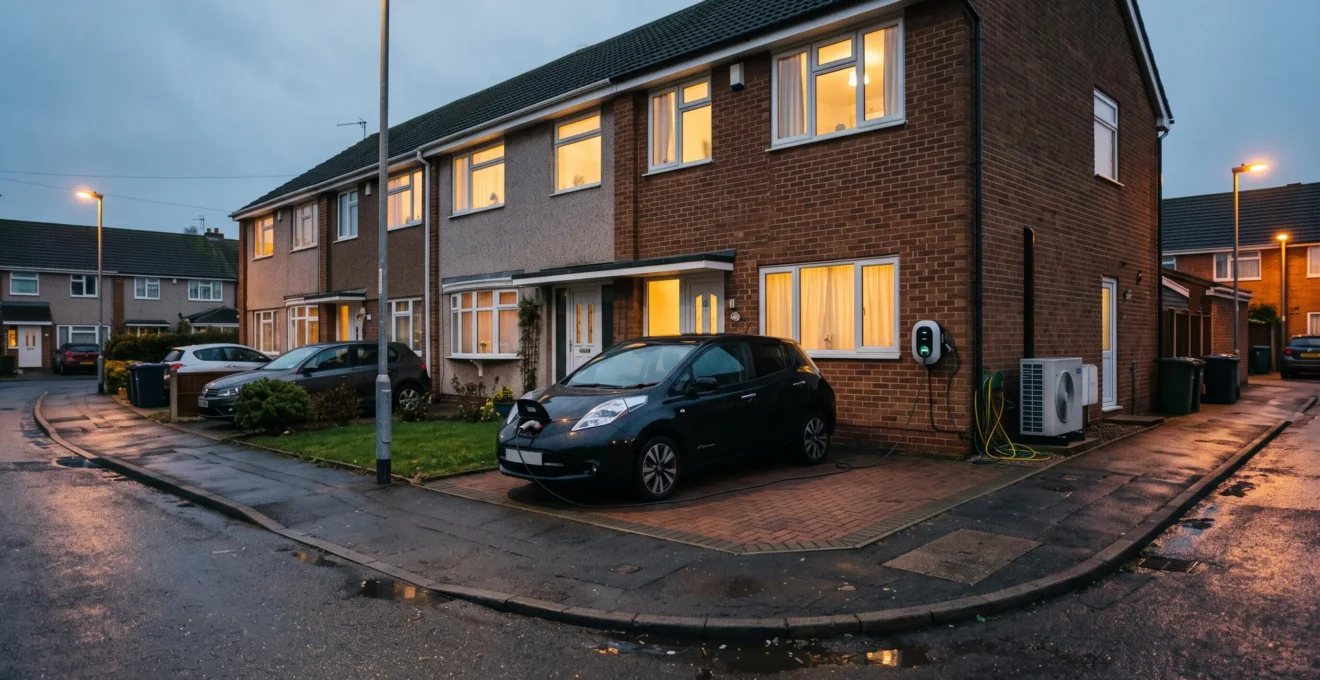
A 7 kW home EV charger does not necessarily deliver 7 kW throughout every charging session. If charging slows between 6pm and 9pm, the cause could be falling supply voltage, household load management, charger temperature, or a charging schedule rather than a fault with the vehicle.
For UK households, the early evening is a demanding period for electricity networks. Cooking, space heating and EV charging may coincide across dozens of homes connected to the same low-voltage feeder. An installation that performs consistently overnight can therefore behave differently when local demand rises.
The important distinction is between a limitation inside the property and one affecting the wider distribution network. A 7 kW charger’s rating describes its potential output under suitable conditions, not a guarantee of uninterrupted charging at that power. Identifying the actual constraint can prevent unnecessary electrical upgrades while revealing when professional investigation or Distribution Network Operator involvement is justified.
Why evening EV charging slows down: the essentials
- Voltage and local demand: Heavy evening electricity use can increase voltage drop on a street feeder, although this does not automatically explain every slowdown.
- Household supply capacity: A charger may intentionally reduce its current when a heat pump, induction hob or other appliance increases demand.
- Practical response: Check charging settings and recorded power first, have the installation assessed where necessary, and involve the DNO when supply capacity or voltage is in question.
- Why Does Peak-Time Demand Create Voltage Drops in Some Streets?
- What Limits Your Home’s Electrical Supply When You Add an EV, Induction, and Heat Pump?
- How to Check if Your Home Can Support EV Charging and a Heat Pump Without Tripping Breakers?
- Single-Phase vs Three-Phase Supply: Which Makes Sense for a High-Load Home?
- The Wiring Shortcut That Can Void Your Charger Warranty and Raise Fire Risk
- When Should You Contact the DNO to Avoid a 6–12 Week Grid Upgrade Delay?
- Why Can Your Street Transformer Become the Bottleneck Even if Your Fuse Is Fine?
- Why Do Gas Price Shocks Show Up in Electricity Bills Even if You Don’t Use Much Gas?
Why Does Peak-Time Demand Create Voltage Drops in Some Streets?
Peak-time demand can cause voltage drops because higher current flowing through electricity distribution cables produces a greater voltage difference along those cables. When several households charge vehicles, heat their homes and cook simultaneously, voltage at some properties may fall. Whether this actually reduces EV charging power depends on the local network, charger behaviour and installation conditions.
UK homes receive electricity at a nominal 230 V. A typical single-phase 7 kW-class charger operating at approximately 32 A draws substantial current for several hours. If neighbouring properties draw similarly large currents, the combined demand increases current through shared sections of the low-voltage network.
Electrical cables have impedance. As current increases, so does the voltage drop along a given cable. The effect is influenced by cable length, conductor characteristics, feeder configuration and the distribution of loads across the network.
This helps explain why two otherwise identical chargers may perform differently on neighbouring streets. A property near its distribution transformer can experience different electrical conditions from one at the distant end of a heavily loaded feeder.
Low voltage does not automatically mean that a charger will throttle. Depending on its controls and protection settings, charging equipment may continue delivering the permitted current, reduce current, or disconnect when operating limits are breached. At a constant charging current, reduced voltage also means reduced electrical power.
In Great Britain, electricity distributors must maintain supply voltage within statutory limits at the relevant supply terminals. The commonly applicable low-voltage range is 230 V +10%/−6%, equivalent to approximately 216.2–253 V. Voltage at the charger can differ because the property’s own wiring adds impedance.
Consequently, a supply that is compliant at the service point can still present a voltage-related problem further along an inadequately designed or heavily loaded installation.
Distinguishing grid conditions from other causes requires looking for patterns rather than assuming that every evening slowdown originates outside the house.
| Observed behaviour | Possible explanation | Useful next check |
|---|---|---|
| Slower charging mainly during busy evenings | Household demand or local supply conditions | Compare voltage, charging current and household load |
| Charging slows when cooking or heating starts | Dynamic load management | Review the charger’s load-balancing records |
| Charging slows after extended operation, regardless of time | Thermal derating | Check charger temperature or diagnostic alerts |
| Charging changes at repeatable scheduled times | Vehicle settings, smart charging or tariff scheduling | Inspect vehicle and charger schedules |
Seasonality also matters. A winter-only problem may coincide with space-heating demand, while a slowdown that occurs during summer charging sessions may point towards equipment temperature, control settings or another electrical issue.
Before requesting a network investigation, establish how much electrical capacity the home itself can provide while other appliances are operating.
What Limits Your Home’s Electrical Supply When You Add an EV, Induction, and Heat Pump?
A home’s usable electrical capacity is limited by its incoming supply, protective devices, wiring and the demand created by appliances running together. A 7 kW charger cannot independently guarantee its rated output when an induction hob, heat pump and other equipment share a constrained supply. Dynamic load management can preserve electrical headroom by reducing charging current when household consumption rises.
In a typical UK single-phase installation, electricity passes through the DNO’s service equipment and main fuse, the metering arrangement, and the consumer unit before reaching individual circuits. Relevant protective devices may include circuit breakers, RCDs and RCBOs.
Domestic service fuses commonly have ratings such as 60 A or 80 A, although the actual rating must be confirmed for the property. The installation’s maximum permissible loading cannot be established simply by reading the charger’s specification.
As a simplified illustration, a 32 A charging load on a 60 A single-phase supply consumes a substantial portion of the available current before cooking, heating, hot water or other appliances are considered.
The critical consideration is simultaneous demand, not the sum of every appliance’s maximum label rating.
UK electrical design uses diversity principles to recognise that many appliances do not operate continuously at their full rated output. However, high-power electrification changes household demand patterns. EV charging can continue for hours, and heat pumps may operate for extended periods during cold weather.
A dynamic load-balancing system addresses this problem by monitoring incoming electrical demand and adjusting the EV charging current to maintain an appropriate margin below the installation’s configured limit.
For example, charging may proceed at a higher current overnight but reduce while an induction hob is in use. This is intentional demand control, not necessarily an indication that the DNO has restricted the connection.
The Energy Networks Association guidance on connecting EV chargers and heat pumps explains the role of distribution network assessment in accommodating additional electrical loads. An installer can use the relevant connection procedures to establish whether notification, approval or network work is needed.
Another frequently overlooked factor is the commissioned maximum charging current. A charger marketed as a 7 kW unit may have been configured to operate below its hardware maximum to suit the available supply.
Check the commissioning documentation and charging records before treating a lower output as unexpected.
Where the installation cannot accommodate the expected simultaneous loads, a structured capacity assessment is more useful than increasing circuit ratings or replacing equipment without investigation.
How to Check if Your Home Can Support EV Charging and a Heat Pump Without Tripping Breakers?
Start by establishing the property’s confirmed supply rating, identifying its largest electrical loads and comparing realistic simultaneous demand with available capacity. Check whether the EV charger can dynamically reduce current and whether protective devices and circuits are suitable. A qualified electrician must verify the electrical design, earthing arrangements and actual installation condition before changes are approved or carried out.
A preliminary household assessment can identify information for the installer without requiring the homeowner to open electrical equipment.
- Establish the supply rating. Find the relevant fuse information in existing installation records or ask the installer or DNO to confirm it. Do not remove the service fuse or open sealed supply equipment.
- Review the consumer unit. Record its model and any accessible labels. Spare circuit positions alone do not establish that there is sufficient electrical capacity or suitable protection.
- List major electrical loads. Include the EV charger, heat pump, induction hob, immersion heater, electric shower and other substantial fixed equipment.
- Identify realistic overlap. Consider which loads may run together on a cold evening rather than assuming every appliance continuously uses its maximum rating.
- Review charging controls. Record the charger’s configured current limit and whether dynamic load management is installed and working.
To understand how the numbers interact, consider a deliberately hypothetical household with a 60 A supply, a charger configured for 32 A and other appliances drawing a combined 35 A at a particular moment.
Illustrative capacity calculation
In this hypothetical scenario, 32 A of EV charging plus 35 A of other simultaneous demand equals 67 A. That exceeds the stated 60 A service rating by 7 A.
If an appropriately designed load-management system reduces EV charging to 20 A while the other loads remain at 35 A, the combined current becomes 55 A. This simplified calculation illustrates demand control; it is not an installation design or proof that the protective arrangements are suitable.
Actual assessments are more involved. Heating equipment may cycle, induction hobs can vary their input and supply capacity cannot be judged from a single snapshot.
A professional survey can measure operating current and voltage, examine termination condition, investigate overheating where indicated, and establish whether the installation has appropriate earthing and protective arrangements.
Earthing systems such as TN-S, TN-C-S and TT have implications for protection design. Outdoor EV charging, in particular, requires attention to the applicable protective requirements and manufacturer instructions.
The resulting decision should distinguish between three possibilities: sufficient capacity without changes, capacity that can be managed by controlling charging current, and insufficient capacity requiring further DNO assessment.
Five checks to complete before requesting an electrical upgrade
- Obtain the main supply rating from the DNO or electrician and save a written confirmation.
- Prepare an appliance inventory showing rated power and likely evening operating times, producing a household load schedule.
- Ask the charger installer for the configured current limit and load-management details, producing a copy of the relevant commissioning settings.
- Arrange a professional assessment of circuits, protective devices and earthing, obtaining a written survey report.
- Request a recommendation comparing managed charging with any necessary supply upgrade, obtaining a documented decision and quotation.
Do not assume that a larger service fuse is automatically suitable simply because a calculation suggests more current would be convenient. The DNO must assess the relevant service equipment and network conditions.
If the assessment shows that a single-phase supply remains restrictive even with managed charging, the next decision is whether a different supply arrangement is justified.
Single-Phase vs Three-Phase Supply: Which Makes Sense for a High-Load Home?
Single-phase supply is often sufficient for a UK home with an EV and heat pump when charging is intelligently managed. Three-phase supply becomes more attractive where substantial loads must operate simultaneously or a genuinely three-phase EV charger is required. The right choice depends on verified household demand, the local network and the cost and feasibility of upgrading the connection.
Most existing UK homes use a single-phase connection. Their conventional domestic EV chargers are commonly rated at approximately 7 kW.
Three-phase supply uses three live conductors whose electrical waveforms are offset from each other. Properly designed equipment can distribute demand across phases and deliver greater total power without placing the entire load on one phase.
An 11 kW three-phase charger, for example, can distribute its charging demand across all three phases where the vehicle and supply support that configuration. It cannot deliver 11 kW merely because its housing or marketing specification says it is three-phase capable.
The property’s actual supply and the vehicle’s onboard AC charging capability determine what is achievable.
The practical options differ in investment, complexity and benefit.
| Strategy | When it makes sense | Important limitation |
|---|---|---|
| Retain single-phase with managed charging | The existing connection can support household demand if EV charging adjusts dynamically | Charging may slow when other appliances operate |
| Request a three-phase connection | Verified demand is too high for a practical managed single-phase arrangement | Availability, network works and costs require DNO assessment |
| Install suitable three-phase-capable equipment before upgrading | A realistic future three-phase conversion is being planned | Single-phase operation remains limited by the present supply and equipment compatibility |
The UK Government electricity network connections action plan discusses standard domestic fuse increases to 80 A or 100 A, depending on the DNO, to accommodate low-carbon technologies.
It also distinguishes these standard fuse upgrades from three-phase conversions, which are not generally provided free of charge.
A three-phase connection may require work on the service cable, meter arrangement and electrical installation. The extent of work depends on local network infrastructure and the existing property connection.
Before choosing it, compare the anticipated extra usable charging capacity with the cost of the conversion and the possibility of scheduling EV charging overnight instead.
Whichever supply arrangement is selected, the charging circuit must be designed and installed correctly; greater available power cannot compensate for inadequate wiring or protection.
The Wiring Shortcut That Can Void Your Charger Warranty and Raise Fire Risk
Connecting a high-power EV charger through unsuitable existing wiring can create overheating and electrical protection risks, particularly during sustained charging. Sharing a circuit that was not designed for the added load, using incorrectly sized cable or omitting required protection can also make an installation non-compliant. Warranty consequences depend on the manufacturer’s actual terms and the circumstances of the fault.
An EV charger is not comparable to an appliance used for a few minutes. It can draw a substantial current for hours, placing sustained thermal demands on cables, terminals and protective devices.
One particularly concerning shortcut is connecting the charger to an existing cooker or shower circuit without a compliant electrical design. The original circuit may have been selected for different loading patterns and protective requirements.
Other problematic practices include using an undersized cable for the installation conditions, creating inaccessible connections without an appropriate compliant arrangement, and selecting residual current protection that does not meet the needs of the EV charging equipment.
The underlying physics is straightforward. Electrical resistance causes heating as current flows, with resistive heating increasing in proportion to the square of the current. Poorly made terminations can introduce additional resistance and concentrate heat at connections.
The Institution of Engineering and Technology explains these protective considerations in its technical article on RCD protection for EV chargers.
The article discusses individual residual current protection for charging points and the arrangements used to address DC residual fault currents. Relevant configurations can include Type A or Type F protection with appropriate DC fault detection, or Type B protection where required.
A separate RCBO is not universally mandatory. Compliant protection may, in some circumstances, be integrated into the charging equipment. The overall installation still has to satisfy the applicable requirements of BS 7671 and the manufacturer’s instructions.
There is likewise no universally correct EV charging cable cross-section. Cable selection must take account of current-carrying capacity, installation method, temperature, grouping, voltage drop and protective coordination.
Before accepting an installation quotation, ask for the specified circuit arrangement, cable details, protective devices and evidence of the installer’s competence. Registration with a recognised scheme such as NICEIC or NAPIT can help establish credentials, but it does not replace checking the actual installation design.
Request the electrical test results and commissioning documentation upon completion. Check the charger’s warranty conditions directly rather than assuming any single installation defect automatically cancels all warranty rights.
Once the property-side design is sound, unresolved supply constraints may require the DNO to assess whether the external connection needs attention.
When Should You Contact the DNO to Avoid a 6–12 Week Grid Upgrade Delay?
Contact the Distribution Network Operator as soon as a planned installation may require a higher service-fuse rating, additional connection capacity or conversion to three-phase supply. It is also appropriate to raise persistent suspected supply-voltage problems. A 6–12 week upgrade allowance may be useful for planning, but actual timescales depend on the DNO, required works and local network conditions.
The DNO owns and operates the local distribution network and associated service infrastructure, rather than selling electricity under the household’s retail tariff.
EV charger and heat pump connections must be handled under the applicable DNO notification or application arrangements. The installer can often manage the relevant process, including using ENA Connect Direct where supported.
It is important to distinguish routine installation notification from a request that requires prior technical assessment. Not every compliant charger installation needs the same type of network work or approval.
Three circumstances justify starting a DNO conversation early:
- The installer identifies a need to increase the capacity of the existing domestic service connection or main fuse.
- A three-phase supply is being considered to accommodate simultaneous high electrical loads.
- Professional measurements or demand calculations suggest that the existing connection cannot support the proposed installation adequately, even with appropriate load management.
Where an upgrade is needed, the process may include an initial application, technical checks, a site survey, a quotation, a schedule of works and coordination with metering or installation contractors.
A straightforward standard fuse increase may be handled differently from a project involving new underground cabling, changes to the service route or reinforcement of the local network.
Therefore, six to twelve weeks is an indicative planning window, not a guaranteed service standard. Some cases may be completed sooner, while complex works can take longer.
Ask the installer to confirm what must be completed before charging equipment can be commissioned. Where a new connection is necessary, installing equipment before the supply changes are agreed could create avoidable expense or rework.
Keep a record of the application reference, technical requirements, quotation and scheduled works. This makes it easier to coordinate the electrician, DNO and any other relevant parties.
Even when a property’s own service connection is adequate, the shared network serving the surrounding street can impose a separate constraint.
Why Can Your Street Transformer Become the Bottleneck Even if Your Fuse Is Fine?
A street transformer can become a constraint because it supplies multiple properties whose combined electricity demand may rise sharply during the evening. Individual service fuses limit demand at each home but do not guarantee unlimited capacity in the shared transformer or feeder. Higher neighbourhood demand can increase voltage drop, although transformer loading alone does not prove why an individual charger slows.
A low-voltage distribution transformer receives electricity from a higher-voltage distribution circuit and supplies homes through one or more low-voltage feeders.
Each property has its own connection arrangements, but current drawn by multiple households travels through shared network components. The transformer and cables must accommodate the aggregate demand, not merely the consumption of a single home.
Consider a hypothetical street where several EV owners arrive home around the same time. Some start charging immediately, while others use electric heating, ovens or other substantial loads.
Even if every installation remains within its individual supply rating, the combined current through common feeder sections can be considerably greater than at quieter times.
Neighbourhood demand can therefore influence local voltage conditions without any household exceeding its own fuse rating.
That does not mean the transformer is necessarily overloaded. A voltage reduction can arise from impedance in the feeder, transformer regulation and loading conditions even without a transformer exceeding its rated capacity.
Likewise, a compliant charger is not guaranteed to reduce current merely because the network is busy. Its response depends on actual voltage, protection functions, vehicle communication and control settings.
Evidence is essential. The DNO can investigate supply conditions, while an installer can check whether the voltage drop is occurring on the property’s own circuit.
Clustering makes this distinction increasingly relevant. Neighbours with similar commuting schedules may begin charging in the same evening window, creating localised demand patterns that are not captured by a national electricity-demand average.
Distribution network operators plan, monitor and reinforce their networks as necessary, but the extent and timing of work depend on observed and anticipated constraints.
For households, shifting flexible charging into a later overnight period can reduce simultaneous demand on the shared network. Where tariff conditions allow, it may also reduce the cost of charging.
Overnight charging is not an absolute solution: the relevant feeder’s demand, other scheduled chargers and the charger’s own settings still determine the actual operating conditions.
Moving charging away from the busiest hours introduces a related financial question: why electricity costs can remain closely tied to gas prices, even in homes that have largely electrified.
Key takeaways before choosing a charging schedule
- Check whether the slowdown is caused by voltage, charger controls or household load management before changing tariffs or equipment.
- Compare the cost of charging at different times against the actual energy delivered, not simply the charger’s rated power.
- Keep network capacity and retail electricity pricing separate: they influence charging for different reasons and require different solutions.
Why Do Gas Price Shocks Show Up in Electricity Bills Even if You Don’t Use Much Gas?
Gas price shocks can increase electricity bills because gas-fired power stations often influence the wholesale price of electricity in Great Britain. When gas generation is needed to meet demand, its operating costs can affect market-clearing electricity prices. This mechanism applies even to households without a gas connection, although the impact on individual bills depends on the retail tariff and how wholesale costs are passed through.
Electricity generation combines technologies with different operating costs. Wind, solar, nuclear and gas-fired generators do not all face the same fuel expenses or market conditions.
In Britain’s wholesale electricity market, the cost of the marginal generation required to meet demand is an important influence on the price paid for electricity in a given trading period.
Gas-fired generation frequently plays this marginal role. When wholesale gas prices rise, electricity prices can therefore increase even though much of the electricity is generated from other sources.
Ofgem explains this relationship in its explanation of wholesale energy costs and household bills, updated in July 2026.
The regulator describes how gas costs influence wholesale electricity prices and how wholesale costs contribute to retail bills. Its explanation places wholesale energy costs at approximately 40% of a household energy bill in the context discussed, rather than presenting that percentage as identical for every customer.
However, wholesale pricing must be distinguished from the tariff a household actually pays.
The Ofgem price cap applies to relevant standard variable or default tariffs. It does not mean that the electricity unit rate of every capped household automatically increases between 6pm and 9pm.
Wholesale market changes also do not pass through instantaneously to all retail contracts. Fixed tariffs, default tariffs and time-of-use products allocate pricing risks and costs differently.
For an EV owner, this creates two distinct considerations:
- Physical capacity: Evening demand can increase loading on the local electricity network and, in some circumstances, contribute to voltage-related charging problems.
- Energy cost: A time-of-use tariff may apply higher prices during particular periods and lower prices overnight, independently of whether the charger is operating at full power.
These mechanisms should not be confused. Higher wholesale electricity prices do not directly instruct a conventional home charger to slow down.
Smart charging services may adjust or delay charging according to tariffs, schedules or service controls, but these are separate from a physical voltage constraint.
To compare tariffs, calculate the expected annual EV charging consumption and consider how many kilowatt-hours can realistically move into cheaper periods. Account for daytime electricity usage, standing charges and any changes in the tariff applied to other household consumption.
An overnight charging rate is not automatically the least expensive overall arrangement. A low EV charging rate can be offset by higher prices during other periods if the household uses substantial electricity outside the discounted window.
The relevant comparison is total annual household electricity cost under realistic usage patterns, not an advertised off-peak rate in isolation.
Record charging power and timing over several representative sessions, compare those records with the household’s electricity tariff, and arrange an electrical assessment if unexpected reductions persist. This evidence provides a practical basis for deciding whether to adjust charging schedules, improve load management or ask the DNO to investigate supply conditions.
Does a 7 kW charger always deliver 7 kW?
No. Its delivered power depends on supply voltage, permitted charging current, vehicle AC charging capability, commissioned settings and control functions. A nominal 7 kW-class unit may operate below its maximum when load management restricts current or the vehicle requests less power. Charging losses and the distinction between electrical input and energy stored in the battery also matter.
Can I tell whether my charger is slowing because of low voltage?
Charging logs and voltage measurements can provide clues, but a reduction in displayed power alone cannot confirm low voltage as the cause. Compare the event with household demand, charger diagnostics and scheduled charging settings. An electrician can measure conditions at the appropriate points, while the DNO can investigate suspected problems with the incoming supply.
Will charging after midnight always be faster?
Not necessarily. Overnight charging may coincide with lower neighbourhood demand, but charging speed remains subject to vehicle limits, charger configuration, available voltage and other loads. An overnight schedule is most useful when it avoids an identified demand constraint or takes advantage of a suitable electricity tariff.
Can a home EV charger and heat pump operate on the same single-phase supply?
Yes, where the electrical installation and incoming supply have sufficient capacity or an appropriately designed load-management arrangement limits simultaneous demand. A qualified installer should assess the supply rating, expected loads, circuits and protective arrangements. Having both technologies does not automatically require three-phase electricity.
Should I contact my electricity supplier or the DNO about low voltage?
For a suspected problem with the local distribution supply, the DNO is the relevant network operator. A charger installation problem should first be assessed by an appropriately qualified electrician or charger installer. The electricity supplier handles retail billing and tariff matters, which are distinct from network voltage and connection-capacity issues.