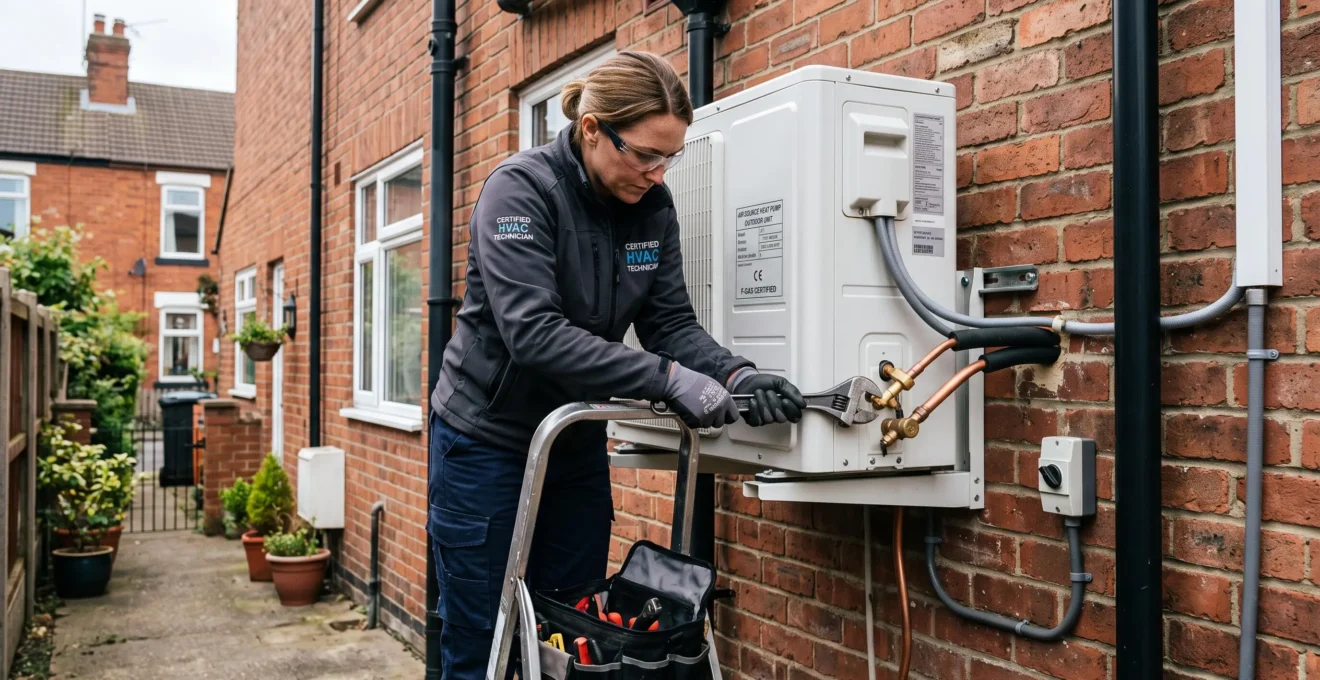
British households face an increasingly difficult thermal balancing act. Summer heatwaves push bedroom temperatures beyond comfortable sleeping conditions, whilst winter cold snaps demand reliable heating. The traditional response—a gas boiler for winter warmth and portable fans or separate air conditioning for summer relief—creates a fragmented, space-consuming and often costly approach to year-round comfort.
A reversible heat pump offers a fundamentally different solution: a single system capable of both heating and cooling by inverting the same thermodynamic cycle. For the temperate oceanic climate of the UK, where extreme temperatures remain relatively rare, this dual-function technology delivers measurable efficiency advantages over maintaining separate equipment—provided the system is correctly sized and the performance thresholds are clearly understood.
- The dual-season challenge: why single-purpose systems fall short
- How does a reversible heat pump actually work?
- What tangible advantages over separate heating and cooling systems?
- Performance thresholds and seasonal efficiency realities
- Which system capacity and configuration for your space?
- Installation considerations and smart control integration
The dual-season challenge: why single-purpose systems fall short
The UK climate has evolved measurably over recent decades. The Met Office records increasingly frequent summer temperatures exceeding 30°C, whilst winter lows still regularly dip below freezing across much of England, Scotland and Wales. This dual seasonal pressure creates genuine discomfort in homes designed primarily for heating, particularly in upstairs bedrooms where summer heat accumulates.
Addressing both seasonal extremes with separate systems carries measurable costs. A replacement condensing gas boiler typically costs between £2,000 and £3,500 installed, whilst adding even a basic single-room air conditioning unit adds another £1,500 to £2,500 to the total outlay. For a family already managing mortgage payments and rising energy bills, this represents a substantial double investment simply to maintain comfortable temperatures year-round.
Space constraints compound the financial burden. Traditional heating radiators occupy valuable wall space in every room, whilst indoor air conditioning units require additional mounting positions and external condenser units. In a typical British semi-detached house of 100–120 m², this dual-equipment approach can claim several square metres of usable wall area and exterior space—resources often at a premium in urban and suburban settings.
Energy tariffs have risen sharply since 2022, making the efficiency of domestic heating and cooling equipment increasingly consequential for household budgets. Systems designed for a single function—heating or cooling but not both—miss the opportunity to share capital investment and installation costs across the full annual comfort requirement. Those seeking to compare different types of air conditioners increasingly encounter reversible models precisely because of this dual-function economic advantage.
How does a reversible heat pump actually work?
The term « reversible heat pump » describes a system capable of moving heat in either direction—extracting it from indoor air to cool a space, or gathering it from outdoor air to warm a space—using the same physical equipment. This is not two separate machines housed in one casing, but rather a single refrigeration cycle with an electronically controlled directional valve.
The underlying principle mirrors that of a domestic refrigerator. A refrigerant fluid circulates through a closed loop, alternately absorbing and releasing heat as it changes state between liquid and gas. A compressor pressurises the refrigerant, raising its temperature, whilst an expansion valve allows it to decompress and cool. Heat exchangers (the evaporator and condenser) facilitate thermal transfer between the refrigerant and the surrounding air.
In cooling mode, the indoor unit acts as an evaporator, absorbing heat from the room and transferring it via the refrigerant to the outdoor unit, which expels it into the external environment. The result: indoor temperatures drop as warmth is actively pumped outside, much like a refrigerator cooling its interior by radiating heat from its rear grille into the kitchen.
In heating mode, the system reverses this flow. A component called the reversing valve redirects the refrigerant’s path, causing the outdoor unit to become the evaporator (absorbing heat from outdoor air, even when cold) and the indoor unit to become the condenser (releasing captured heat into the room). This inversion is electronic and instantaneous—no physical components are swapped or added.
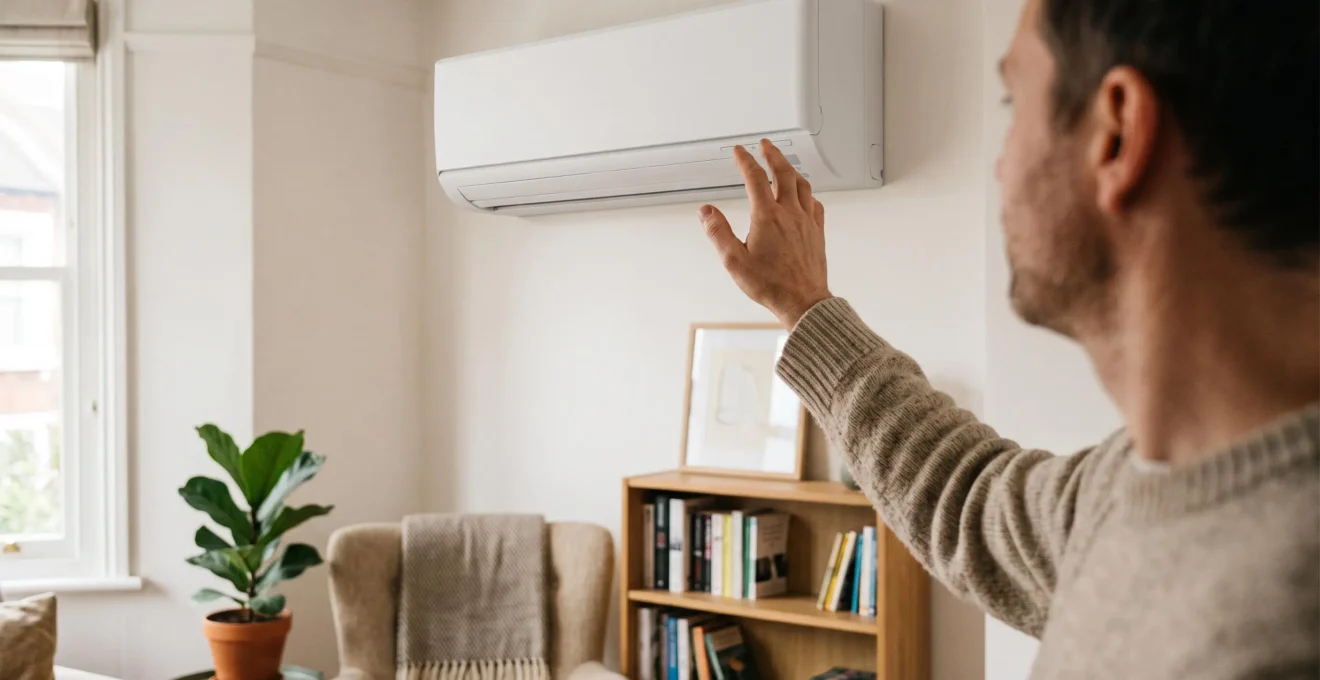
This clarifies a common misconception: a reversible heat pump is not « two appliances in one » requiring duplicate machinery. All core components—compressor, expansion device, heat exchangers, refrigerant circuit—remain identical. Only the direction of thermal transfer changes, controlled by switching the reversing valve position. The simplicity of this mechanism underlies both the system’s reliability and its cost advantage over purchasing and installing entirely separate heating and cooling equipment.
The refrigerant: safe and increasingly eco-friendly: Modern reversible heat pumps use refrigerant fluids designed to minimise environmental impact and operate safely within sealed systems. Refrigerants such as R32 have lower global warming potential than older alternatives, and the closed-loop design prevents release during normal operation. Professional installation and periodic maintenance ensure the system remains leak-free throughout its lifespan.
What tangible advantages over separate heating and cooling systems?
Choosing a reversible heat pump over maintaining separate heating and cooling systems delivers measurable benefits across installation cost, operational efficiency, space utilisation and long-term maintenance—benefits particularly pronounced in the UK’s temperate climate and current energy market.
Installation cost consolidation represents the most immediate financial advantage. According to the Energy Saving Trust, a typical air source heat pump installation costs around £12,000 in the UK. Whilst this appears substantial, it replaces the combined outlay for both a replacement boiler (£2,000–£3,500) and a separate air conditioning system (£1,500–£2,500 for a single room, significantly more for multi-room coverage). For whole-home comfort, a single reversible system often proves cost-competitive or cheaper than dual equipment, whilst requiring only one installation appointment and one set of building modifications.
Government support further improves the financial picture. The Boiler Upgrade Scheme, administered by Ofgem, provides £7,500 towards air-to-water heat pumps and £2,500 for residential air-to-air systems—grants unavailable for conventional boiler replacements. This targeted subsidy directly addresses the upfront cost barrier for households replacing aging gas heating systems.
Energy efficiency is quantified by the Coefficient of Performance (COP): the ratio of heat energy delivered to electrical energy consumed. Whilst a conventional electric heater or boiler achieves a COP of approximately 1.0 (one unit of heat per unit of electricity), reversible air-to-air heat pumps typically operate between COP 3.0 and 4.0 under moderate UK conditions. This means producing three to four kilowatt-hours of heating or cooling for every kilowatt-hour of electricity consumed—a multiplication effect derived from moving existing heat rather than generating it through combustion or resistance.
3.5
kWh output per 1 kWh input
A COP of 3.5 means every pound spent on electricity delivers £3.50 worth of heating or cooling—unlike electric resistance heating’s 1:1 ratio. This efficiency advantage translates directly into lower monthly running costs across both summer and winter.
Real-world UK field trials paint a more conservative picture than laboratory specifications. Research from the UK Collaborative Centre for Housing Evidence found air source heat pumps achieving an average COP of approximately 2.0 in British homes—below manufacturer claims but still double the efficiency of direct electric heating. Building insulation quality emerged as the primary factor explaining the gap between laboratory and installed performance, underscoring the importance of adequate thermal envelope standards.
Space savings prove particularly valuable in British housing stock, where room dimensions are often modest. A reversible system eliminates the need for bulky radiators on every wall, freeing floor and wall space for furniture placement and interior design flexibility. A single wall-mounted indoor unit occupies roughly 0.5 m² of wall area, compared to the several square metres claimed by multiple radiators plus separate cooling equipment across a typical three-bedroom home.
Simplified maintenance reduces both hassle and long-term costs. A single annual service appointment covers the complete heating and cooling system, rather than separate boiler servicing and air conditioner checks. Filter cleaning, refrigerant level verification and component inspection occur within one technician visit, streamlining household management and reducing cumulative service expenses over a 10–15 year equipment lifespan.
| Cost component | Gas boiler + AC units | Reversible heat pump |
|---|---|---|
| Installation (after grants) | £4,000–£6,000 | £4,500–£9,500 |
| Annual running cost (estimate) | £900–£1,400 | £700–£1,100 |
| Annual maintenance | £150–£250 (two systems) | £80–£150 (one system) |
| 10-year total | £14,500–£23,000 | £12,300–£22,000 |
These figures represent typical scenarios for a 100–120 m² semi-detached house with average insulation. Actual costs vary with regional energy tariffs, usage patterns and building thermal performance, but the total cost of ownership over a decade frequently favours the integrated reversible approach—particularly when accounting for the space and convenience benefits that pure cost comparisons cannot capture.
Performance thresholds and seasonal efficiency realities
Transparent discussion of performance limitations distinguishes realistic guidance from promotional overselling. Reversible heat pumps do not maintain constant efficiency across all outdoor temperatures—a characteristic rooted in fundamental thermodynamics that every prospective buyer should understand before committing to the technology.
COP declines as outdoor temperature drops. Extracting heat from colder air requires greater compressor effort, reducing the ratio of heat delivered to electricity consumed. A system achieving COP 4.5 at an outdoor temperature of 7°C might deliver COP 3.0 at 0°C and COP 2.5 at -5°C. This degradation is predictable and universal across all air-source heat pump designs—a consequence of thermodynamic laws, not manufacturing quality.
The UK’s temperate oceanic climate substantially mitigates this concern. According to the Energy Saving Trust’s analysis of UK air temperature patterns, outdoor temperatures fluctuate between -5°C and 25°C for at least 95% of the year across most of England, Scotland and Wales. Prolonged periods below -5°C remain rare outside elevated or northern locations, meaning systems operate within their efficient performance band throughout the majority of the heating season.
SCOP provides a more realistic efficiency measure than instantaneous COP figures quoted at a single test temperature. The Seasonal Coefficient of Performance averages efficiency across the range of temperatures experienced during an entire heating or cooling season, weighted by the time spent at each temperature level. For UK conditions, SCOP ratings between 3.0 and 4.0 represent realistic expectations for quality air-to-air reversible systems—figures that account for both mild days (high COP) and cold snaps (reduced COP).
Understanding SCOP: your seasonal efficiency indicator: SCOP calculates average performance across a complete heating season rather than at a single idealised temperature. A system with SCOP 3.5 delivers 3.5 kWh of heat for every 1 kWh of electricity consumed when averaged over typical UK winter conditions—a more reliable basis for estimating annual running costs than laboratory COP figures measured at 7°C outdoor temperature.
Modern systems maintain operation down to outdoor temperatures of -15°C to -25°C, depending on model specifications, though efficiency drops progressively throughout this range. For most UK households, the practical question is not whether the system will function during cold weather, but whether its reduced efficiency at those temperatures remains acceptable. With SCOP values above 2.0 even during cold periods, the system continues outperforming electric resistance heating and offering comparable or better efficiency than gas boilers.
Performance below 0°C: expect efficiency drop, not system failure: Air-source heat pumps remain operational during sub-zero temperatures common in British winters, but COP decreases as outdoor air grows colder. At -5°C, expect COP around 2.0–2.5 rather than the 3.5–4.5 achievable at milder temperatures. The system continues heating effectively—it simply consumes more electricity per unit of heat delivered during these brief cold snaps.
For households particularly concerned about performance during rare extreme cold events, maintaining the existing gas boiler as a backup heat source offers reassurance whilst still enabling heat pump operation for the vast majority of the year. This hybrid approach preserves the efficiency gains during typical UK weather whilst providing a fallback for the small fraction of days when outdoor temperatures challenge heat pump efficiency limits.
Which system capacity and configuration for your space?
Correct sizing represents the single most consequential decision affecting comfort, efficiency and equipment longevity. An undersized system struggles to maintain temperature during peak demand, whilst oversizing increases both purchase cost and operational inefficiency through excessive on-off cycling. Determining appropriate capacity requires considering building size, insulation quality and intended coverage area.
Heating and cooling capacity is measured in kilowatts (kW), representing the rate of thermal energy transfer. UK building regulations and MCS installation standards provide sizing methodologies based on heat loss calculations, but a simplified estimation uses thermal demand per square metre. Well-insulated properties built after 2010 typically require 40–60 watts per m², homes from the 1990–2010 period with average insulation need approximately 60–80 W/m², whilst poorly insulated pre-1990 buildings may demand 80–100+ W/m² or more.
-
Measure your heated floor area
Calculate the total square metrage of all rooms requiring heating or cooling, excluding unheated spaces such as garages or uninsulated loft areas.
-
Identify your building’s insulation level
Determine approximate thermal performance based on construction era: post-2010 (good insulation, 40–60 W/m²), 1990–2010 (average insulation, 60–80 W/m²), or pre-1990 (limited insulation, 80–100 W/m²). Retrofit insulation improvements shift older properties towards better categories.
-
Calculate approximate heat demand
Multiply floor area by the watts-per-square-metre factor: a 120 m² home from 1995 with average insulation requires roughly 120 × 70 W/m² = 8,400 watts (8.4 kW).
-
Select equipment capacity with modest margin
Choose a system rated slightly above calculated demand to accommodate peak conditions without excessive oversizing: for an 8.4 kW requirement, a 9 kW nominal capacity unit provides appropriate headroom.
This estimation provides initial guidance, but professional heat loss calculation by an MCS-certified installer remains essential for final system selection. Installers account for building orientation, window area, air infiltration rates and local climate data—variables affecting actual thermal demand that simplified rules cannot capture.
Configuration choice between mono-split and multi-split systems depends on coverage requirements and budget. A mono-split configuration comprises one outdoor unit paired with a single indoor unit, suited to heating and cooling a primary living area or open-plan ground floor. Multi-split systems connect one outdoor unit to multiple indoor units (typically two to five), enabling independent temperature control in separate rooms—valuable for managing upstairs bedrooms independently from downstairs living spaces.
| Factor | Mono-split | Multi-split |
|---|---|---|
| Coverage | Single room or open zone | Multiple independent rooms |
| Installation cost | £3,000–£5,000 | £6,000–£12,000+ |
| Temperature control | Uniform for covered area | Individual per indoor unit |
| Exterior space | One outdoor unit | One outdoor unit (larger) |
| Best suited for | Flats, studios, main living areas | Whole-home comfort, multi-storey houses |
Inverter technology represents the standard in modern reversible systems, including those from manufacturers such as Westpoint serving both residential and light commercial markets. Unlike fixed-speed compressors that operate at full capacity or switch off entirely, inverter-driven compressors modulate output continuously to match real-time thermal demand. This variable-speed operation improves efficiency, reduces temperature fluctuations, quietens operation and extends component lifespan—benefits justifying the modest cost premium over basic on-off systems.
Available capacity ranges span from compact 2–4 kW units for small flats or single rooms, through mid-range 5–9 kW systems appropriate for typical 80–150 m² homes, to larger 10–15+ kW installations for spacious properties or light commercial applications. Westpoint’s product range covers this full spectrum, illustrating the breadth of options enabling proper matching between building requirements and equipment capacity.
Installation considerations and smart control integration
Understanding installation prerequisites and control capabilities helps set realistic expectations and ensures the technology integrates smoothly into daily household routines. Whilst not requiring the extensive pipework modifications associated with wet central heating systems, reversible air-to-air installations do involve specific electrical, spatial and regulatory requirements.

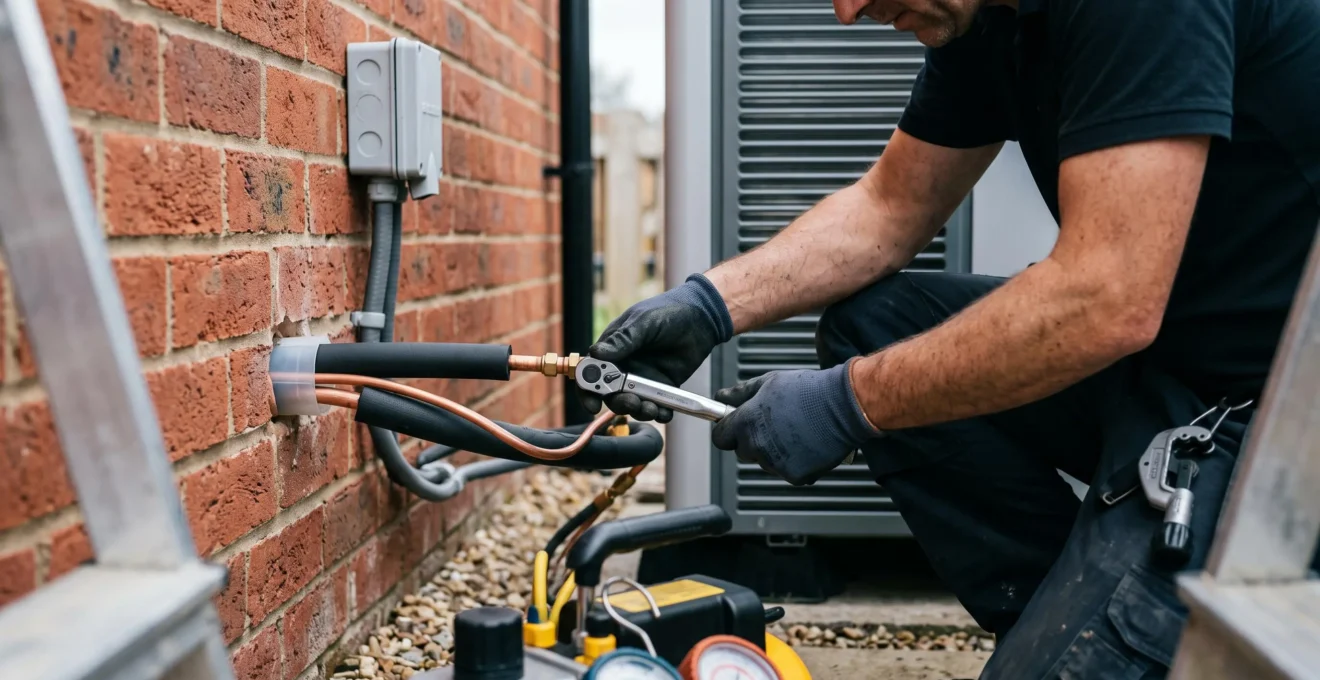
Spatial requirements begin with locating the outdoor unit. This component needs exterior wall mounting, ground placement or balcony installation with adequate ventilation clearance on all sides—typically 30–50 cm minimum. Maximum refrigerant line length between outdoor and indoor units generally ranges from 15 to 25 metres depending on model specifications, constraining placement options in larger properties. Indoor units mount high on interior walls (usually 2–2.5 metres above floor level) to optimise air circulation, requiring sufficient clearance from ceilings, adjacent walls and obstructions.
Electrical infrastructure demands dedicated circuit protection from the main consumer unit, with cable sizing appropriate to system power draw—typically 16–32 amp capacity depending on equipment rating. Professional electrical work by a qualified electrician ensures compliance with UK wiring regulations and building standards. Installation also requires a discreet refrigerant line conduit penetrating the external wall, plus condensate drainage from the indoor unit to exterior or waste water systems—a simple 20–25 mm pipe run, but one requiring planning during installation.
Smart controls and connectivity have evolved from optional extras to standard features on quality reversible systems. Manufacturers including Westpoint integrate smartphone app control, enabling temperature adjustment, mode switching and scheduling from anywhere with internet access. Geolocation features can trigger pre-heating or pre-cooling based on proximity to home, whilst real-time energy monitoring displays instantaneous and cumulative electricity consumption—valuable data for optimising usage patterns and managing monthly bills.
Weekly programming allows setting different temperatures for weekday mornings, daytime (when the house may be empty), evenings and weekends, matching comfort delivery to actual occupancy. This scheduling capability prevents wasted energy heating or cooling unoccupied spaces—a control refinement impossible with basic thermostatic systems and particularly valuable for households with regular routines.
MCS certification of the installer represents a non-negotiable requirement for quality assurance and financial support eligibility. The Microgeneration Certification Scheme sets installation standards, verifies installer competence and provides the necessary credentials for accessing government grants under the Boiler Upgrade Scheme. According to Ofgem’s scheme administration, only MCS-certified installers can submit grant applications on behalf of property owners—making certification status the gateway to £2,500–£7,500 in upfront cost reduction for eligible heat pump installations.
MCS certification: why it matters for quality and grants: MCS (Microgeneration Certification Scheme) certifies that installers follow proper sizing methodology, use approved equipment and meet quality standards. For homeowners, MCS certification ensures professional installation and represents the only route to claiming Boiler Upgrade Scheme grants—currently £2,500 for residential air-to-air systems. Verify installer credentials at the official MCS database before committing to any quotation.
The Boiler Upgrade Scheme provides substantial financial support for replacing fossil fuel heating with heat pump technology. Grants of £7,500 apply to air-to-water systems (which integrate with wet radiator circuits), whilst air-to-air reversible systems receive £2,500 for residential installations. These grants reduce the upfront cost barrier, bringing total installation expense after subsidy into closer alignment with conventional boiler replacement costs—a deliberate policy intervention designed to accelerate heat pump adoption across the UK housing stock.
- Reversible heat pumps provide both heating and cooling using one system through an electronically controlled valve that inverts the refrigeration cycle—not two separate machines, but one thermodynamic process running in either direction.
- Expect realistic seasonal efficiency (SCOP) between 3.0 and 4.0 in UK conditions, meaning three to four times more heat delivered than electricity consumed—significantly better than electric resistance heating and comparable to gas boilers, even accounting for real-world performance below laboratory claims.
- Correct sizing matters critically: calculate approximately 60–80 W/m² for typical 1990s–2000s British housing with average insulation, then obtain professional MCS heat loss assessment to confirm capacity and qualify for government grants up to £7,500.
- UK climate suits reversible heat pumps well, with temperatures remaining between -5°C and 25°C for 95% of the year—the operational range where air-source systems maintain efficiency advantages over traditional separate heating and cooling equipment.
For households seeking to reduce energy bills whilst addressing both summer overheating and winter heating needs, reversible heat pump technology offers a proven, financially supported pathway. The UK’s temperate climate, government grant availability and rising cost of fossil fuels align to make properly specified and professionally installed systems a pragmatic choice for year-round domestic comfort. Further guidance on broader home energy efficiency strategies appears in coverage of smart appliances energy efficiency and practical approaches to smart home energy savings that complement heating and cooling system upgrades.