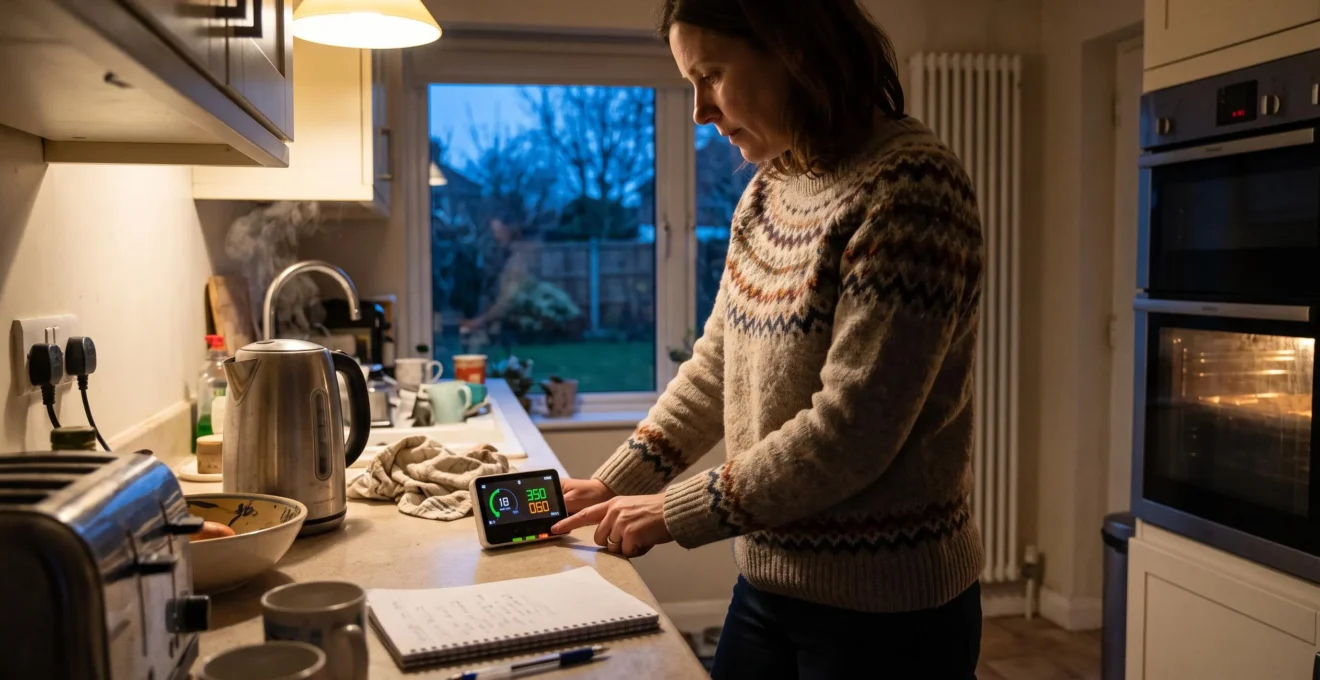
Smart grids can lower household electricity bills, but only when your energy use, tariff and connected devices work together. A smart meter alone does not guarantee savings. The financial opportunity comes from using electricity at cheaper or more useful times, participating in flexibility schemes, and avoiding unnecessary increases in electrical supply capacity.
For a UK homeowner considering an electric vehicle (EV), heat pump or home battery, this creates a practical choice. You can manage electricity manually, automate selected appliances or keep a conventional tariff if your household cannot shift much consumption. Each approach involves different costs, convenience and data-sharing requirements.
The complication is that smart-grid benefits are uneven. A household able to schedule EV charging overnight may have substantial flexibility, while someone dependent on evening electric heating may have very little. Understanding that difference matters more than buying the latest controller.
The useful question is therefore not whether smart grids are inherently cheaper, but which changes produce measurable savings without making your home harder to manage.
Smart grids: what UK households need to know
- Flexible electricity use can reduce costs, but savings depend on your tariff, available off-peak periods and actual consumption patterns.
- Smart tariffs provide price incentives; home energy management systems automate responses. You do not necessarily need both.
- Before investing in chargers, controllers or supply upgrades, review your meter data, privacy permissions and realistic maximum electrical demand.
- Why Do Smart Grids Need Flexible Homes to Prevent Peak-Time Stress?
- How to Join a Flexibility Scheme Without Losing Comfort or Control?
- Smart Tariff or Home Energy Management System: Which Gives More Control?
- The Smart Grid Privacy Mistake That Exposes More Data Than You Think
- When Should You Start Using Smart Grid Features if You Don’t Have an EV Yet?
- Time-of-Use Tariff or Fixed Rate: Which Works Better if You’re Home After 6pm?
- How to Do a Basic Load Audit Before You Ask for a Supply Upgrade?
- What Limits Your Home’s Electrical Supply When You Add an EV, Induction, and Heat Pump?
Why Do Smart Grids Need Flexible Homes to Prevent Peak-Time Stress?
Smart grids need flexible homes because electricity demand becomes more expensive and difficult to manage when many households use powerful appliances simultaneously. Moving some consumption to quieter periods helps balance supply and demand without necessarily reducing total electricity use. For homeowners, that flexibility can create opportunities to save money or receive rewards.
Consider a typical British winter evening. People return home, prepare dinner, heat their rooms and potentially plug in electric cars. Electricity demand rises across the network, while available generation and network capacity must accommodate the combined load.
Grid stress describes this system-wide imbalance or constraint, not an individual home’s energy consumption in isolation. Your kettle is unlikely to create a problem by itself. Millions of appliances operating during similar periods create a much greater challenge.
Meeting peak demand may require more expensive generation, additional balancing actions or investment in infrastructure. Moving flexible consumption can reduce some of those pressures.
Importantly, shifting electricity is different from saving electricity. An EV requiring the same amount of energy to recharge can consume that electricity later in the evening. The charging requirement remains; its timing changes.
Great Britain’s Demand Flexibility Service provides a concrete example. Introduced in winter 2022, it began operating year-round on 27 November 2024. From 14 April 2026, eligible participants could also be rewarded for increasing electricity consumption at useful times, rather than only reducing demand during specified periods.
According to NESO‘s Demand Flexibility Service explanation, eligible households participate through registered suppliers or aggregators, with rewards depending on the provider.
A real-world example: Britain’s Demand Flexibility Service
The service was established to help manage electricity demand during periods when the system needed support. Households with suitable smart meters could participate through approved providers.
Its expansion from seasonal demand reduction to year-round flexibility demonstrates that the value of flexible electricity use can arise from increasing or decreasing demand at particular times. It does not establish a guaranteed reward for individual households.
Homes unable to change their schedules can still use electricity normally. The service does not impose a general penalty simply because a household chooses not to participate.
There is nevertheless a longer-term distributional question: if future tariffs increasingly reflect peak costs, less flexible households might struggle to access the same savings. That is a possibility to assess, not an established universal outcome.
The practical opportunity is to identify electricity consumption that can move without affecting comfort, safety or essential daily routines. That is also the starting point for choosing a flexibility scheme.
How to Join a Flexibility Scheme Without Losing Comfort or Control?
You can join a UK electricity flexibility scheme without surrendering household control by choosing a provider with clear participation rules, understandable rewards and optional automation. A working smart meter is generally required for the Demand Flexibility Service. Before enrolling, establish whether events are voluntary, who can control connected devices and how your reward will be calculated.
Start with your electricity supplier. Ask whether it offers flexibility rewards directly or works through another provider. An independent aggregator may also offer a suitable programme, subject to eligibility and compatibility requirements.
Do not assume that having a smart meter automatically guarantees participation. The meter must work correctly, the provider must accept your household, and the relevant consumption data must be available.
Your baseline matters as much as the advertised reward. In schemes using a consumption baseline, the provider estimates how much electricity you would normally have used during an event. Your reward may depend on the difference between that estimate and your measured use.
Different providers can apply different methods. A household with unusually low normal consumption may have little eligible reduction available, even if it makes a genuine effort.
Comfort and control depend on two separate decisions. First, determine whether you personally respond to event notifications or allow a supplier, aggregator or authorised controller to adjust appliances. Second, check whether you can override an automated change.
For example, you might agree to delay EV charging while retaining the ability to start immediately when an unexpected journey becomes necessary. The same principle applies to heating: maintaining a safe, comfortable indoor temperature takes priority over earning a modest reward.
NESO describes participation in individual Demand Flexibility Service events as voluntary. In most cases, not changing consumption means receiving no reward rather than incurring a penalty. However, you should verify your specific provider’s terms rather than treating this as a universal contractual guarantee.
After your first event, compare the notification, the recorded electricity consumption and the reward shown in your account. Ask the provider to explain any baseline calculation you cannot reconcile.
Also check whether participation requires extensive device permissions or half-hourly data access. A manually managed scheme may be preferable if you are uncomfortable granting remote control.
A scheme is worthwhile only if its rewards justify the effort and permissions involved. Once you know how participation works, the next decision is whether a tariff alone provides enough control or automation would genuinely help.
Smart Tariff or Home Energy Management System: Which Gives More Control?
A smart electricity tariff controls when electricity is cheaper or more expensive; a home energy management system (HEMS) controls how compatible household devices respond. A tariff can produce savings without additional hardware if you shift consumption yourself. A HEMS may make that process more convenient, but its value depends on compatibility, automation features and the cost of the equipment.
Think of the tariff as the pricing rules and the HEMS as the operating mechanism. Neither automatically guarantees a cheaper bill.
A time-of-use tariff might offer lower rates overnight. You could benefit simply by scheduling your EV charger or immersion heater using its built-in controls. A separate energy management platform may add little if those features already cover your needs.
Conversely, a household with solar panels, battery storage, an EV and a heat pump may have several appliances to coordinate. A compatible HEMS could manage charging, storage and heating schedules against changing electricity prices.
The following comparison separates what you actually gain from each option.
| Decision factor | Time-of-use tariff | Home energy management system |
|---|---|---|
| Main function | Changes electricity unit rates by time | Schedules or adjusts compatible devices |
| How savings arise | Using electricity during cheaper periods | Automating consumption to exploit suitable tariffs or energy availability |
| Hardware requirement | Usually needs a suitable working smart meter | May require compatible controllers, appliances or additional equipment |
| Household involvement | Manual planning or existing appliance timers | Potentially less ongoing manual intervention |
| Main limitation | Expensive periods can outweigh off-peak benefits | Hardware costs, integration limits and possible supplier dependence |
| Best initial use | Testing whether your consumption can shift | Coordinating several substantial flexible loads |
Energy Saving Trust advises consumers to compare real household consumption against tariff structures, rather than assuming that discounted off-peak rates always lead to lower bills.
The hidden issue is technology lock-in. Some chargers and management platforms support only particular suppliers, interfaces or tariff integrations. Switching suppliers later could remove useful automation features.
Before purchasing a controller, ask whether it supports your intended tariff, works without a proprietary cloud service and allows you to export relevant consumption information.
Manual override is equally important. A system that cannot accommodate an urgent charging requirement or a change in heating needs may create more frustration than savings.
For many households, starting with a tariff and existing appliance timers is a sensible low-commitment approach. More sophisticated automation becomes easier to justify once measured consumption shows that additional coordination is worthwhile.
The Smart Grid Privacy Mistake That Exposes More Data Than You Think
The main smart-grid privacy mistake is granting broad access to detailed electricity consumption data without understanding who receives it or why. Half-hourly readings can reveal patterns in household activity, especially when combined with other information. A smart meter does not automatically expose that information to every company, but connected apps, tariffs and flexibility services can introduce additional sharing arrangements.
Electricity data is more informative than a single monthly bill. Frequent readings can reveal changes in household demand and potentially support inferences about occupancy, routines or the operation of powerful appliances.
These are potential inferences, not guaranteed identifications. Their accuracy depends on the resolution of the readings, household characteristics and any other available data.
The privacy risk grows when several services gain access to detailed information. A tariff comparison service, EV charging application and flexibility aggregator may each request data for different purposes.
The mistake is not simply agreeing to smart-meter installation. It is accepting broad third-party permissions without checking the data resolution, purpose, retention period and onward-sharing arrangements.
UK GDPR requirements and the smart-meter data access framework create obligations and distinctions between different uses of household information. Meter data needed for billing is not equivalent to unrestricted access for optional commercial services.
Ofgem‘s official smart meter guidance explains that smart meters support accurate billing, energy management and additional services, and directs consumers to their suppliers for information about recording and sharing data.
Contact your electricity supplier and ask which organisations currently receive your consumption information, the time intervals involved and which permissions you can change.
For a separate app or aggregator, consult its privacy notice and request an explanation of retention, deletion and withdrawal procedures. Do not assume that changing a supplier setting automatically revokes permissions previously granted to an independent service.
There is a genuine trade-off. A dynamic tariff or detailed flexibility calculation may require more granular readings than a conventional billing arrangement. Restricting access can therefore limit the availability of certain optional features.
That does not mean every smart-grid feature requires the widest possible disclosure. Share only the information necessary for a service you actually use.
Privacy is another reason to introduce smart-grid features gradually: you can learn which services provide tangible value before authorising additional connections.
When Should You Start Using Smart Grid Features if You Don’t Have an EV Yet?
You can start using smart-grid features before buying an electric vehicle because many ordinary household loads already offer flexibility. Washing machines, immersion heaters, storage heating and home batteries may be scheduled around suitable electricity prices. Beginning with consumption data and low-cost scheduling helps you understand potential savings before committing to dedicated EV equipment or complex automation.
The first step is to review your existing smart meter. Confirm that it communicates reliably and ask your supplier how to access your consumption history.
Examine which periods account for the largest share of your electricity use. Identify appliances that could operate at another time without disrupting your routine.
Then assess whether a suitable time-of-use tariff would reward those changes. Switching tariffs is not automatically advisable: if your main loads cannot move, remaining on a conventional tariff may be cheaper.
Use built-in appliance scheduling where it is available. Delayed-start functions can provide some of the practical benefits of smart automation without purchasing a separate energy management system.
Smart plugs can also provide useful monitoring or switching functions for suitable low-power appliances. However, they are not universally appropriate for washing machines, heaters or other high-power equipment. Check the manufacturer’s instructions, electrical rating and suitability before connecting any appliance.
Follow appliance fire-safety guidance when choosing operating times. Cheap overnight electricity is not a good reason to leave unsuitable appliances running unattended while everyone sleeps.
Using your consumption records over several weeks can help reveal recurring patterns and realistic opportunities, although no fixed learning period guarantees savings.
The advantage of beginning early is that you develop a clearer understanding of your household before a major new load arrives. When you eventually buy an EV or heat pump, you can evaluate equipment against known energy needs rather than assumptions.
Choose hardware after confirming tariff compatibility. An expensive charger or proprietary controller may be difficult to use with your preferred future supplier.
Once you know which appliances can move, the next question becomes financial: whether those flexible loads are sufficient to offset the higher rates that some time-of-use tariffs charge during busy evening periods.
Time-of-Use Tariff or Fixed Rate: Which Works Better if You’re Home After 6pm?
A time-of-use tariff can still work for someone who is home after 6pm, but it depends on how much electricity they must use during expensive periods. If most consumption involves evening cooking and heating, a conventional single-rate tariff may be more economical. If substantial appliance use can move to cheaper hours, time-of-use pricing may offer savings.
The crucial distinction is between being at home and using high-power equipment. Lighting and ordinary electronics might represent unavoidable evening consumption, whereas EV charging, water heating or some laundry tasks can often be scheduled separately.
Start by separating your evening electricity into two categories: consumption that cannot realistically shift and consumption that can.
A useful comparison should include both groups because a low off-peak price can be offset by expensive electricity used during peak periods.
For example, consider a purely hypothetical household using 10 kWh of electricity daily. Suppose 4 kWh must remain in an expensive evening window, while 6 kWh could move to a cheaper period.
Its time-of-use electricity cost would depend on the two applicable unit rates, alongside the standing charge. Comparing only the discounted 6 kWh would produce a misleading result.
Illustrative tariff comparison
Assume, purely for illustration, a single-rate tariff of 25p/kWh and a time-of-use tariff charging 35p/kWh during the relevant peak period and 15p/kWh off-peak. Standing charges are assumed equal.
At 10 kWh per day, a single rate costs £2.50 in electricity units. A household using 4 kWh at peak and 6 kWh off-peak would pay £2.30 on the illustrative time-of-use tariff. If only 3 kWh could shift off-peak, the time-of-use cost would be £2.90 instead. These are hypothetical prices, not current market quotations.
The example shows why the share of demand you can shift is often more important than the headline off-peak discount.
Peak windows vary between products. One tariff might have a particularly expensive late-afternoon period, while another uses changing half-hourly prices. A household returning after 6pm must check the actual schedule rather than assume every evening unit will be expensive.
Energy Saving Trust’s advice on switching to a time-of-use tariff recommends reviewing historical half-hourly consumption and comparing peak rates, off-peak rates, standing charges and applicable exit fees.
The same guidance explains that some smart tariffs vary their prices at half-hourly intervals. The financial exposure can therefore differ considerably between a predictable fixed schedule and a more dynamic product.
Also consider the alternatives to night-time appliance operation. Midday cheaper periods, home battery storage or shifting EV charging can sometimes provide flexibility without disrupting sleep or safe appliance use.
A smart tariff is only an opportunity, not a guarantee. Similar scrutiny should apply when deciding whether your electrical connection needs costly upgrading to accommodate additional appliances.
How to Do a Basic Load Audit Before You Ask for a Supply Upgrade?
A basic electrical load audit estimates the maximum power your home could realistically demand when major appliances operate together. It helps determine whether adding an EV charger, heat pump or induction hob may exceed existing supply capacity. The audit is a preparation tool, not a substitute for an electrician’s assessment or the distribution network operator’s decision.
Begin with a list of major electrical appliances and their rated input power. Include existing equipment and any new devices you plan to install.
A typical audit distinguishes appliances that operate continuously, those that cycle on and off, and those that can be scheduled or automatically limited.
Do not simply add every nameplate rating and assume all equipment operates at maximum power simultaneously. That gives a theoretical total that may substantially overstate realistic household demand.
Instead, assess likely simultaneous operation. For instance, cooking, heating and EV charging may overlap during a winter evening, while an immersion heater could potentially be scheduled for another period.
Professionals assess this using appropriate diversity assumptions, equipment characteristics and relevant installation requirements. There is no single universal diversity percentage suitable for every household.
Next, identify the existing main-fuse rating and relevant consumer-unit information. Do not remove electrical covers, touch live components or attempt to inspect sealed network equipment.
Your supplier or distribution network operator may be able to confirm connection information. The electrician must assess the installation’s actual suitability.
Historical smart-meter demand records can offer useful evidence, but they do not automatically predict what happens after an EV charger or heat pump is added.
UK Power Networks explains that some customers adding low-carbon technologies do not need a main-fuse upgrade. Its assessment process can consider recorded historical maximum demand and the proposed new installation.
An installer may also consider load management. A compatible EV charger could automatically reduce charging power when household demand rises. Whether such an arrangement is acceptable and sufficient depends on the installation and the relevant network operator’s requirements.
Documenting these options before requesting reinforcement helps prevent decisions based on an unrealistic assumption that every appliance will run at full power simultaneously.
Five steps to prepare a useful home load audit
- Inventory major appliances: Record each appliance, its rated input power and whether it is existing or planned. Deliverable: an appliance power table.
- Identify overlapping demand: Note which major appliances could realistically operate together on a busy winter evening. Deliverable: a simultaneous-use scenario.
- Gather supply information safely: Record visible consumer-unit details and obtain main-fuse information from the appropriate professional or operator. Deliverable: a documented supply-information sheet.
- Review measured electricity demand: Request available smart-meter consumption history and identify relevant high-demand periods. Deliverable: a dated consumption summary.
- Request a professional capacity assessment: Give an electrician or qualified installer your appliance list, operating scenarios and proposed new equipment. Ask them to assess diversity, load management and network notification requirements. Deliverable: a written technical recommendation.
Keep the resulting documentation when discussing an EV charger or heat-pump installation. It provides a more useful starting point than an unsupported request for the largest available main fuse.
The final decision requires understanding the physical bottlenecks within your electrical supply, because smart scheduling cannot compensate for unsafe wiring or an inadequate connection in every situation.
Key takeaways before upgrading your electrical supply
- Maximum simultaneous demand matters more than the sum of every appliance’s rated power.
- Smart charging and approved load management may reduce the need for additional connection capacity, but professional assessment is essential.
- The main fuse, consumer unit, incoming connection and internal wiring must all be suitable for the proposed installation.
What Limits Your Home’s Electrical Supply When You Add an EV, Induction, and Heat Pump?
Your home’s electrical supply is limited by the capacity and condition of its network connection, main fuse, consumer unit, protective devices and internal wiring. Adding an EV charger, induction hob and heat pump increases the possibility of simultaneous high demand. Smart load management may avoid some upgrades, but only where the existing electrical installation can safely support the proposed arrangement.
Electricity reaches your home through the local distribution network and service connection. The main fuse provides an important limit on the incoming supply, while downstream cables, protective devices and circuits must also be correctly sized.
A larger main fuse cannot make unsuitable internal wiring safe. Likewise, installing a new consumer unit does not automatically increase the capacity of the network connection.
The practical capacity is determined by the constraints of the installation as a whole.
UK Power Networks describes domestic main-fuse upgrade options involving existing 30 A or 60 A fuses and potential increases to 80 A or 100 A. Requirements above 100 A may call for a more substantial supply upgrade within its service area.
These ratings do not mean every home can safely accept a larger fuse or that every network operator follows an identical procedure.
For an authoritative overview of the assessment process, consult UK Power Networks’ domestic fuse upgrade guidance. Its procedures are specific to its network area, so homeowners elsewhere should use their own distribution network operator.
The owner of the main fuse and its holder is generally the network operator under the arrangements described by UK Power Networks. Responsibility for the meter, meter tails, consumer unit and consumer tails is divided between the relevant parties. This is one reason an electrical upgrade may involve more than one organisation.
Scheduling can sometimes prevent the equipment from demanding maximum power simultaneously. For instance, an EV charger capable of automatically limiting its output could reduce charging power while the household is cooking.
A heat pump’s operating requirements are different, particularly where supplementary electric heating is involved. Any control strategy must respect equipment performance, comfort, safety and manufacturer requirements.
Similarly, induction cooking equipment requires suitable circuit design and protection, even when a system is intended to manage overall household demand.
Load management is not a substitute for correcting unsafe electrical installations. A qualified installer must evaluate both peak demand and the suitability of the existing equipment.
If an upgrade is necessary, the installer can help establish the correct connection application or notification route with the local distribution network operator. The operator then determines whether the existing supply is sufficient or additional work is required.
Costs and timescales vary with the connection, required works and network circumstances. A fuse assessment is not the same as major network reinforcement, and it would be misleading to apply a single price to both.
Before buying an EV charger, induction hob or heat pump, give a qualified installer your proposed equipment specifications and documented household load audit. Ask for a written assessment of the existing supply, safe load-management possibilities and any network approval required. That is the most practical way to gain the benefits of a smarter home without paying for unnecessary complexity.
Will installing a smart meter automatically reduce my electricity bill?
No. A smart meter records and communicates electricity consumption more accurately and can support access to flexible tariffs. Savings depend on changing consumption, selecting a suitable tariff or using information to reduce avoidable demand. Installation alone does not guarantee a lower bill.
Can I participate in smart-grid services without allowing remote control of my heating?
Yes, some flexibility arrangements rely on voluntary behaviour changes rather than direct appliance control. Always check the provider’s specific permissions, event requirements and override options. Not every service offers the same degree of manual control.
Are smart tariffs suitable for homes with solar panels?
They can be, particularly where a household can coordinate consumption, battery charging or EV charging with suitable price periods. However, the result depends on generation patterns, import prices, export arrangements, standing charges and equipment compatibility. Compare the whole household’s electricity costs and export income rather than import rates alone.
What happens if my smart meter stops communicating?
Contact your electricity supplier to investigate the communication problem and confirm how your tariff and billing will operate while it is unresolved. Some flexible tariffs and reward schemes require reliable half-hourly readings, so eligibility or particular features may be affected.
Do smart grids require every household to own a home battery?
No. Batteries are one way to move electricity consumption between periods, but they are not essential for household flexibility. Built-in EV charging schedules, suitable heating controls, appliance timers and voluntary demand-response programmes can provide flexibility without battery storage. Whether a battery is financially worthwhile requires a separate assessment of its cost, use and tariff arrangements.