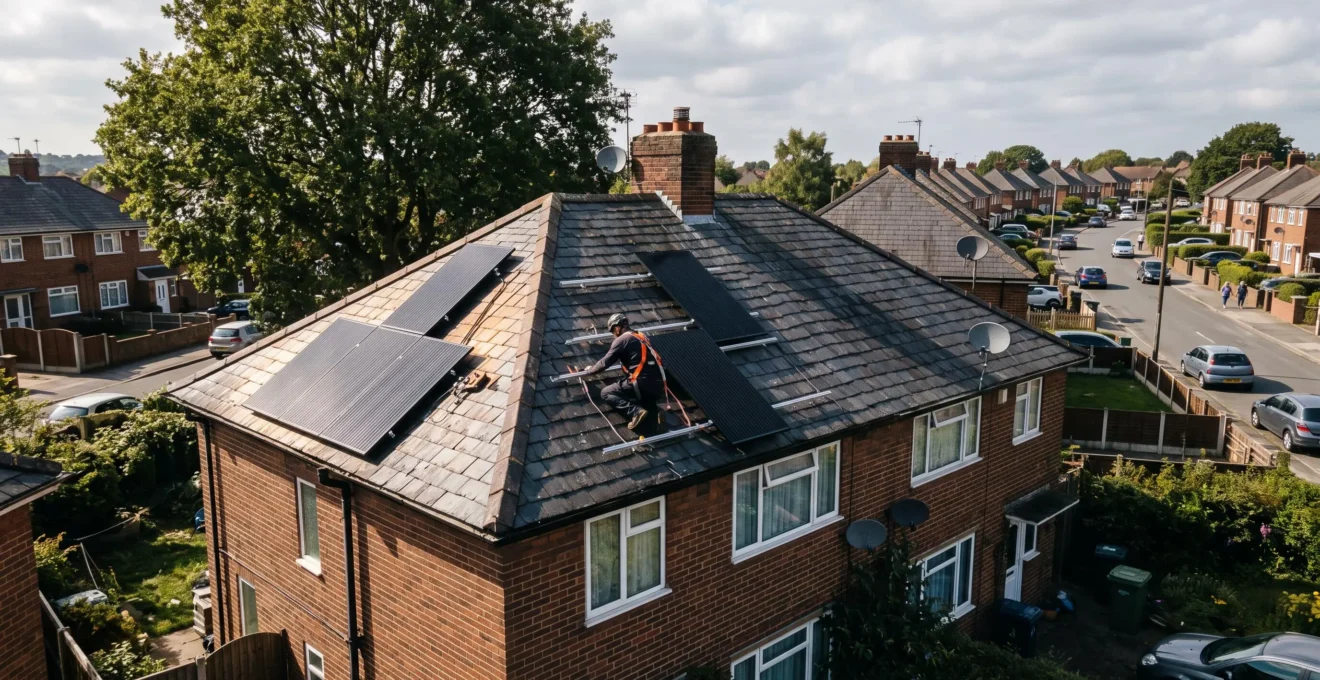
Solar panels can still be worth installing on a UK roof that receives direct sunlight only after 11am. The deciding factors are how much usable sunlight reaches the panels for the rest of the day, how shading changes across the seasons, and how much generated electricity the household can use or sell.
A roof shaded by trees until late morning is a different investment from an unobstructed south-facing roof. However, delayed direct sunlight does not mean generation starts at 11am: photovoltaic panels can also produce electricity from diffuse daylight, although at reduced output. A west-facing roof with an open afternoon sky may remain viable, while a nominally south-facing roof with persistent obstructions could disappoint.
The financial question is not simply how many panels fit. It is whether a properly shade-adjusted generation forecast, realistic household consumption pattern and defensible installation quote produce an acceptable return. Before committing thousands of pounds, homeowners need evidence specific to their roof rather than reassuring national averages.
Is late-morning solar worth considering?
- Sunlight after 11am is not a deal-breaker. Roof direction, seasonal shading and remaining daylight determine the usable generation window.
- Payback depends on where electricity goes. Compare the value of electricity consumed at home with what an export tariff actually pays.
- A credible quote must explain the losses. Ask for a documented shade assessment, realistic generation and self-consumption estimates, equipment specifications and warranty terms.
- Why Can Two UK Homes 2 Miles Apart Get 2x Different Solar Output?
- Why Can Two UK Homes 2 Miles Apart Get 2x Different Solar Output?
- How to Estimate Your Solar Self-Use Rate Without Any Apps or Monitoring Gear?
- Microinverters or a String Inverter: Which Works Better With Patchy Shade?
- The Solar Quote Red Flag That Usually Hides a 10-Year Maintenance Headache
- When Should You Install Solar Panels to Avoid a 6-Week Delay and Miss Summer Output?
- How to Shift 3 Key Loads Into Solar Hours Without Changing Your Routine?
- Why Is Your Home Energy Production Lower Than the Installer Predicted by 20%?
Why Can Two UK Homes 2 Miles Apart Get 2x Different Solar Output?
Two UK homes only two miles apart can achieve very different solar yields because their panels receive different amounts of usable sunlight. Roof direction, slope, surrounding obstructions and local weather all affect production. A twofold difference is possible under sufficiently different conditions, but it is not a typical or guaranteed relationship between neighbouring properties.
Consider two similarly sized rooftop systems. One faces an open section of sky; the other sits behind a mature tree until 11am and receives further chimney shade later in the afternoon. Even if both use identical panels, their annual production may diverge substantially.
Three physical factors deserve particular attention:
- Orientation and pitch: a roof facing west receives a different distribution of sunlight from one facing south or east. The slope changes how directly sunlight strikes the modules throughout the year.
- Nearby obstructions: trees, chimneys, dormers and neighbouring houses can remove direct sunlight from individual panels or entire roof sections.
- Local conditions: valley fog, coastal cloud, surrounding terrain and recurring seasonal weather patterns can influence the solar radiation actually reaching a property.
A shaded roof is therefore not necessarily receiving uniformly poor sunlight. It may have a productive afternoon window that a broad geographical estimate fails to describe.
The Energy Saving Trust‘s rooftop solar installation guidance explains that shading can be more influential than orientation alone. Installers should assess the impact of obstructions throughout the day and across seasons.
Local microclimates matter too, but their significance must be established rather than assumed. Morning valley fog may reduce direct radiation, while coastal cloud patterns can change available daylight. Urban heat haze is not, by itself, evidence of a predictable annual generation penalty. Roof geometry and shade should be investigated before attributing a major yield gap to weather.
Before inviting an installer, record when sunlight reaches each usable roof section. Check at hourly intervals, ideally across several days with different conditions. Note whether a chimney shadow crosses the proposed panel positions, rather than simply observing whether the garden looks sunny.
This home observation is only a preliminary shade profile. The sun’s height and path change with the seasons, so a few observations cannot replace annual shading analysis. Photographs taken from a suitable safe location can nevertheless make the first installer conversation much more productive.
The next step is to turn those observations into a usable annual generation estimate, rather than judging your project against a nearby household’s electricity bill.
Why Can Two UK Homes 2 Miles Apart Get 2x Different Solar Output?
Nearby homes can have substantially different solar production because public geographical averages do not fully capture roof-specific exposure. To investigate whether your home could produce much less than a neighbour’s, compare roof geometry, shading and estimated annual yield using public mapping tools and an MCS-based calculation. Treat any twofold difference as something to test, not assume.
Start with satellite imagery. Google Earth can help identify roof planes, adjacent trees, nearby buildings and likely installation space. Where available, three-dimensional building views and solar mapping overlays can provide additional context, but their detail and reliability vary by location.
These tools are useful for screening. They are not automatically equivalent to a validated, year-round shadow simulation, especially where tree heights, seasonal foliage or recent construction are missing.
The UK’s MCS solar PV methodology provides a more disciplined comparison. Under the MCS Solar PV Installation Standard MIS 3002, estimated annual generation incorporates installed capacity, regional solar yield and a shade factor. Roof orientation and inclination also contribute to the calculation.
For an initial comparison, the underlying relationship can be expressed as:
Estimated annual generation (kWh) = installed capacity (kWp) × applicable regional yield (kWh/kWp) × shade factor.
This simplified expression is not permission to guess the inputs. The regional yield must correspond to the relevant methodology, roof orientation and pitch, while the shade factor must reflect a defensible assessment.
Generic online calculators can conceal meaningful differences if they assume an unshaded roof, select a default orientation or omit information about morning obstructions. For a roof receiving direct sunlight mainly after 11am, compare scenarios with correctly assessed shade factors rather than changing a generic annual output figure by an arbitrary percentage.
A neighbour’s good results become useful evidence only when the comparison is technically meaningful:
- The systems have comparable installed capacity, or their yields are normalised to kWh per kWp.
- Roof orientation and pitch are similar.
- Tree cover, chimneys and neighbouring obstructions are reasonably comparable.
- Production records cover a meaningful period, ideally a full year.
- The figures represent generated electricity, not merely household bill savings or export payments.
A neighbour reporting excellent savings may simply consume more of their solar electricity at home. That tells you something about their household economics, not necessarily about your roof’s generating potential.
Ask prospective installers for the inputs behind their predictions. A credible annual estimate should describe the roof actually being quoted, not an idealised property in the same postcode.
Once generation has been estimated realistically, the next question is how much of that electricity your household can use at the times it becomes available.
How to Estimate Your Solar Self-Use Rate Without Any Apps or Monitoring Gear?
You can estimate solar self-use with a paper timetable showing when your household consumes electricity and when the roof is likely to generate it. Match daytime appliance use against the expected solar production window, then estimate how much generation could be consumed immediately. The result is an initial planning assumption, not a measured or guaranteed self-consumption rate.
Self-use matters because a unit of electricity consumed at home can avoid an import purchase, while exported electricity earns whatever payment the household’s applicable export tariff provides. Which option is worth more depends on the import and export rates, contractual terms and timing.
The basic calculation is:
Solar self-use rate (%) = solar electricity consumed directly at home ÷ total solar electricity generated × 100.
Do not confuse this with the percentage of household demand supplied by solar. A home might use most of its solar output while still importing substantial electricity during the evening and winter.
For seven days, draw an hourly timetable and record when people are home and when significant loads operate. Include laundry, cooking, hot water, homeworking equipment, EV charging and any other substantial electricity demand.
Use the roof observations to mark the likely late-morning and afternoon production period. Remember that a roof shaded until 11am may still generate some electricity earlier from diffuse daylight, while cloud can reduce production even during the nominally sunny period.
Next, distinguish between energy consumption and appliance running time. A washing machine operating for two hours does not necessarily consume electricity at a constant rate. Without appliance energy ratings or meter data, your timetable can identify likely overlap, but cannot produce a reliable kWh-based percentage on its own.
Where your electricity bills provide consumption information, use those figures as a cross-check against any installer-supplied estimate. Ask the installer to explain which occupancy pattern, annual electricity demand and projected generation profile were used.
A roof with delayed direct sunlight can sometimes suit an afternoon-heavy household better than expected. Someone working from home, using an electric hot-water cylinder or running appliances after lunch may consume a larger share of its output than a household with little daytime demand.
However, a higher percentage of self-use does not automatically compensate for lower total generation. Both quantities must enter the financial calculation.
The MCS installation standard requires a self-consumption estimate using its prescribed guidance or an equivalently valid method where the prescribed approach does not apply. A handwritten timetable is useful preparation, not a substitute for that formal estimate.
With the likely production and consumption patterns understood, attention can shift to whether the inverter configuration handles the particular shadows affecting your panels.
Microinverters or a String Inverter: Which Works Better With Patchy Shade?
Microinverters can be attractive when patchy shade affects different solar panels at different times, because each module operates more independently. A conventional string inverter can still be the better-value option where shading is limited or most panels experience similar conditions. The correct choice depends on panel layout, electrical configuration, shade patterns and total installed cost.
In a conventional string system, several panels are connected electrically and their operating characteristics interact. Shading one module can reduce the output of its string, although modern panels, bypass diodes and inverter tracking algorithms can limit certain losses. A single shaded panel does not invariably reduce every other panel’s output by the same proportion.
Microinverters convert electricity at individual modules, reducing the effect of one panel’s shading on others. DC power optimisers offer another module-level approach while commonly retaining a central inverter.
Module-level electronics cannot recover the sunlight physically blocked by a tree or chimney. Their potential benefit is reducing additional electrical losses resulting from mismatched panel conditions.
The engineering and maintenance trade-offs deserve as much attention as predicted output. A central inverter is generally easier to access from a garage or utility room. Module-level devices involve additional electronics at roof level, which can make an individual replacement more complicated when scaffolding or roof access is required.
Warranty duration, failure coverage and replacement labour arrangements vary by manufacturer and product. A longer equipment warranty is not necessarily equivalent to lower lifetime maintenance costs.
Use the following comparison when reviewing installer proposals.
| Decision factor | String inverter | Microinverters or module-level solutions |
|---|---|---|
| Light, concentrated morning shade | Potentially economical when correctly designed | Benefits need to justify additional cost |
| Irregular shade crossing several panels | May experience mismatch losses depending on configuration | Can reduce mismatch losses between affected modules |
| Initial equipment cost | Often lower for straightforward installations | Frequently higher; compare complete quotations |
| Failure and repair access | Accessible central component, subject to installation location | Module-level components may require roof access |
| Performance visibility | Usually system-level or string-level unless additional equipment is fitted | Often supports panel-level information, depending on product |
Ask the installer which panels are affected, during which seasons and for approximately how long. Request predicted annual generation for the proposed string system and the relevant module-level alternative, using comparable assumptions.
An installer recommending the cheapest architecture without modelling losses may simply be prioritising a convenient design. Equally, an installer recommending microinverters everywhere without demonstrating their benefit is not presenting a sufficiently evidence-based case.
On a roof shaded until 11am, shading across the entire array at the same time is a different electrical problem from a chimney shadow moving across individual panels after midday.
Even the right inverter will not protect against poor workmanship, vague specifications or a warranty that leaves costly roof-access work with the homeowner.
The Solar Quote Red Flag That Usually Hides a 10-Year Maintenance Headache
The biggest red flag in a solar quotation is often missing technical and warranty detail, not the quoted price itself. If the inverter model, panel specifications, mounting arrangement, workmanship coverage and shade-adjusted output estimate are unclear, homeowners cannot assess long-term repair exposure. Such omissions do not prove the installation will fail, but they make its risks difficult to evaluate.
A cheap system that operates reliably may be an excellent purchase. The problem is comparing it with a more detailed quotation as though both provide identical equipment, installation quality and aftercare.
Start by distinguishing three different protections:
- Product warranty: covers qualifying equipment defects under the manufacturer’s stated conditions.
- Performance warranty: typically concerns specified panel performance characteristics over time, subject to the manufacturer’s terms. It is not automatically a promise of a particular household’s annual generation.
- Workmanship warranty: addresses installation-related defects within its defined scope and duration.
These protections are not interchangeable. In particular, an advertised long-term panel performance warranty does not necessarily cover inverter replacement, roof leaks, labour or scaffolding.
Warranty exclusions and conditions must be checked product by product. Unauthorised alterations, non-compliant installation, misuse and damage outside the covered scope may affect protection, but there is no single exclusion list that applies to every supplier.
Roof integrity deserves explicit attention. Ask how mounting loads will be supported, how tiles or other coverings will be protected, whether roof penetrations are necessary and how any penetrations or flashings will be weatherproofed. Clarify responsibility for rectifying water ingress attributable to installation work.
Also establish whether the quoted installer will perform the work directly or use subcontractors, who supervises the installation, and who responds if a fault appears years later.
For MCS-certified installations, the installation standard includes requirements for pre-contract technical information. A proposed module layout, relevant manufacturer datasheets and applicable shade assessment information should not be treated as optional marketing extras.
Five checks to complete before accepting a solar quote
- Obtain the equipment schedule: save a document listing panel and inverter manufacturers, exact model numbers, quantities and installed capacity in kWp.
- Request the generation calculation: retain a written annual kWh forecast with orientation, pitch, postcode region and shade factor clearly identifiable.
- Verify warranty coverage: create a comparison sheet recording product, performance and workmanship warranty terms, including labour and access exclusions.
- Clarify roof installation responsibilities: obtain written mounting and weatherproofing details, together with the name of the party responsible for remedial work.
- Check installer accountability: verify the relevant certification status, identify any subcontractors and retain the named contact and process for after-sales support.
Compare all quotes against the same proposed roof area and broadly comparable generation assumptions. Otherwise, a lower total can reflect fewer panels, weaker documentation or a different equipment specification rather than better value.
Once the preferred design and installer have been identified, the remaining risk is timing: a commercially attractive project can still miss valuable generation months if approvals and scheduling are left too late.
When Should You Install Solar Panels to Avoid a 6-Week Delay and Miss Summer Output?
To protect your first summer of solar production, begin planning well before the installation date you want. A six-week delay is plausible for some projects but is not a standard UK lead time. Surveys, installer workload, scaffolding, equipment availability and electricity network requirements can all affect scheduling, so the safest approach is to work backwards from a realistic commissioning date.
The cost of delay is seasonal. UK solar production is generally concentrated in the brighter parts of the year, meaning an installation completed after summer may generate considerably less electricity during its first calendar months of operation.
That does not necessarily worsen the long-term economics by the same proportion. A system installed in autumn can still deliver many subsequent summers of generation. The important distinction is between delaying the start of savings and permanently losing system performance.
For a roof that receives direct sunlight only after 11am, winter deserves particular caution. Shorter days, lower solar angles and longer obstruction shadows may leave a much narrower productive window than the one observed during summer.
Construct a schedule with separate milestones:
- Roof assessment: confirm usable roof area, structural considerations and any visible shading complications.
- Design and quotation: obtain a site-specific output estimate and compare the equipment and warranties.
- Administrative checks: clarify any applicable planning, building or grid-connection requirements before confirming the installation programme.
- Installation booking: agree the availability of labour, scaffolding and equipment.
- Commissioning and handover: establish when the system is expected to operate and when the final documentation will be supplied.
Grid procedures require particular clarity. Depending on the proposed system and connection arrangements, the relevant G98 or G99 process may involve notification or prior approval. Under the MCS installation standard, the contractor is responsible for the applicable DNO notification. Ask how grid requirements affect your particular project and whether any approval is needed before installation.
Booking during winter can provide time to prepare for a spring installation and may avoid competing with some peak-season enquiries. However, neither shorter waiting times nor discounts are guaranteed: regional demand and individual installer availability determine the actual benefit.
Do not rush an incomplete roof survey merely to capture an earlier installation slot. A well-designed system commissioned later is preferable to a hurried installation with unresolved shading or weatherproofing questions.
Once installed, household consumption timing becomes the most accessible way to improve the value of generation without modifying the roof.
How to Shift 3 Key Loads Into Solar Hours Without Changing Your Routine?
Three practical loads to shift into solar hours are electric hot-water heating, the washing machine and the dishwasher. Where the appliances and household arrangements permit timed operation, these loads can run during late-morning or afternoon generation without requiring someone to remain at home. The financial benefit depends on available solar surplus and the relative value of imported and exported electricity.
For a roof that becomes substantially sunnier after 11am, the aim is not to run every appliance as early as possible. It is to place flexible demand into the hours when the system is most likely to generate more electricity than the household would otherwise consume.
1. Electric hot-water heating. A suitable hot-water cylinder with an immersion heater may offer useful flexibility. If the system supports timed heating, its schedule can potentially be moved towards the main production window while preserving adequate hot-water availability.
The result depends on cylinder capacity, insulation, existing heating controls and household demand. Existing hygiene-related temperature and heating requirements must remain satisfied. Some installations also use a purpose-designed solar diverter to direct surplus electricity to hot-water heating.
2. Washing machine. A built-in delay-start function may allow a planned wash to begin around the afternoon solar window. Choose a programme appropriate for the laundry and avoid running an appliance unattended contrary to the manufacturer’s safety guidance.
Moving a wash from an evening period into a productive afternoon may increase direct solar consumption. But moving it from one already-sunny hour to another offers little or no additional benefit.
3. Dishwasher. Where the manufacturer supports delayed operation, a dishwasher can be scheduled for a period that usually coincides with generation. As with washing machines, heating portions of the cycle may create brief periods of relatively high electricity demand.
Built-in appliance scheduling is generally preferable to assuming that a basic smart plug can safely switch or restart any appliance. External timers must be appropriately rated and compatible with the manufacturer’s operating instructions. Fixed immersion-heater circuits should not be controlled with an ordinary plug-in timer.
The calculation behind load shifting is straightforward. In Great Britain, eligible generators may receive payment for exported electricity under the Smart Export Guarantee. Ofgem‘s Smart Export Guarantee information for generators confirms that suppliers set their own export rates and terms.
When shifting one kWh of consumption replaces a kWh that would otherwise have been imported, but also prevents exporting that solar kWh, the approximate benefit is the avoided import cost minus the forgone export revenue. Time-dependent tariffs and other contractual terms can change this comparison.
To judge whether scheduling works, compare the previous and proposed appliance times, rather than assuming every midday cycle represents a saving. Several modest improvements can contribute across a year, but they should not be counted twice in the payback estimate.
Real generation and consumption records can then show whether the assumptions made before installation are reflected in actual system performance.
Key takeaways before checking real-world performance
- Keep the original shade-adjusted forecast and its assumptions: they form the proper baseline for checking annual production.
- Separate generation problems from disappointing financial savings. High exports, poor tariff terms or lower household self-use can reduce returns even when panels perform correctly.
- Collect comparable seasonal evidence before blaming faulty hardware. A short cloudy spell is not proof of a defective installation.
Why Is Your Home Energy Production Lower Than the Installer Predicted by 20%?
A solar system generating 20% less electricity than its installer predicted may be affected by inaccurate shading assumptions, equipment problems, system losses or unusual weather. However, a 20% shortfall is not a universal fault threshold. Establish whether the comparison covers the correct period and the original roof-specific forecast before deciding that the system is underperforming.
Start with the distinction between expected and measured generation. An installation quote should identify an estimated annual generation figure in kWh. That number is the relevant reference, not an average from a national solar calculator or the output of somebody else’s installation.
Next, check the period being compared. The system’s first few months may contain a very different mix of seasons from an annual forecast. A winter-heavy period should not be assessed against a simple fraction of expected annual generation without a suitable seasonal adjustment.
The MCS installation standard explicitly treats generation and self-consumption estimates as estimates rather than guarantees. An apparent shortfall therefore requires investigation, not an automatic assumption of contractual breach.
Possible causes include:
- Unmodelled shading: trees, chimneys or buildings obstruct panels more extensively than the forecast allowed for, particularly when the sun is low.
- Incorrect assumptions: the original estimate used an unsuitable orientation, roof inclination or shade factor.
- Inverter clipping or design constraints: output is limited by the electrical configuration or inverter capacity, although some clipping may have been anticipated in a correctly designed system.
- Equipment or connection faults: inverter shutdowns, malfunctioning modules, wiring defects or recurring communication and operating errors may indicate problems requiring professional assessment.
- Soiling and environmental effects: dirt or deposits can affect output, but their significance depends on the condition of the modules and installation.
- Weather variation: actual solar radiation may differ from the weather assumptions underlying the estimate.
A useful diagnostic sequence begins with commissioning documentation, the quoted annual kWh estimate and the corresponding design assumptions. Then compare generation-meter readings or inverter production records over an appropriate interval.
If possible, review the timing of output losses. Repeated reductions when the same chimney shadow reaches the array may point towards an underestimated shading problem. Unexpected shutdowns or persistent faults in equipment logs call for a different investigation.
Do not confuse an inverter monitoring app’s missing or interrupted data with proven missing electricity generation. Where a separate generation meter exists, comparing its readings with the monitoring system can help identify reporting discrepancies.
A documented shortfall should be presented to the installer with the original quotation, commissioning records, generation readings, relevant fault messages and dates. Ask for a written explanation and, where appropriate, an inspection under the applicable workmanship or equipment warranty terms.
Panel performance warranties must also be interpreted carefully. They generally do not promise that the entire rooftop system will achieve the quotation’s predicted annual kWh under every year’s weather and shading conditions. Any enforceable remedy depends on the actual contract, warranty wording and cause of the problem.
For a roof receiving direct sunlight mainly after 11am, the strongest preventive measure is ensuring that the original forecast accurately accounts for the morning shade and its seasonal variation. An installer who cannot explain these assumptions before installation will struggle to establish a defensible performance baseline afterwards.
Before signing a contract, request the annual generation estimate, its shade assumptions, the self-consumption forecast and the associated warranty documentation in writing. These records provide a more reliable foundation for both the investment decision and any future performance dispute.
Do solar panels generate electricity before 11am if the roof is shaded?
Yes. Solar PV modules can generate electricity from diffuse daylight without receiving direct sunlight. Output will generally be lower when panels are shaded, and the amount depends on available irradiance, the obstruction and the system design. A roof shaded until 11am does not necessarily produce zero electricity during the morning.
Can a small roof still justify solar panels?
Potentially. The important factors are usable panel area, annual generation, installation cost and the value of the electricity produced. A smaller installation with limited shading and well-matched daytime household demand may be financially preferable to a larger system with poor exposure. Request a calculation for the actual number and position of panels proposed.
Is a solar battery necessary for a roof that gets afternoon sun?
No. A battery is not a requirement for solar PV. It may increase the proportion of generated electricity used later in the household, but it adds equipment cost, conversion losses and additional considerations around usable capacity and battery life. Compare a solar-only installation with a solar-and-battery proposal using the same roof generation estimate and realistic electricity tariffs.
Will a tree growing taller affect solar panel output over time?
It can. Tree growth and changes in foliage may alter the amount and timing of shade reaching the panels. Ask the installer to assess existing trees and discuss plausible future obstruction risks. Any tree work should respect ownership, applicable protections and local requirements; projected solar savings alone do not justify assuming a tree can be removed.
Can a UK homeowner receive solar export payments without buying a battery?
Yes. In Great Britain, an eligible grid-connected solar PV installation can receive export payments under an applicable Smart Export Guarantee arrangement without requiring a battery. Eligibility, certification, metering and supplier contract conditions still apply. Northern Ireland has different export arrangements, so homeowners there should check the relevant local requirements and available contracts.