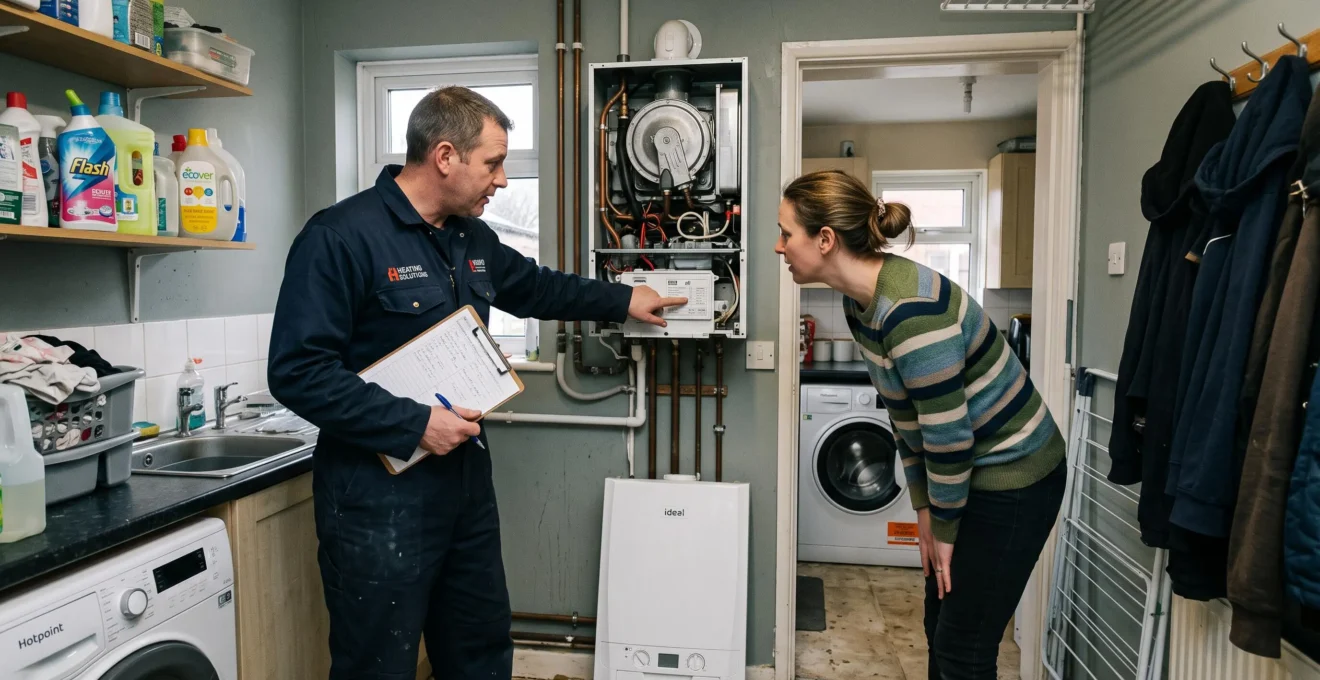
A boiler advertised as “hydrogen-ready” sounds like an obvious way to protect a British home against future changes in energy policy. Keep familiar radiators, avoid a disruptive installation and switch fuels when the gas network changes. The problem is that a compatible appliance does not create a hydrogen supply, and a possible future conversion is not the same as a credible household heating plan.
For a typical UK home, hydrogen heating remains a speculative option rather than a practical alternative to a heat pump or an existing gas boiler. The UK government’s March 2026 position identifies heat pumps and heat networks as the principal routes for decarbonising buildings. It considers domestic hydrogen heating unproven, with any eventual role likely to be limited.
That does not make hydrogen useless. It means homeowners need to separate industrial applications and local demonstrations from the decisions they can actually make: whether to replace an ageing boiler, improve insulation, electrify heating or retain a functioning system while preparing for its replacement.
Hydrogen heating in UK homes: the essential points
- Hydrogen boilers are not a dependable future heating option for ordinary households because supply, conversion and policy approval remain uncertain.
- Heat pumps generally make much more efficient use of electricity, although installation suitability and running costs depend on the property and tariff.
- Boiler condition, heating demand, available space and local infrastructure matter more than a manufacturer’s “hydrogen-ready” label.
- Why Does Hydrogen Usually Deliver Less Useful Heat per kWh Than Direct Electrification?
- How to Spot a Misleading “Hydrogen-Ready” Claim in 5 Minutes?
- Hydrogen Boiler or Heat Pump: Which Fits a Flat With Limited Outdoor Space?
- The Safety Assumption That Makes Hydrogen Sound “Just Like Gas” When It Isn’t
- When Should You Ignore Hydrogen and Upgrade Now Based on Your Boiler’s Age?
- Upgrade Now or Wait: Which Is Smarter if Your Heating System Has 2–5 Years Left?
- Stay on Gas or Electrify Partly: What Cuts Price Risk Faster on a Tight Budget?
- Why Do Fossil Energy Prices Spike So Fast and Hit Households First?
Why Does Hydrogen Usually Deliver Less Useful Heat per kWh Than Direct Electrification?
Hydrogen heating usually delivers less useful warmth from the same renewable electricity because producing, preparing and burning hydrogen introduces successive energy losses. A heat pump instead uses electricity to move existing heat into a building, delivering several units of heat per unit of electricity under suitable conditions. That fundamental difference makes direct electrification considerably more resource-efficient for most homes.
Green hydrogen production starts with electricity driving an electrolyser, which splits water into hydrogen and oxygen. Some electrical energy is lost during this conversion. Additional energy can be required for compression, storage and transport. Finally, a hydrogen boiler burns the resulting fuel to heat water, introducing another conversion loss.
An electric heat pump follows a different physical pathway. Its compressor moves heat from outdoor air, the ground or another suitable source into the heating circuit. Because the electricity powers heat transfer rather than producing all the heat directly, the useful output can exceed the electrical input.
For a household, this efficiency gap has practical consequences. Supplying the same warmth through hydrogen may require substantially more renewable generation and supporting infrastructure. The relevant question is not simply whether hydrogen can be manufactured with low emissions, but how much electricity and infrastructure it consumes compared with available alternatives.
A hydrogen boiler that accepts a blend containing 20% hydrogen by volume does not escape this problem. Blending changes fuel composition, not the basic combustion process. Moreover, hydrogen contributes less energy per unit of volume than natural gas, so a 20% volume blend must not be interpreted as a 20% reduction in energy-related emissions.
Hydrogen may nevertheless prove useful in applications where direct electrification is especially difficult, including certain industrial processes requiring high temperatures. It may also support energy storage and specialised local energy systems. Those applications have different technical and economic requirements from domestic central heating.
The UK government’s hydrogen heating overview places this distinction in policy context: heat pumps and heat networks are the primary approaches, while any domestic hydrogen role is expected to emerge later and remain limited.
“As hydrogen is not yet a proven technology for home heating, a role would come later and likely be limited.”
For a homeowner considering an upgrade, the stronger starting point is therefore the property’s heat demand and suitability for electrification, rather than the theoretical possibility of using hydrogen in an existing-looking boiler.
Efficiency does not settle every installation decision, but it explains why hydrogen faces a substantial disadvantage before running costs or local availability are even considered.
How to Spot a Misleading “Hydrogen-Ready” Claim in 5 Minutes?
To assess a “hydrogen-ready” claim, identify the actual fuel concentration the boiler can use, check the manufacturer’s technical documentation and establish what a future conversion would require. Compatibility with a hydrogen blend is not proof that an appliance can operate on pure hydrogen. Neither capability guarantees that hydrogen will ever become available at your address.
Three descriptions are frequently confused:
- Hydrogen-blend ready: the appliance is designed or confirmed to operate with a specified proportion of hydrogen mixed into natural gas, potentially up to 20% by volume.
- Hydrogen-ready: generally describes a gas appliance intended to be convertible to operation on 100% hydrogen, subject to the manufacturer’s stated design, conversion requirements and applicable approval arrangements.
- Hydrogen-powered: would describe an appliance actually operating on hydrogen. It should not be confused with ordinary domestic gas boilers currently marketed as potentially convertible.
The distinction matters because a boiler’s label concerns an appliance, not a guaranteed future fuel network. Conversion could depend on regional energy policy, network engineering, safety requirements and the availability of a suitable hydrogen supply.
The CMA‘s Worcester Bosch consumer protection case illustrates the risk of overstated marketing. The regulator investigated how boilers compatible with blends containing up to 20% hydrogen were promoted and raised concerns about claims suggesting environmental or future-proofing benefits. The manufacturer subsequently gave formal undertakings concerning its marketing.
The most useful evidence is the exact model documentation. Look for the specified hydrogen concentration, relevant approvals, conversion components, who can perform the work and any conditions attached to that conversion. If the seller cannot identify those documents, the marketing claim should not influence the purchase.
Five checks before paying for a hydrogen-ready boiler
- Photograph or record the full model and product identification number. Deliverable: an unambiguous model reference.
- Obtain the manufacturer’s installation instructions and relevant certification documents. Deliverable: a saved copy showing the applicable fuel specification.
- Ask whether the appliance accepts a hydrogen blend or can be converted to 100% hydrogen. Deliverable: written confirmation stating the supported concentration.
- Request the documented conversion procedure, required parts and any applicable conditions. Deliverable: a manufacturer-backed explanation or written acknowledgement that details remain unresolved.
- Compare a quotation for the proposed model with a suitable conventional alternative. Deliverable: an itemised price difference and a clear statement of what extra capability, if any, is included.
A price premium needs particular scrutiny. The available evidence does not establish a representative premium across the market, and neither a small nor a large additional charge creates a guaranteed future benefit. Any premium should be justified by documented features useful to the purchaser, rather than an uncertain regional conversion.
The next constraint is more immediate: even when an appliance fits physically, the building may offer very different possibilities for electrified heating.
Hydrogen Boiler or Heat Pump: Which Fits a Flat With Limited Outdoor Space?
For a flat with little or no outdoor space, neither a conventional air-source heat pump nor a future hydrogen boiler is automatically the right answer. A hydrogen boiler might fit an existing cupboard, but its fuel supply is uncertain. Electrification may still be possible through alternative heat pump configurations, shared building systems or direct-electric heating, depending on space, demand and permissions.
Most conventional air-source heat pumps require an outdoor unit with adequate airflow, suitable mounting and consideration of noise and access. In blocks of flats, planning requirements, building ownership, lease conditions and communal areas can complicate installation.
A hydrogen boiler seems attractive because it could potentially occupy space already used by a gas boiler. Yet the household cannot simply order a hydrogen supply as it can order an appliance. Distribution networks, rather than individual leaseholders, would determine whether an area could be converted.
There are other options worth investigating before assuming electrification is impossible:
- Compact or high-temperature air-source heat pumps, where an acceptable external installation location exists.
- Exhaust-air heat pumps, where the ventilation design, airflow and building heat demand support their use.
- Communal heating or shared-loop heat pump systems, where building-wide coordination is possible.
- Direct-electric or electric boiler systems, which can reduce equipment-space requirements but generally use more electricity per unit of delivered heat than heat pumps.
A property-specific survey should also consider hot-water storage. Replacing a combi boiler with a heat pump may require cylinder space, although system arrangements differ. A compact unit is not necessarily suitable merely because it physically fits.
The following decision grid highlights the considerations that change the answer.
| Property constraint | Option worth assessing | Main limitation |
|---|---|---|
| Small heat demand and good insulation | Compact heat pump or carefully assessed direct-electric heating | Electricity consumption, installation suitability and hot-water provision |
| No private outdoor area | Shared heat pump or communal heat network | Freeholder involvement, communal infrastructure and collective agreement |
| Limited internal cylinder space | System designs with alternative hot-water arrangements | Available equipment space and adequate hot-water capacity |
| High heat demand and poor insulation | Fabric improvements followed by a detailed heat pump assessment | Emitter sizing, heat losses, permissions and installation cost |
| Existing gas boiler in a rented or leasehold flat | Maintain safe operation while investigating coordinated building options | Landlord, leaseholder or freeholder permissions and network decisions |
Ownership matters as much as hardware. A leaseholder may not control the external wall, roof or courtyard. A tenant may have even less authority to make permanent alterations. Shared systems can overcome individual space restrictions, but only where building stakeholders agree on an appropriate approach.
A hypothetical example makes the distinction clear. A well-insulated flat with modest heat demand but no outdoor installation permission might be a candidate for a building-wide solution. A large, poorly insulated flat with the same space restriction could require substantial fabric and emitter improvements first. Identical floor plans do not imply identical heating requirements.
Where access and ownership prevent an immediate switch, improving the building fabric and coordinating with other residents can still move the decision forward without relying on hydrogen arriving.
The Safety Assumption That Makes Hydrogen Sound “Just Like Gas” When It Isn’t
Hydrogen and natural gas can both be used as combustible fuels, but their safety characteristics are not interchangeable. Hydrogen behaves differently when it leaks, ignites or burns, which affects appliances, pipework, detection and ventilation requirements. This does not mean domestic hydrogen use is inherently impossible; it means safe conversion requires specific engineering controls and regulatory assessment.
Hydrogen molecules are small, and leakage behaviour through particular joints, seals and materials can differ from methane. Its ignition characteristics also differ, while a hydrogen flame can be difficult to see in ordinary daylight.
These properties matter because a system designed for natural gas cannot automatically be assumed suitable for pure hydrogen. Materials, combustion systems, meters, pipework and leak-detection arrangements may need assessment or modification.
Hydrogen is naturally colourless and odourless. Natural gas supplied to UK homes is deliberately odorised to help occupants recognise leaks. A future hydrogen distribution system would require appropriate safety arrangements rather than assuming household smell-based checks remain identical.
A standard domestic carbon monoxide alarm is not a hydrogen leak detector. Carbon monoxide detection remains important where appliances can produce CO, but an alarm designed to detect CO should never be treated as proof that hydrogen cannot be leaking.
The relevant distinction is between a hazard and the controls used to manage it. Hydrogen has an established history of industrial handling, and domestic demonstrations are intended to assess how its risks can be managed in households.
The HSE‘s assessment role in 100% hydrogen heating includes consideration of evidence from the H100 Fife project and wider hydrogen-heating scenarios. Completion of a safety-evidence review should not, however, be interpreted as blanket approval for converting every British home.
H100 Fife: a domestic hydrogen demonstration
The H100 Fife programme is designed around a new hydrogen network serving approximately 300 participating homes. The government describes the project as a geographically limited demonstration involving hydrogen produced through electrolysis using offshore wind electricity.
Its value lies in testing domestic hydrogen systems and associated safety arrangements under defined conditions. Its limited scope does not establish nationwide availability, household affordability or the practicality of converting the existing gas network everywhere.
For a homeowner, the important consequence is that genuine hydrogen conversion would involve coordinated infrastructure and appliance arrangements. It would not be equivalent to changing an energy tariff or modifying a boiler independently.
Until a verified conversion scheme exists, households should follow the safety requirements for their current fuel and equipment. Work on gas appliances must be left to appropriately registered professionals; homeowners should never attempt experimental hydrogen conversion.
The engineering challenge is manageable in principle but substantial in practice, and it reinforces the need to base replacement decisions on systems that can actually be installed and supplied.
When Should You Ignore Hydrogen and Upgrade Now Based on Your Boiler’s Age?
You should generally stop treating future hydrogen availability as a reason to delay when your boiler is unreliable, expensive to maintain or approaching replacement. There is no dependable timetable for widespread domestic hydrogen supply. A household needing heat in the next few winters must therefore choose among available systems, with boiler condition, affordability and property suitability determining the timing.
Boiler age is useful evidence, but it should never be the only test. A well-maintained older boiler may remain serviceable, while a newer unit with recurring faults or unavailable parts may justify earlier replacement.
Use four practical indicators:
- Condition: recurring breakdowns, leaks, abnormal operation or professional safety concerns.
- Repairability: whether suitable replacement parts and competent servicing remain available.
- Cost: the pattern of repair spending relative to a planned replacement.
- Performance: whether heating controls, system design and boiler operation continue to meet household needs efficiently.
A new gas boiler may be the practical choice for a household facing an urgent breakdown and unable to install alternative heating promptly. But that choice continues dependence on gas infrastructure and prices. It can also postpone future electrification, especially if the owner understandably wants to obtain years of service from a recent purchase.
Conversely, replacing a functioning gas boiler early with a heat pump may not be financially justified in every home. Installation costs, available support, emitter upgrades and expected operating performance must all be evaluated.
Insulation and heating controls offer a less speculative route. Reducing heat loss benefits almost any replacement technology, and better controls can improve comfort without presupposing a future hydrogen supply.
Local information deserves attention, but only when it is specific and credible. A network operator’s documented infrastructure proposal or a formal local heating strategy is more relevant than a generic national advertisement. Being near an industrial hydrogen project does not itself establish that domestic conversion will occur.
A sensible replacement quotation should therefore include the options available now and an explanation of why each is suitable. Homeowners can ask for heat-loss calculations and emitter assessments before ruling out a heat pump.
When the system still has several years of reliable service ahead, those years are more valuable as preparation time than as an indefinite bet on hydrogen.
Upgrade Now or Wait: Which Is Smarter if Your Heating System Has 2–5 Years Left?
If your heating system probably has two to five years of useful life remaining, the strongest approach is usually to prepare for replacement without necessarily replacing it immediately. Insulation, heat-loss assessment, radiator checks and installation planning preserve options. Waiting becomes risky only when it means postponing every decision until a breakdown forces an emergency purchase.
Begin by establishing what a suitable replacement would actually involve. A room-by-room heat-loss assessment can show whether existing radiators could work with lower heating-water temperatures or whether selected emitters need upgrading.
Next, assess the building fabric. Draught-proofing, appropriate insulation and improved controls can reduce demand regardless of the eventual heat source. Hot-water storage deserves separate consideration, particularly where a combi boiler currently supplies hot water without a cylinder.
The financial question is whether extending the existing system remains worthwhile. Keep a record of annual servicing, repairs, parts replacement and any unexplained change in energy use. Compare the likely additional repair expenditure with the costs and benefits of replacing the system on a planned schedule.
Do not count an expensive repair as automatically wasteful: a repair that restores several years of safe, efficient service can sometimes be economical. Equally, repeated repairs may become poor value when failure risk and reduced reliability are taken into account.
A planned replacement also gives time to investigate heat pump quotations, property permissions, installer availability and eligibility for financial support, including the Boiler Upgrade Scheme where applicable. Eligibility and funding conditions must be checked at the time of application rather than assumed in advance.
Hydrogen policy announcements may be worth monitoring, but they should be treated as decision evidence only when they specify an actual local pathway and credible implementation arrangements. A trial, consultation or proposed blending policy is not a commitment to supply a particular household with pure hydrogen.
The major avoidable problem is emergency replacement during a cold spell. Under time pressure, households often have fewer practical choices because building work, equipment selection and any necessary permissions cannot be organised immediately.
Preparing while the boiler still works gives the household time to choose an appropriate technology, rather than allowing the date of the next breakdown to make the decision.
Stay on Gas or Electrify Partly: What Cuts Price Risk Faster on a Tight Budget?
For a household on a tight budget, reducing heat demand is often the most accessible first move, while partial electrification can reduce gas dependence where equipment costs and electricity tariffs make sense. However, switching energy sources does not automatically reduce bills. The financial result depends on gas and electricity prices, appliance efficiency, installation costs and how the household uses heat.
UK households face two related risks. Natural gas prices respond to international fuel markets, while electricity prices can also be influenced by gas-fired generation. Electrification therefore reduces direct gas consumption but does not necessarily eliminate exposure to gas-related price movements.
The immediate opportunity is to spend money where savings do not depend on predicting future fuel prices. Suitable draught-proofing, heating controls and targeted insulation reduce energy requirements under both gas and electric systems.
After those improvements, a heat pump can be assessed against the property’s actual heat demand. Its running-cost competitiveness depends on the electricity-to-gas unit-price ratio and the seasonal performance achieved in the home.
Ofgem‘s published average Direct Debit unit rates for Great Britain from October to December 2026 provide a useful comparison, although actual rates vary by region, meter and tariff.
3.30:1
The approximate electricity-to-gas unit-price ratio calculated from October–December 2026 average rates of 26.32p/kWh electricity and 7.97p/kWh gas. These are unit rates, not delivered-heat costs; the published electricity rate excludes VAT for this period, while the gas figure includes 5% VAT.
Ofgem’s energy price cap unit rates, October–December 2026.
The comparison becomes more meaningful when converted into useful heat. For a boiler, divide the gas unit price by its actual seasonal efficiency. For a heat pump, divide the electricity unit price by its achieved seasonal coefficient of performance, commonly expressed as SCOP.
Consider an explicitly hypothetical example using those published average unit prices, an assumed boiler efficiency of 90% and a heat pump SCOP of 3.5. Delivered heat would cost approximately 8.86p/kWh from gas and 7.52p/kWh from the heat pump. At a SCOP of 3.0, the heat pump figure would rise to approximately 8.77p/kWh.
These figures illustrate sensitivity to performance rather than predicting anyone’s bill. They exclude installation, servicing and fixed charges and retain the VAT treatment of the published rates. A heat pump with an unsuitable system design or less favourable electricity tariff may not produce the assumed savings.
Time-of-use electricity tariffs can improve the economics where heating or hot-water production can shift to cheaper periods without compromising comfort. The benefit depends on the tariff and the home’s ability to store or schedule heat; expensive peak electricity can undermine savings if demand cannot move.
On a limited budget, the order of expenditure matters more than committing immediately to complete electrification. Address affordable heat losses, optimise existing controls, assess likely future heating demand and then compare available replacement options using real quotations.
Even a carefully designed heating system cannot eliminate every energy-price shock, making the structure of UK gas and electricity pricing important to the final decision.
What matters before choosing your next heating system
- Compare the cost of delivered heat, not just the headline price of a gas or electricity unit.
- Separate immediate savings from protection against future price volatility; the cheapest tariff today is not necessarily the least exposed to later shocks.
- Assess whether your household can lower total energy demand before committing capital to a new fuel or appliance.
Why Do Fossil Energy Prices Spike So Fast and Hit Households First?
Fossil energy prices can rise rapidly because global supply disruptions affect internationally traded fuels, including the gas purchased by the UK. Households then experience these increases through retail tariffs as suppliers’ costs feed into pricing arrangements. Electrification can reduce direct exposure to gas, but its protection is incomplete while gas continues to influence electricity prices.
The UK produces some domestic natural gas but also depends on imports. When international wholesale markets tighten, domestic production does not automatically shield consumers from wider market prices. Import costs and competing demand for available supplies can influence the price paid by suppliers.
Gas storage, supply contracts and market conditions affect how shocks are transmitted. A disruption may involve geopolitical events, production problems, transport restrictions or unusual demand. None guarantees a specific retail price movement, but all can influence wholesale fuel costs.
For households on standard variable tariffs, Ofgem’s energy price cap provides a regulated framework for unit rates and standing charges. The cap is updated periodically, rather than changing instantly whenever wholesale prices move. This creates a delay between wholesale-market developments and the rates many domestic customers pay.
The price cap also does not impose a fixed maximum total household bill. A home using more energy generally pays more through its variable consumption charges.
Electric heating changes the exposure rather than automatically removing it. Gas-fired generation can influence wholesale electricity prices, so a household using a heat pump remains affected by the wider electricity market. Nevertheless, a sufficiently efficient heat pump requires much less purchased electricity per unit of useful heat than direct resistance heating.
As the electricity system incorporates more renewable generation, storage and flexibility, the potential exists to reduce dependence on gas for power generation. How quickly households benefit also depends on tariff design, infrastructure costs and electricity-market arrangements.
Hydrogen does not inherently eliminate fossil-fuel price risk. Hydrogen produced from natural gas remains exposed to the cost of its feedstock. Hydrogen produced using renewable electricity avoids that particular feedstock dependency but still faces electricity, infrastructure, storage and delivery costs.
Homeowners can conduct a simple exposure test using their bills. Separate variable energy charges from standing charges, calculate annual gas and electricity consumption, then estimate how a hypothetical increase in each unit price would affect annual spending. This reveals which parts of the bill respond directly to usage and price changes.
For example, a hypothetical household using 10,000 kWh of gas annually would face an additional £100 in variable charges if its gas unit rate rose by 1p/kWh and consumption remained constant. The illustration excludes any changes to standing charges, VAT treatment or consumption behaviour.
Lowering heating demand reduces the number of units exposed to future price changes regardless of the energy source. Switching to a well-performing heat pump can add a further benefit by reducing direct reliance on purchased gas, although the financial outcome still depends on electricity prices.
Before replacing a boiler, obtain a property-specific heat-loss assessment, compare realistic lifetime costs and check credible local infrastructure plans. Treat hydrogen compatibility as a documented appliance characteristic, not a reason to postpone an otherwise necessary heating decision.
Can an existing natural gas boiler be converted to run on 100% hydrogen?
Not unless the particular appliance is designed and approved for an appropriate conversion, with a documented manufacturer procedure and suitable infrastructure. Compatibility with a hydrogen blend does not demonstrate suitability for pure hydrogen. Any conversion would require qualified professionals and the relevant network and safety arrangements.
Will a hydrogen-ready boiler increase the value of my home?
There is no evidence in the supplied sources establishing a typical property-value premium for a hydrogen-ready boiler. Its future usefulness depends on whether a suitable hydrogen supply and conversion process ever become available. Buyers should not assume that a marketing label translates into a measurable increase in resale value.
Can solar panels make a heat pump cheaper to run?
They can reduce purchased electricity when on-site solar generation coincides with heat pump demand. However, winter heating requirements and seasonal solar output do not always align. Savings depend on the installation, consumption patterns, tariff and any electricity storage arrangements. A household-specific energy model is preferable to assuming that rooftop solar will cover most winter heating.
Should homeowners disconnect their gas supply after installing a heat pump?
That depends on whether any other appliances still use gas. If the household becomes entirely electric, removing an unnecessary gas supply may avoid future gas standing charges, subject to the supplier’s and network operator’s arrangements. Disconnecting a supply and modifying gas pipework must be handled through the appropriate authorised procedures, not as a DIY task.
Does living near a hydrogen production facility mean domestic hydrogen heating is coming?
No. Industrial hydrogen production does not establish that the local residential network will be converted. Domestic supply would require specific distribution infrastructure, approved safety arrangements, suitable appliances and a credible implementation plan. Homeowners should seek an explicit local network proposal rather than infer availability from proximity to a hydrogen project.