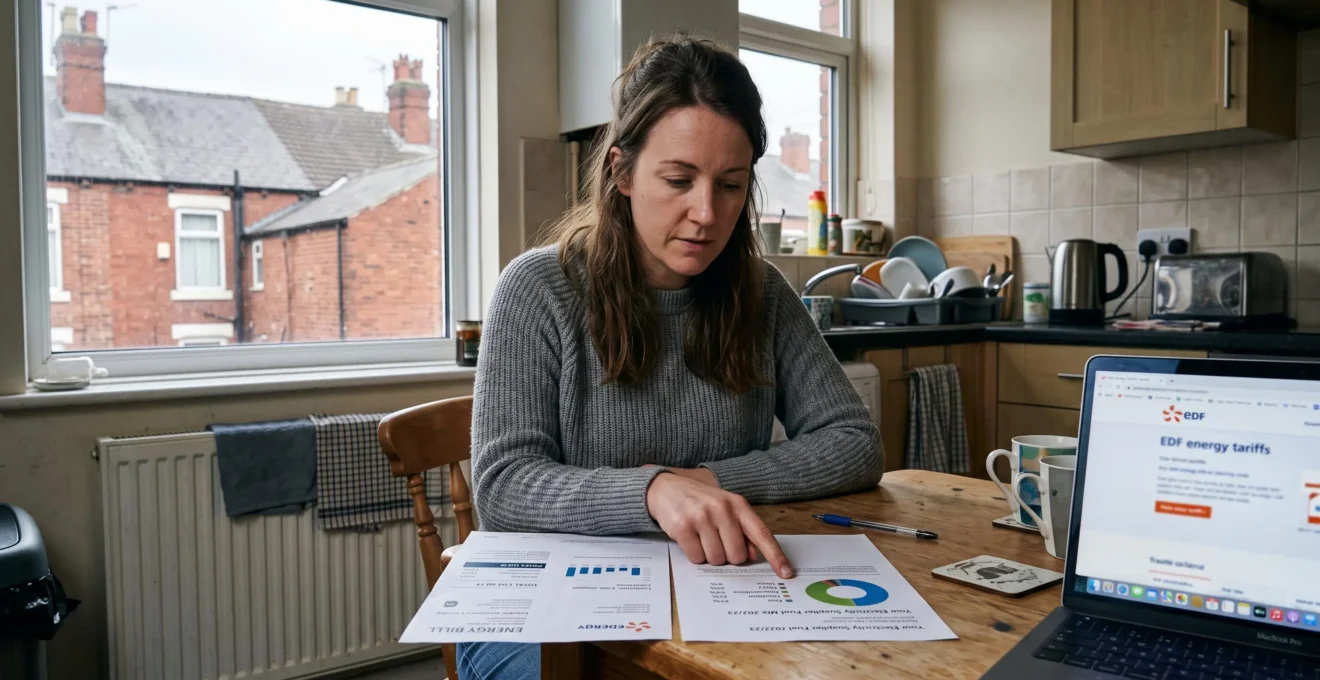
Not having a suitable roof for solar panels does not prevent a UK household from supporting renewable electricity or reducing its energy-related carbon footprint. It does, however, change which options are practical and what each choice can achieve.
For renters, switching electricity tariffs may be the simplest starting point. Flat owners can consider community energy projects that finance generation away from their buildings. Homeowners with unsuitable roofs may achieve more through insulation, heating improvements or a heat pump than through changes to their electricity supply alone.
The important distinction is between buying electricity marketed as renewable, helping to finance additional renewable generation, and physically reducing energy consumption or emissions. These are different outcomes, even when suppliers describe them using similar environmental language.
The most sensible option depends on who controls the property, how it is heated, the available budget, and whether the priority is flexibility, measurable environmental impact or long-term investment.
Green energy without rooftop solar: the essentials
- Renters: Compare renewable electricity tariffs, but prioritise energy-saving actions you can control without permanent alterations.
- Flat owners: Consider community renewable projects if you want to help finance physical generation rather than rely only on certificate-backed electricity claims.
- Homeowners: Assess heating, insulation and renewable electricity together. The most effective combination depends on the property’s existing energy systems.
- Why Can “100% Renewable Electricity” Still Feel Confusing on the UK Grid?
- How to Choose a Green Energy Option if You Rent and Can’t Alter the Property?
- Green Tariff or Community Solar: Which Has More Real Impact for Flat Owners?
- The Low-Impact “Green Add-On” That Looks Good but Changes Almost Nothing
- When Should You Switch to a Green Tariff if You’re Mid-Contract?
- How to Compare Two Low-Carbon Options Using a 5-Point Boundary Checklist?
- Solar, Heat Pump, Biomass, or Green Tariff: What Fits a Rural UK Home Best?
- Which “Sustainable Energy Source” Actually Cuts Your Footprint Without Hidden Trade-Offs?
Why Can “100% Renewable Electricity” Still Feel Confusing on the UK Grid?
A UK electricity tariff can be advertised as 100% renewable even though the electricity entering your home comes from the shared grid, which carries power generated from multiple sources. The renewable claim commonly reflects an annual certificate-matching process rather than a separate physical delivery of renewable electricity. Understanding that distinction helps households assess what their payments actually support.
In Great Britain, Renewable Energy Guarantees of Origin (REGOs) provide evidence that eligible electricity has been generated from renewable sources. Suppliers can use these certificates in their annual fuel mix disclosure to substantiate renewable electricity claims.
Under Ofgem’s Fuel Mix Disclosure requirements, suppliers disclose their generation fuel mix annually. The disclosure period runs from 1 April to 31 March, with relevant information due by 1 October.
This system accounts for electricity generation and supply over a reporting period. It does not identify which generator supplied an individual household at a particular moment.
Two electricity tariffs carrying the same renewable label may therefore represent different approaches:
| Tariff approach | What supports the claim | What needs verification |
|---|---|---|
| REGO-backed tariff | Renewable generation certificates used for electricity accounting | Whether the arrangement supports additional renewable investment |
| Tariff linked to power purchase agreements | Contractual purchases from renewable generators | Contract duration, project details and evidence of new capacity support |
| Tariff with a renewable investment commitment | Supplier funding or investment arrangements | Which projects receive funding and what outcomes are documented |
A power purchase agreement can provide revenue certainty to a renewable generator, but its existence alone does not prove that a particular power station would otherwise never have been built. The terms and financing context matter.
To assess a supplier, start with its published fuel mix disclosure, then examine the projects or contracts behind its renewable claims. Independent tariff assessments may provide additional context, although their methodology, independence and publication date should be checked.
Ofgem also makes certificate and generating-station information available through its public REGO reports and data. These records help establish what certificates exist, but do not independently prove additional renewable capacity.
Even a credible renewable tariff does not change the physical grid mix at the moment you switch on an appliance. Shifting flexible electricity use towards periods of abundant renewable generation addresses a different aspect of the problem: when electricity is consumed.
Renewable electricity accounting is useful, but it becomes more meaningful when the supplier can explain the projects, contracts and investment mechanisms behind its claims.
How to Choose a Green Energy Option if You Rent and Can’t Alter the Property?
If you rent in the UK and cannot make permanent property alterations, start with changes that are within your control: choosing an electricity tariff when you pay the supplier directly, understanding your energy consumption and using removable efficiency measures. Larger building improvements usually require landlord involvement, so the best option is often the one that remains practical throughout your tenancy.
Renters have three broad levels of control over their energy choices.
- Account-level changes: Comparing suppliers, choosing tariffs and reviewing billing arrangements when the tenant holds the energy account.
- Portable or removable measures: Plug-in energy monitors, suitable smart plugs, removable draught-proofing and certain radiator reflectors.
- Permission-dependent improvements: Permanent heating installations, external equipment, electrical modifications and changes to windows or building fabric.
According to Ofgem’s home energy supplier switching guidance, tenants responsible for paying their energy bills can generally choose to switch supplier or tariff. They should still check their tenancy agreement for notification requirements or default-supplier provisions.
When bills are included in rent and the landlord controls the energy account, the tenant may not be able to switch independently. Prepayment arrangements can also affect tariff availability and the practical switching process.
The following decision grid helps match common rental restrictions to realistic actions.
| Rental situation | Practical starting point | Important limitation |
|---|---|---|
| Tenant pays energy supplier directly | Compare tariffs and renewable supply evidence | Check contract terms and available payment arrangements |
| Prepayment meter | Compare compatible tariffs and meter arrangements | Not every tariff or payment method will be available |
| Short tenancy | Use portable monitoring and removable efficiency measures | Avoid investments that depend on long occupancy |
| Poor energy performance with no permission for works | Track heating consumption and request targeted landlord improvements | Major fabric and heating changes remain outside tenant control |
| Energy bills included in rent | Ask the landlord about supply and building efficiency | Direct tariff switching may not be available |
Before purchasing portable equipment, consider whether it is appropriate for the specific appliance and installation. Smart plugs, for example, should not be used to control high-power heating equipment unless they are explicitly rated and suitable for that use.
There is also a limit to what a tariff change can achieve. If a rented property loses substantial heat, its heating demand remains high regardless of how the electricity supplier describes its generation mix.
Reviewing heating schedules, identifying unnecessary appliance consumption and discussing property improvements with the landlord may therefore offer more direct opportunities to reduce energy use.
A green tariff is associated with the customer’s supply account, but moving home does not guarantee that the same tariff and prices will transfer unchanged. The supplier may need to establish a new arrangement for the next property.
The strongest renter strategy combines freedom of supplier choice, where available, with realistic consumption improvements that do not depend on owning the building.
Green Tariff or Community Solar: Which Has More Real Impact for Flat Owners?
For flat owners without individual roof access, a green tariff and community solar project achieve different things. A tariff can support renewable electricity purchasing arrangements, while community solar can provide capital for physical generating assets. A credible project that enables additional renewable capacity may offer a more direct investment connection, although neither option automatically guarantees a particular emissions reduction.
A tariff is generally simple to adopt and reverse. It changes the commercial arrangements associated with the household’s electricity consumption without requiring rooftop access, planning approval or property alterations.
Community energy takes a different approach. Residents may invest in, become members of or otherwise support an organisation developing renewable generation. Depending on the scheme, the electricity might supply a local building or be exported to the wider network.
The output depends on the project’s installed capacity, operating conditions and actual generation. It should be assessed through documented project information, not just the existence of a solar installation.
The comparison becomes clearer when assessed against practical household priorities.
| Decision factor | Green electricity tariff | Community solar |
|---|---|---|
| Initial commitment | Usually a supply contract | May involve capital investment or membership |
| Physical renewable asset | Not necessarily financed by the tariff | Typically central to the project |
| Flexibility | Relatively straightforward to change, subject to contract terms | Withdrawal or share repayment may be restricted |
| Evidence of impact | Generation claims, certificates and contracts | Project financing, capacity and generation records |
| Potential financial outcome | Household electricity costs | Possible member returns, subject to project terms and risks |
For a community scheme, check the organisation’s registration, governance and published reporting. A Community Benefit Society may provide a recognisable structure, but that registration does not guarantee investment performance.
Ask whether the proposed project is operational, under construction or still seeking finance. Examine how the capital will be used, whether electricity generation is reported, how surpluses benefit the community, and what restrictions apply to withdrawing an investment.
Community shares should not be treated like an instant-access savings account. Capital may be at risk, expected returns may not materialise, and the ability to withdraw funds may depend on organisational rules and available resources.
A flat owner does not necessarily need to choose one mechanism exclusively. A well-supported renewable tariff can sit alongside participation in a credible community energy project, provided the household can afford the additional commitment.
For households without roof ownership, community energy can create a route into renewable generation, but the financial and environmental credibility of the specific project remains decisive.
The Low-Impact “Green Add-On” That Looks Good but Changes Almost Nothing
The least useful green energy add-ons are those that charge a premium without demonstrating changes in electricity generation, energy consumption or measurable environmental outcomes. Examples can include loosely documented carbon offsets, tree-planting promotions and eco-labelled extras without a clear funding mechanism. Their value depends on verifiable results, not how prominently the environmental message appears on a bill.
An optional charge might promise to support environmental activity without changing the household’s electricity supply or the property’s energy demand. That does not mean every offset or tree-planting scheme is worthless. It means the claimed benefit must be assessed separately from the marketing language.
Two questions reveal the difference:
- What changes? Does the payment reduce energy demand, support measurable renewable generation or finance another clearly identified environmental outcome?
- What proves it? Is there documented evidence of the funded activity, its monitoring arrangements and the result attributed to the payment?
Consider a hypothetical household offered an optional environmental add-on for an extra monthly charge. Instead of assuming that the premium reduces electricity-related emissions, the household can compare it with spending the same amount on suitable draught-proofing, monitoring equipment or community energy participation.
These alternatives are not automatically superior. Their usefulness depends on the property’s condition, equipment suitability, the project’s credibility and the ability to measure any resulting change.
The point is to make the opportunity cost visible: money allocated to an unverifiable environmental claim cannot simultaneously fund a practical energy improvement.
There is also a behavioural risk. A household that believes a green subscription has already addressed its environmental impact may pay less attention to heating demand, inefficient equipment or other significant sources of energy consumption.
Before buying an add-on, ask the provider to explain exactly where the money goes, whether the activity would otherwise have occurred, and how the result is measured. If the answer remains vague, the environmental benefit is uncertain.
Spending less on a poorly evidenced claim can leave room for a more transparent and suitable action, even when that action is modest.
When Should You Switch to a Green Tariff if You’re Mid-Contract?
Switching to a green electricity tariff during a fixed contract makes sense when the new arrangement justifies any exit fee and price difference. In Great Britain, a regulatory switching window has allowed customers to leave fixed-term deals without exit fees during their final 49 days. Before changing supplier, verify the applicable terms and compare the total financial consequences.
Ofgem documented this 49-day rule in its regulatory statement on the 49-day switching window, published in December 2017. Because that document concerns historical compliance cases, customers should confirm the current requirements and their supplier’s contractual terms before relying on the window.
A practical switching decision starts with the existing contract rather than the new tariff advertisement.
- Find the fixed tariff’s end date and any applicable exit fee.
- Check whether the proposed switch falls within an exit-fee-free period.
- Obtain a comparison based on your actual consumption and payment arrangements.
- Compare the expected remaining cost of the current tariff with the new tariff and any switching charges.
- Assess the environmental evidence behind the proposed tariff before committing.
The financial comparison should consider both unit rates and standing charges. A tariff with a lower electricity unit rate is not necessarily cheaper overall if its standing charge is higher or if other terms differ.
Hypothetical example: should a household switch early?
Suppose a household has six months remaining on its fixed electricity tariff. The existing supplier would charge a hypothetical £50 exit fee, while the proposed tariff is expected to cost £6 less per month at the household’s assumed consumption.
Over six months, the illustrative bill saving would be £36. After the hypothetical £50 exit fee, the household would be £14 worse off during that period. These figures are purely illustrative, not current tariff prices or an estimate of typical savings.
The example shows why a lower advertised rate does not automatically justify immediate switching. The household must also decide how much it values the environmental characteristics of the new tariff.
Timing matters because a tariff change affects future purchases. Nevertheless, the environmental benefit of switching sooner cannot be calculated simply from the number of months brought forward: it depends on what the new tariff actually supports.
Customers approaching the end of a fixed deal should also review what happens after expiry. A fixed price period may finish without the energy supply itself stopping, and the replacement tariff may be less attractive.
Recording the contract end date and reviewing alternative offers in advance reduces the chance of drifting onto an unsuitable arrangement.
The best switching date is the one that balances contractual cost, tariff quality and the household’s environmental priorities, rather than assuming an immediate green switch is always worthwhile.
How to Compare Two Low-Carbon Options Using a 5-Point Boundary Checklist?
To compare two low-carbon energy options fairly, examine what each changes, how long its effects last, whether the decision can be reversed, who benefits and what evidence supports the environmental claim. These five boundaries prevent misleading comparisons between certificate-backed electricity purchasing, physical heating improvements and investments in renewable infrastructure.
A renewable tariff and a heat pump, for example, operate on different parts of a household’s energy footprint. One influences electricity purchasing arrangements; the other changes how heat is produced inside the property.
Comparing their advertised carbon benefits directly without defining the relevant boundaries can give a misleading result.
| Boundary | Green electricity tariff | Heat pump subscription |
|---|---|---|
| 1. What changes? | Electricity purchasing and renewable supply claims | Physical heating equipment and its energy consumption |
| 2. Time horizon | Ongoing while the tariff arrangement applies | Installation and operating period, subject to subscription terms |
| 3. Reversibility | Generally easier to reverse, with possible contractual costs | Equipment and property changes can be harder to reverse |
| 4. Who benefits? | Household, supplier and potentially renewable generators | Occupants, property owner and equipment provider |
| 5. Evidence | Fuel mix disclosures, certificates and generation contracts | Installation design, metered energy use and heating performance |
For a renter with uncertain housing arrangements, reversibility may be essential. A tariff change might therefore be more suitable even when a heating upgrade could produce a more substantial physical change.
For an owner-occupier planning to stay for many years, a heating improvement may be more attractive, particularly when replacing a carbon-intensive system. Performance still depends on the property’s heat demand, installation quality and ongoing operation.
A heat pump subscription also introduces questions that an outright equipment purchase may not raise: ownership, maintenance responsibilities, contract duration and what happens when the subscription ends.
There is no universal carbon score that resolves all these questions. Annual certificate matching and estimated lifetime heating emissions are measurements of different activities. A valid emissions comparison needs consistent assumptions, including the energy source displaced, the relevant period and the measurement method.
Create your five-point green energy comparison sheet
- Define the change: Write one sentence describing what each option physically or contractually changes. Deliverable: two clearly defined option descriptions.
- Set the time boundary: Record the expected contract or operating period for both options. Deliverable: a comparison timeline with any unknown dates marked.
- Check reversibility: Identify cancellation terms, removable equipment and permanent property alterations. Deliverable: a list of commitments and exit conditions.
- Map the beneficiaries: Identify who receives financial, operational or community benefits. Deliverable: a stakeholder list for each option.
- Audit the evidence: Collect supplier disclosures, installation specifications or project performance records and mark unsupported claims. Deliverable: a two-column evidence register.
Once the sheet is complete, compare the options according to your actual constraints rather than adding the five categories into an arbitrary numerical score. Some boundaries will matter more than others, and a single non-negotiable restriction may rule out an otherwise attractive choice.
The most useful comparison is not simply which option sounds greener, but which offers a credible, measurable and practical improvement within the household’s circumstances.
Solar, Heat Pump, Biomass, or Green Tariff: What Fits a Rural UK Home Best?
For a rural UK home, the most suitable green energy option depends heavily on its existing heating system, insulation, available space and planning constraints. A property heated with oil or LPG faces different decisions from an electrically heated home. Heat pumps, solar generation, biomass and renewable tariffs address different energy needs, so they should be assessed as parts of a wider household strategy.
Rural properties outside the mains gas network may depend on delivered heating fuels. In such homes, changing electricity supplier does not directly replace the emissions associated with burning fuel for space heating or hot water.
That makes the existing heating system a useful starting point.
A heat pump can replace combustion-based heating with electrically driven heating, but its suitability depends on careful design. Heat loss, distribution systems, radiator capacity and operating temperatures all influence performance.
Solar photovoltaic panels can generate electricity at the property, but roof condition, orientation, shading and ownership may limit installation. Suitable ground-mounted systems may be another possibility where land, electrical infrastructure and planning requirements allow.
Biomass heating can provide substantial heat output, although it introduces requirements around sustainable fuel sourcing, storage, deliveries, combustion emissions, maintenance and an appropriate flue.
A green tariff requires no renewable generation equipment at the property, making it accessible in many situations, but it does not directly improve an inefficient heating system.
| Option | Installation requirements | Costs and practical constraints |
|---|---|---|
| Solar PV | Suitable roof or ground space, electrical connection and any required approvals | Initial equipment cost; performance depends on installation conditions and electricity use |
| Heat pump | Suitable heating design, equipment location and potentially changes to heat distribution | Installation cost and running economics depend on heat demand, efficiency and energy prices |
| Biomass heating | Fuel storage, suitable boiler location, flue and fuel delivery access | Fuel availability, maintenance, emissions controls and storage requirements |
| Green electricity tariff | Compatible electricity supply and tariff arrangement | Tariff prices, contract terms and quality of renewable supply evidence |
Investment sequencing can be as important as the equipment choice. Understanding the building’s heat losses and improving appropriate insulation or controls can make it easier to specify an efficient heating system.
However, a heat pump does not necessarily require every conceivable insulation upgrade before installation. The relevant question is whether the planned system can meet the property’s heating needs efficiently and comfortably under realistic conditions.
Listed buildings and properties in conservation areas may require additional scrutiny. Some alterations may be restricted or subject to consent, and the applicable requirements depend on the location and proposed works.
Owners should discuss constraints with their local planning authority and obtain an appropriately detailed installation assessment before committing to physical changes. Grant eligibility and installation rules should also be verified for the relevant UK nation rather than assumed to be uniform.
For many rural homes, understanding and addressing heating demand is a more useful first investment decision than choosing renewable electricity technology in isolation.
Key takeaways before making your choice
- Compare green energy claims against the system or fuel they actually replace; benefits measured on different boundaries should not be treated as interchangeable.
- Prioritise actions you can legally, financially and practically implement rather than chasing the technology with the strongest marketing claim.
- Look for evidence of physical improvements, credible additional generation or independently understandable energy outcomes before committing money.
Which “Sustainable Energy Source” Actually Cuts Your Footprint Without Hidden Trade-Offs?
No sustainable energy source is entirely free of environmental trade-offs. The most credible household choice is one that reduces a relevant source of emissions while making its wider impacts and limitations clear. For UK households without rooftop solar, that may mean combining verifiable renewable electricity purchasing, reduced heating demand and appropriate participation in community energy projects.
The first step is to distinguish energy production from household consumption. Wind, solar, hydroelectricity and biomass can all contribute to energy supply, but their environmental effects depend on how projects are developed, operated and accounted for.
Wind and solar installations require materials, manufacturing and suitable sites. Their overall impacts depend partly on manufacturing processes, equipment life and land use.
Hydropower can provide renewable electricity, but individual projects may affect river ecosystems and water flows. These consequences depend on location, design and operation.
Biomass requires particular care because the origin of the fuel, land management, transport, combustion emissions and carbon accounting assumptions all affect its environmental credibility. A renewable classification alone does not establish that every biomass supply chain has the same climate impact.
For household decisions, three questions help uncover hidden trade-offs:
- What does the option displace? Identify the electricity, fuel or energy demand being replaced rather than relying on a generic carbon-saving claim.
- Who bears the wider costs? Consider land use, material extraction, local environmental effects and the financial obligations attached to the project.
- How is the outcome measured? Look for transparent boundaries, operational evidence and assumptions that can be independently understood.
The relevant priority also varies between homes. A household using substantial quantities of fossil fuel for heating may have more direct scope to change its emissions through heating improvements than through electricity procurement alone.
By contrast, an all-electric household with an efficient building may find that responsible electricity consumption, tariff quality and the timing of demand deserve greater attention.
A flat owner without control over communal heating may have fewer options for physical improvements, making community energy participation or tariff selection relatively more practical.
The three most accessible approaches without suitable roof space can therefore work together rather than compete:
- Choose credible renewable electricity arrangements: Look beyond REGO matching where possible and assess evidence of meaningful renewable procurement or investment.
- Reduce avoidable heating demand: Use suitable controls, maintenance and property improvements according to ownership and permission constraints.
- Support physical renewable capacity: Consider credible community energy participation when the project, investment risks and personal finances make it appropriate.
Not every household needs all three. A renter on a short tenancy may reasonably focus on tariff choice and removable efficiency improvements. An owner-occupier may have stronger reasons to invest in heating infrastructure. Someone with spare capital and limited property control may prefer community energy involvement.
Evidence quality matters throughout. A measurable reduction in energy use is not the same as an estimated reduction in carbon emissions. Likewise, a renewable generation certificate does not by itself demonstrate that new generating capacity was financed.
The practical next step: Review your most recent energy bill, identify how your home is heated and note which property changes you can authorise. Then compare one credible electricity option with one realistic energy-demand improvement, using documented costs and evidence rather than marketing claims alone.
Can I use renewable electricity if my home does not have solar panels?
Yes. Households connected to the electricity grid can consider renewable electricity tariffs without installing generation equipment. The important distinction is that a tariff’s renewable claim usually concerns electricity procurement and accounting rather than separate physical delivery to the property. Supplier disclosures and evidence of generation investment help assess the claim.
Does joining a community solar project reduce my electricity bill?
Not necessarily. A community energy investment may support a generating project without changing your domestic electricity tariff or directly reducing your bill. Any financial returns, bill benefits or member payments depend on the specific scheme. Check its published terms rather than assuming that owning community shares entitles you to free or discounted electricity.
Can a tenant ask the landlord to install a heat pump?
Yes. A tenant can propose a heating upgrade and explain how it may affect running costs, comfort and building performance. However, permanent installation generally requires the relevant property owner’s agreement and an appropriate technical assessment. Whether it is suitable depends on the existing system, building characteristics and any applicable property restrictions.
Is a smart meter the same as a renewable energy system?
No. A smart meter measures energy use and communicates readings; it does not generate renewable electricity or make the energy supply renewable. Its information can help households understand consumption patterns and evaluate suitable tariff arrangements, but any savings depend on subsequent decisions and changes in energy use.
What should I check before paying extra for a green electricity tariff?
Compare the unit rate, standing charge, contract duration and applicable exit fees. Then examine the supplier’s fuel mix disclosure and supporting renewable electricity arrangements. A higher price does not automatically mean greater environmental impact. Ask for evidence of the projects, contracts or investments behind the premium and assess whether those benefits justify the additional cost.