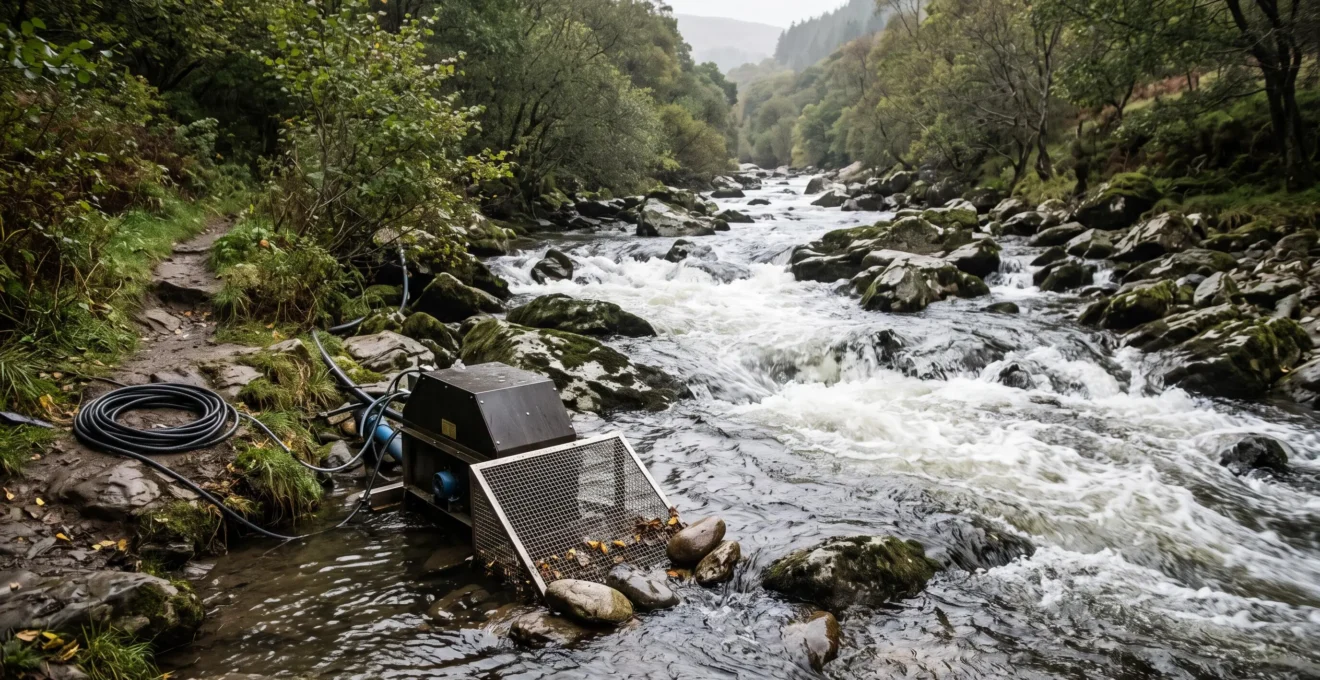
A river can rush over rocks, create impressive white water and still offer surprisingly little usable electricity. The reason is straightforward: water speed alone does not determine hydropower output. A generator needs sufficient energy passing through its turbine, a suitable operating environment and a system capable of converting that energy efficiently.
For conventional hydropower, available power depends primarily on water flow rate and vertical drop, known as head. For turbines operating directly in moving water, current speed matters greatly, but so do rotor area, flow direction and extraction efficiency. A fast-moving surface may conceal a shallow channel, irregular underwater currents or a limited volume of usable water.
These distinctions matter when assessing a river beside a UK property, comparing potential micro-hydro locations or considering tidal-stream generation. They explain why a visually dramatic current can disappoint while a less striking, more consistent water source supports a better installation.
Understanding the physical limits before considering equipment, permissions or costs makes it possible to distinguish an attractive watercourse from a genuinely useful energy resource.
Fast water and usable hydropower: the essentials
- Speed is only one variable. Water volume, available head, turbine swept area and conversion efficiency determine how much power can be captured.
- Flow quality matters. Directional changes, uneven velocity and turbulence can complicate turbine operation, even where visible currents are strong.
- Long-term conditions decide feasibility. Seasonal flow, ecological restrictions and legal permissions can matter more than a single impressive current measurement.
- Why Can Turbulent Water Cut Turbine Efficiency Even When Speed Looks High?
- How to Compare Two River Spots for Energy Potential Without Specialist Instruments?
- Tidal Stream vs River Current: Which Is More Predictable Over 30 Days?
- The Constraint That Stops Most Water-Current Energy Ideas Before They Start
- When Should You Measure Water Currents to Avoid a One-Off “Flood Week” Bias?
- How to Estimate Hydropower Output Using Only Head and Flow in 5 Minutes?
- How to Shortlist Renewables for Your Home Using 5 Site Questions?
- Which Renewable Energy Source Works Best for UK Homes With Limited Roof Space?
Why Can Turbulent Water Cut Turbine Efficiency Even When Speed Looks High?
Turbulent water can reduce turbine performance when its direction and velocity fluctuate in ways that interfere with efficient energy extraction. Although faster currents contain more kinetic energy, a turbine cannot necessarily capture that energy consistently. The consequences depend on rotor design, flow alignment, turbulence characteristics and operating conditions; turbulence does not automatically reduce efficiency in every installation.
A turbine converts energy by allowing moving water to exert forces on its blades. It performs best when the incoming flow resembles the conditions for which its rotor and control system were designed. If the current repeatedly changes direction, the effective angle at which water strikes the blades changes too.
These variations can produce uneven loading, fluctuating torque and additional mechanical stresses. In some installations, unsteady conditions also increase vibration or contribute to unfavourable pressure behaviour. Cavitation is possible in susceptible turbine designs when local pressure falls sufficiently, but it should not be assumed simply because a river looks turbulent.
Flow misalignment is particularly important. Research on a 20 kW hydrokinetic turbine investigated both incoming flow angle and turbulence intensity. Increasing the yaw angle reduced the turbine’s power and thrust coefficients. However, the turbulence intensities examined had relatively little effect on those coefficients, while producing substantial changes in wake structure.
Research example: direction can matter more than turbulence intensity
A numerical investigation of a three-bladed, 20 kW in-stream turbine examined yaw angles of 0°, 5°, 10° and 15°, alongside turbulence intensities of 3%, 6% and 9%.
The study found declining power and thrust coefficients with increasing yaw angle. Turbulence intensity had comparatively small effects on these coefficients within the tested range. The findings are specific to the investigated design and conditions, rather than a universal rule for all turbines. See the research on yaw angle and turbulence in hydrokinetic turbines.
A rocky river illustrates another limitation. Water accelerates through narrow passages while slower eddies develop behind boulders. A surface observation may capture the fastest local movement rather than the current available across a turbine’s full rotor area.
A useful preliminary indicator is to watch the same stretch of water for several minutes. Foam repeatedly circling, strong cross-stream movements or abrupt changes in the visible flow direction suggest a complex current pattern. These are reasons to investigate further, not reliable numerical measures of turbine efficiency.
A smoother-looking current can therefore be a better candidate when it offers sufficient speed across a usable installation area and maintains a consistent direction.
The next step is to compare actual locations systematically, since even a visually stable current may move too little water to support meaningful electricity production.
How to Compare Two River Spots for Energy Potential Without Specialist Instruments?
Compare two river locations by combining a rough surface-speed test with channel width, water depth and flow consistency. Timing a floating marker provides an initial speed comparison, while cross-sectional measurements help reveal differences in water volume. These observations can identify a promising location, but they cannot replace professional measurements for turbine sizing or investment decisions.
Choose two accessible, reasonably straight sections of river where the current is visible and the banks can be observed safely. Avoid entering moving water, working near unstable edges or making measurements during flooding.
A simple field comparison follows four steps:
- Mark a known distance. Identify two fixed points along the bank, preferably beside a relatively uniform section of current.
- Time the surface movement. Observe a clearly visible floating marker travelling between the points. Repeat several times under similar conditions and retrieve any marker only where this can be done safely without entering the water.
- Record channel dimensions. Estimate width and use available maps, existing surveyed information or safe bank-based observations to assess depth. Do not wade into an unfamiliar river to collect measurements.
- Note current stability. Record visible eddies, directional changes, obstacles and evidence of changing water levels.
For a preliminary comparison, surface speed is distance travelled divided by elapsed time. If a marker takes 10 seconds to cover 15 metres, its observed surface speed is 1.5 metres per second. This is an illustrative calculation, not a validated estimate of the river’s mean velocity.
The distinction matters because river discharge depends on cross-sectional area multiplied by average water velocity. The U.S. Geological Survey explains this relationship in its USGS explanation of how streamflow is measured. Professional methods account for variations in channel depth and velocity rather than relying on one surface observation.
Consider two explicitly hypothetical river sections. Site A is narrow and shallow, with surface water moving quickly. Site B is wider and deeper, with a somewhat slower current. Site B may carry substantially more water overall, even though Site A looks more energetic.
However, greater total discharge does not automatically make Site B better for a free-stream turbine. The rotor only intercepts part of the current, so local velocity at the intended installation depth and the available swept area remain essential.
| Criterion | Potentially favourable indication | Reason for caution |
|---|---|---|
| Surface speed | Consistently moving current | Fast surface water may not represent depth-averaged velocity |
| Channel dimensions | Adequate depth and usable width | Shallow or obstructed sections may limit rotor placement |
| Flow direction | Relatively stable alignment | Eddies and cross-currents complicate operation |
| Seasonal behaviour | Water remains available in dry periods | High flows may be temporary |
| Site access | Safe access for assessment and maintenance | Bank instability, flood risk or restrictions may prevent installation |
For a UK site, public river-flow records from the relevant national environmental or hydrological services can add valuable seasonal context. The nearest gauging station is not necessarily representative of a particular property, especially where tributaries, abstractions or channel changes intervene.
A basic field test is sufficient to shortlist locations for further investigation. It is not sufficient to forecast annual electricity production, select a commercial turbine or justify construction.
Once a promising location has been identified, the next question is not merely how much energy it might produce, but how reliably its current can be predicted.
Tidal Stream vs River Current: Which Is More Predictable Over 30 Days?
Tidal-stream currents are generally more predictable in timing over a 30-day period because their main cycles are driven by the gravitational influence of the Moon and Sun. River currents depend heavily on rainfall, catchment conditions and water management, making future discharge less certain. Predictable tidal timing, however, does not mean constant current speed or guaranteed electricity output.
Tidal flows alternate with the tidal cycle, producing periods of stronger movement and weaker movement. Local geography, seabed shape and channel geometry determine how these changes appear at a potential turbine location.
Over approximately one lunar month, spring and neap tides produce a recurring pattern. Spring tides occur around new and full moons, while neap tides occur around the quarter-moon phases. The NOAA explanation of spring and neap tides describes these astronomical cycles and their timing.
It is important to distinguish tidal range from tidal-stream velocity. A larger tidal range often accompanies stronger currents in suitable locations, but the relationship depends on local hydrodynamics. Tide-height predictions alone are not sufficient to calculate the energy available to a current turbine.
River systems behave differently. Discharge depends on precipitation, groundwater contributions, upstream storage, land conditions and, in some rivers, managed releases. A catchment may retain relatively stable flow for extended periods or respond rapidly to heavy rain.
These differences influence how a generator should be evaluated:
| Factor | Tidal stream | River current |
|---|---|---|
| Main driver | Astronomical tidal forcing | Catchment water supply and management |
| Timing | Recurring and forecastable tidal cycles | Variable according to catchment response |
| Expected variations | Spring-neap changes and weaker flow around reversals | Rainfall events, seasonal changes and low-flow periods |
| Forecast uncertainty | Local weather and hydrodynamic effects remain relevant | Rainfall uncertainty becomes increasingly important |
| Planning implication | Recurring generation windows can support scheduling | Long-term flow records help establish dependable output |
A river may offer a higher average output than a particular tidal site during some periods. Conversely, a tidal turbine can benefit from relatively predictable operating windows while producing little electricity during weak-flow intervals.
Predictability is especially relevant to energy storage. Knowing approximately when tidal generation will rise or fall helps schedule flexible consumption and assess battery requirements. Nevertheless, storage sizing must also consider the household’s demand, consecutive low-generation periods, forecast uncertainty and access to backup electricity.
For rivers, historical low-flow conditions may be more useful than a short-term prediction when the objective is reliable year-round supply.
Neither source should be judged by its most powerful hour. A project must be capable of working within the physical and operational limits of the site throughout the intended operating period.
The Constraint That Stops Most Water-Current Energy Ideas Before They Start
The fundamental constraint is insufficient extractable energy at the intended installation site. Fast water may lack adequate volume, usable depth, hydraulic head or suitable turbine placement. Even where the physical resource is promising, water rights, environmental protection and construction permissions can prevent development. A workable scheme must satisfy both the energy calculation and the site’s practical requirements.
Two distinct approaches to hydropower are often confused.
Head-based hydropower uses the energy released when water moves through a vertical drop. Its gross power depends on the water flow rate and the available head. A reasonably modest water flow can therefore be useful where sufficient head exists.
Hydrokinetic generation extracts energy directly from moving water without relying on a conventional hydraulic drop. Here, the power passing through the rotor’s swept area depends on the cube of current velocity, as well as water density and rotor area.
For an idealised uniform current, the incoming kinetic power is described by:
P = ½ × ρ × A × v³
In this expression, P is power in watts, ρ is water density in kilograms per cubic metre, A is the area swept by the rotor in square metres and v is current velocity in metres per second. Actual electrical output is lower because the turbine cannot extract all incoming kinetic energy and the mechanical and electrical systems introduce losses.
The cubic relationship means current speed is important, but only over the area actually intercepted by the turbine. A fast current confined to a narrow gap cannot be treated as though the entire river were moving at that speed.
For a head-based scheme, the gross-power relationship is different:
P = ρ × g × Q × H
Here, Q represents volumetric flow rate, H is hydraulic head and g is gravitational acceleration. This formula cannot be applied unchanged to a free-stream turbine where no defined hydraulic head is being exploited.
Both approaches are constrained by environmental conditions. A scheme cannot necessarily divert all the river’s water or occupy the most energetic part of a channel. Ecological needs, fish passage, flood conveyance and other water uses may restrict how a project operates.
In England, the Environment Agency identifies several potential requirements for new hydropower developments, including abstraction licences, impounding licences, fish-pass approvals and permissions relating to works near watercourses. The applicable requirements depend on the activity and location. The Environment Agency guidance on new hydropower schemes provides the relevant starting point for England; separate arrangements apply in Scotland, Wales and Northern Ireland.
Before spending money on equipment, three screening questions help eliminate weak proposals:
- Is there a measurable hydraulic drop or a sufficiently strong, continuous current at a physically usable location?
- Is enough water or current energy available across ordinary seasonal conditions, rather than only during high flows?
- Is lawful access, environmental approval and permission to construct the installation realistically achievable?
These questions do not determine final feasibility, but a clearly negative answer to any of them is a reason to reconsider the concept before commissioning detailed design work.
A site that passes the initial screen still needs observations across different water conditions. Otherwise, an assessment can be distorted by the particular week in which the river was inspected.
When Should You Measure Water Currents to Avoid a One-Off “Flood Week” Bias?
Measure water currents under several contrasting flow conditions rather than during one unusually wet or dry period. Observations after heavy rainfall can exaggerate typical generation potential, while a single severe low-flow measurement can make a useful site appear unviable. Historical discharge records and repeated site observations provide a stronger basis for understanding the available resource.
River flow is not a fixed property. Rainfall can increase water levels and current speeds temporarily, while extended dry conditions can reduce the water available for generation.
A measurement taken during a flood week can create two problems. First, it may encourage selection of an oversized turbine that rarely operates near its intended output. Second, it may overstate how much energy the system could generate throughout the year.
High-flow conditions also introduce hazards and may be unsuitable for operation because of debris, excessive loading or site-specific environmental restrictions.
The opposite bias matters too. Recording only the lowest observed flow is useful for assessing dependable minimum generation, but it should not be mistaken for the site’s typical or annual energy potential.
A sensible preliminary monitoring programme should include observations during:
- A sustained relatively dry period, when water availability may constrain generation.
- Ordinary conditions without a recent major rainfall event.
- A wetter period, recorded only when conditions are safe.
- Different seasons, where access and available records permit.
Historical river-gauge records can help establish how frequently each condition occurs. Flood marks, vegetation patterns and observations from people familiar with the river may provide additional context, but they should not replace measured hydrological evidence.
Five practical checks before estimating annual river energy
- Create a site record: mark the proposed measurement location on a map and save a dated photograph showing the river section.
- Log the initial flow observation: record the test distance, repeated timing results and visible current conditions in a field sheet.
- Identify seasonal context: note recent rainfall, observed water level and whether the visit occurred during ordinary, unusually dry or unusually wet conditions.
- Find a historical reference: record the nearest relevant public gauging station, its catchment relationship to the site and the period covered by available data.
- Write an uncertainty summary: distinguish minimum observed conditions, ordinary conditions and higher-flow observations, identifying measurements that still require professional verification.
For an early design screen, low-flow conditions help determine whether a system can deliver its intended minimum output. Annual electricity estimates, however, require a broader distribution of flows and a model of how the equipment performs across them.
A useful assessment therefore separates dependable power from total expected energy. One describes output under demanding conditions; the other depends on the frequency and duration of different flows.
With representative flow information and a credible estimate of available head, a conventional micro-hydro proposal can move from qualitative observations to a first numerical calculation.
How to Estimate Hydropower Output Using Only Head and Flow in 5 Minutes?
Estimate the electrical output of a head-based hydropower scheme by multiplying water flow rate by available hydraulic head, water density and gravitational acceleration, then applying an assumed overall system efficiency. This produces a preliminary power estimate in watts. It is not a calculation for a turbine operating solely in a free-flowing current without an exploitable hydraulic drop.
The standard relationship is:
Gross hydraulic power (W) = ρ × g × Q × H
For a preliminary calculation using fresh water, it can be approximated as:
Gross power (W) ≈ 9,810 × Q × H
Where Q is flow in cubic metres per second and H is head in metres. The constant reflects an approximate fresh-water density of 1,000 kilograms per cubic metre and gravitational acceleration of 9.81 metres per second squared.
To estimate electricity rather than gross hydraulic power, multiply by the overall efficiency:
Electrical power (W) ≈ 9,810 × Q × H × η
The symbol η represents the combined conversion efficiency, expressed as a fraction. Losses associated with the turbine, generator and other components must be considered. Where gross head is used, hydraulic losses between the intake and turbine must also be accounted for rather than assumed negligible.
Consider this explicitly hypothetical micro-hydro scenario:
Worked example: estimating output from a small hydraulic drop
Assume a usable water flow of 0.020 cubic metres per second, a net hydraulic head of 3 metres and an illustrative overall turbine-generator efficiency of 60%. These values are assumptions for calculation practice, not measurements from a real installation.
Gross power = 9,810 × 0.020 × 3 = 588.6 W.
Estimated electrical output = 588.6 × 0.60 = 353.16 W, or approximately 353 W.
This is the estimated power at the stated operating conditions, not a forecast of continuous year-round production. Actual output would vary with available flow, operating head and system performance.
Estimating head can be approached with a properly used water-filled transparent tube, comparing water-level elevations between points along a slope. A smartphone inclinometer can assist with a preliminary slope assessment when combined with a measured horizontal distance, but its readings alone do not establish hydraulic head accurately.
Flow measurement requires equal care. A bucket-and-stopwatch method can be practical for a small, safely accessible, contained discharge, provided the entire relevant flow can be captured without disturbing the watercourse. It is generally inappropriate for measuring an open river.
For a river, a rough estimate can be developed from cross-sectional area and representative average velocity, but surface-marker timing alone does not establish that average. Accurate design work needs more dependable measurements and consideration of how much water may legally and environmentally be used.
The difference between gross and net head is particularly significant where water passes through a long pipe or penstock. Friction, bends, fittings and intake arrangements can consume part of the available pressure energy.
Finally, an electrical power estimate is not the same as an energy estimate. Power is measured in watts or kilowatts, while accumulated electricity is measured in kilowatt-hours. Multiplying a power estimate by operating hours is valid only when those hours and operating conditions are justified.
If the calculated output is modest or the required water diversion is impractical, the appropriate next step may be to compare other renewable technologies rather than trying to extract more energy from an unsuitable stream.
How to Shortlist Renewables for Your Home Using 5 Site Questions?
Shortlist household renewable technologies by checking the physical conditions of the property before comparing equipment prices. Roof exposure, available ground space, usable water resources, local wind conditions and planning constraints determine which options deserve further investigation. The best shortlist also considers when the household consumes electricity, not simply which technology could generate the largest annual total.
Five practical questions can eliminate unsuitable options early:
- How much sunlight reaches the available roof? Consider roof orientation, usable area and seasonal shading from neighbouring buildings, trees or chimneys.
- Is there suitable outdoor space? Ground-mounted solar panels or installations on outbuildings may be possible where the main roof is constrained, subject to access and permissions.
- Does the property have a usable water resource? Establish whether there is sufficient hydraulic head and flow or a viable hydrokinetic current, together with lawful access.
- What are the local wind conditions? Consider the site’s exposure, surrounding obstacles and whether there is credible wind-resource evidence at the intended turbine height.
- What restrictions affect installation and operation? Examine shading, boundaries, neighbours, environmental requirements and any necessary permissions before selecting equipment.
These questions are a screening tool, not a universal ranking of renewable energy sources. A property without a suitable watercourse can immediately exclude on-site micro-hydro. A sheltered urban garden may also be unsuitable for a small wind turbine, even where regional wind conditions appear favourable.
A roof with limited space may still accommodate an effective solar installation if its available area receives sufficient sunlight. The relevant comparison is expected generation from the actual usable surface, not simply the nominal efficiency of a panel.
Household consumption should then refine the shortlist. A property that uses most electricity in the evening may benefit differently from solar generation than one with substantial daytime demand. Batteries, flexible appliances and export arrangements can change the value of electricity produced at particular times.
Hydropower requires similar matching. A system capable of relatively steady generation may align well with continuous household demand, but only if water availability, environmental limits and operating conditions support that output.
Comparing technologies on annual kilowatt-hours alone can conceal these differences. A more meaningful assessment examines expected production, likely self-consumption, seasonal gaps, installation constraints and dependence on the electricity network.
For UK homes where usable roof area is especially limited, these site characteristics help narrow the decision to a small number of realistic alternatives.
Key takeaways before choosing a household renewable system
- Assess each technology against the property’s usable resources rather than its theoretical maximum efficiency.
- Consider the timing of generation alongside the household’s demand and any storage requirements.
- Check practical installation space, maintenance access and relevant permissions before making a financial comparison.
Which Renewable Energy Source Works Best for UK Homes With Limited Roof Space?
For many UK homes with limited roof space, a carefully designed solar photovoltaic installation is the most practical on-site starting point. Small wind turbines require favourable local exposure, while micro-hydropower is relevant only where an adequate and legally usable water resource exists. Ground-mounted solar, outbuilding installations and community energy arrangements may offer alternatives when the main roof cannot support sufficient generation.
High-efficiency solar panels can be useful where space is the principal constraint. They allow more rated generating capacity within a given panel area, although actual electricity production still depends on orientation, shading, weather and system design.
The UK’s relatively moderate solar resource does not eliminate solar generation as an option. Daylight conditions vary seasonally, so a credible proposal should account for expected winter and summer output rather than relying on a single peak-generation figure.
Small wind turbines can perform well at appropriately exposed locations, but the resource must be assessed at the proposed installation height. Buildings, trees and surrounding terrain can create turbulence and reduce usable wind speed. An exposed rural property and a sheltered urban property therefore present very different prospects.
Micro-hydro presents a more specialised opportunity. A suitable stream with dependable flow and useful hydraulic head may provide electricity across periods when solar generation is weak. However, river adjacency alone does not demonstrate feasibility, and environmental permissions remain essential.
For properties that cannot accommodate enough rooftop equipment, the alternatives can be compared as follows:
| Option | Where it may fit | Principal limitation |
|---|---|---|
| High-efficiency rooftop solar | Small but suitably exposed roof sections | Restricted usable area and seasonal sunlight |
| Solar on outbuildings | Garages or other suitable structures | Structural suitability, shading and installation permissions |
| Ground-mounted solar | Properties with suitable outdoor space | Land availability, shading and planning considerations |
| Small wind turbine | Genuinely exposed sites with adequate wind resources | Local wind quality, siting constraints and maintenance |
| Micro-hydropower | Sites with accessible, usable water resources | Hydrology, engineering and environmental permissions |
| Community energy participation | Households with limited on-site generation opportunities | Project availability and the terms of participation |
Electricity export arrangements can also influence the financial assessment. The UK’s Smart Export Guarantee provides an established framework for eligible small-scale low-carbon electricity exports in Great Britain, but eligibility and contractual terms must be checked with the relevant provider and current official guidance. Northern Ireland has different arrangements.
Planning and environmental requirements also vary by technology and location. A solar installation, small wind turbine and watercourse-based generator should not be assumed to share the same permission rules across England, Scotland, Wales and Northern Ireland.
When adequate on-site generation is not feasible, community energy participation or purchasing electricity through a renewable-focused supply arrangement may be worth examining. These approaches differ from operating a generator at home, and contractual renewable-energy claims should be evaluated on their specific terms.
For a property beside a stream, the most useful comparison begins with a measured hydraulic resource and a realistic estimate of annual usable output. If the water resource is too small, too irregular or environmentally unsuitable, the visual appeal of the river should not outweigh a better-supported solar or shared-energy option.
Start by documenting the property’s available space, electricity demand and any accessible water resource. Then obtain site-specific assessments for the remaining realistic technologies, comparing usable annual electricity, operating constraints and necessary permissions rather than advertised peak power alone.
Does white water indicate that a river is suitable for a turbine?
No. White water often indicates aeration and disturbed flow around rocks, drops or other obstacles. It does not quantify the water velocity across a proposed rotor or the energy that can be converted into electricity. A suitable turbine location requires measurements of current conditions, usable space and site constraints.
Can doubling river-current speed produce eight times as much power?
In an idealised hydrokinetic model with unchanged water density and rotor area, the kinetic power passing through the swept area is proportional to velocity cubed. Doubling speed therefore multiplies this incoming power by eight. Actual electrical output will not necessarily increase by the same factor because turbine performance, operating limits and site conditions can change.
Can a small river generate electricity without a waterfall?
Potentially. A hydrokinetic turbine can extract energy directly from moving water without a conventional hydraulic drop. However, sufficient current speed, rotor area, depth and stable operating conditions are necessary. A separate head-based scheme may exploit a less obvious difference in water elevation, provided the engineering and permissions are suitable.
Is a fast river always better than a slow river for micro-hydropower?
No. A fast but shallow river may offer limited space and inconsistent currents, while a slower river could support a useful head-based system if sufficient flow and vertical drop are available. The comparison depends on the intended turbine technology, representative measurements, water availability and environmental restrictions.
Can hydropower provide continuous electricity throughout the year?
Some installations can produce electricity over extended periods, but uninterrupted output should never be assumed. Seasonal low flows, maintenance, debris, environmental operating conditions and equipment limits can reduce or stop production. A dependable supply assessment needs long-term hydrological evidence, a realistic turbine performance model and suitable provision for periods of inadequate generation.