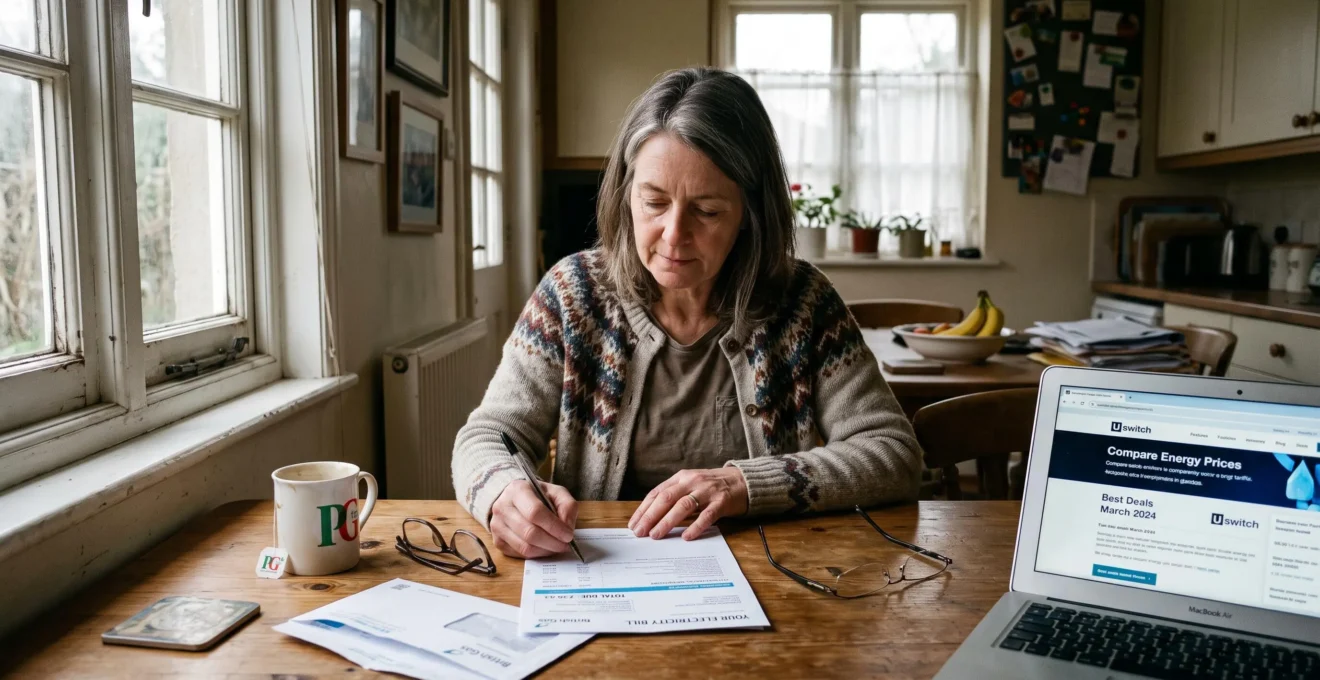
Your energy supplier sends the bill, but it does not independently control everything you pay. Electricity generators influence wholesale prices, network operators maintain the infrastructure delivering energy, Ofgem regulates important parts of the system, and government policy affects certain costs and support schemes.
Understanding these responsibilities matters when prices rise unexpectedly, your lights flicker, or you are deciding whether to switch tariffs. A higher bill might reflect greater consumption, changing wholesale prices, network investment, or an inaccurate meter estimate. Each situation requires a different response.
For domestic customers in England, Scotland and Wales, Ofgem’s energy price cap provides protection on eligible default tariffs. It does not guarantee a fixed total bill. Most ordinary business energy contracts operate differently and are not covered by the domestic price cap. Northern Ireland also has separate regulatory arrangements.
The practical question is therefore not simply who charges you, but which organisation controls the problem you want to solve—and which costs you can realistically influence.
UK energy bills: what matters most
- Your supplier handles tariffs, billing and payments; network operators handle the physical electricity distribution network and many local supply faults.
- Ofgem regulates eligible domestic tariff rates, but your total bill still depends on consumption and your specific tariff.
- Comparing unit rates, standing charges and meter readings helps distinguish genuine price increases from problems you can correct.
- Why Do Network Charges Rise Even When Your Usage Falls?
- How to Decode Your Energy Bill in 10 Minutes and Spot What You Can Control
- Supplier or DNO: Who Should You Contact When Lights Flicker at Peak Time?
- The Energy Scam Pattern That Targets Confused Households During Price Surges
- When Do Energy Market Changes Show Up on Bills After a Price Shock?
- Why Do Gas Price Shocks Show Up in Electricity Bills Even if You Don’t Use Much Gas?
- Fixed, Variable, or Tracker Tariff: Which Is Safest if You Work From Home?
- How Do You Protect Your Household From Energy Price Swings Without Obsessing Daily?
Why Do Network Charges Rise Even When Your Usage Falls?
Network charges can rise even when your electricity consumption falls because maintaining and upgrading energy infrastructure costs money regardless of how many units an individual household uses. Your personal consumption reduction does not directly determine network tariffs. Network costs depend on regulated investment allowances, infrastructure requirements and charging arrangements across the wider system.
Electricity bills combine costs with different economic characteristics. Wholesale electricity purchases are closely connected to energy volumes and market prices. Network infrastructure, meanwhile, requires ongoing expenditure on cables, substations, maintenance, resilience and additional capacity.
Distribution Network Operators (DNOs) maintain regional electricity distribution infrastructure. Ofgem regulates their allowed revenues through network price controls, assessing expenditure plans and investment requirements. These arrangements are separate from the retail energy contracts offered by suppliers.
Network companies recover regulated costs through charges within the electricity system. Suppliers generally incorporate these costs into the tariffs paid by households. Consequently, a customer will not necessarily see a separately labelled network charge on their bill.
Under Ofgem’s explanation of the energy price cap and standing charges, the regulated domestic tariff calculation includes wholesale costs, network costs, policy costs, operating allowances and other components.
Importantly, a standing charge is not exclusively a network charge. It covers several categories of costs, while network expenditure can also influence other parts of the tariff.
A possible system-wide effect is that spreading largely fixed infrastructure expenditure across fewer units of energy could increase the cost allocated per unit. However, that does not establish that lower national consumption automatically increases every household’s network unit rate. Regulatory allowances, charging methodologies and the allocation of costs also matter.
Illustrative example: lower consumption, higher rates
Consider a purely hypothetical household whose electricity consumption falls by 10%, while its tariff’s unit rate rises because of wider energy and network costs.
The household may use fewer kWh but save less money than expected. Whether its actual bill rises depends on the new unit rate, standing charge and amount consumed. This scenario illustrates the distinction between consumption and price; it is not evidence of a specific network charging change.
To investigate your own charges, compare the standing charge and unit rate on successive bills, then examine Ofgem’s published breakdown of tariff costs. These figures can provide context, but they will not necessarily reveal a precise household-specific network charge.
The Tariff Comparison Rate (TCR), where supplied, represents an illustrative overall tariff comparison based on assumed consumption. It should not be treated as a direct measurement of network costs.
For an individual household, the most effective next step is to separate price movements from usage changes before deciding whether a higher bill is unavoidable or potentially reducible.
How to Decode Your Energy Bill in 10 Minutes and Spot What You Can Control
You can understand the main drivers of a UK energy bill in about ten minutes by checking three things: how many kWh you were charged for, the unit rate applied to each kWh, and the standing charge for the billing period. Then confirm whether the meter readings are actual or estimated and whether your tariff still suits your usage.
Start with three passes through the statement.
- Consumption: identify the electricity and gas units charged, the billing dates and the unit rates.
- Fixed and regulated costs: find the daily standing charges and note that wider network and policy costs may be embedded in tariff prices rather than itemised.
- Supplier-specific conditions: check the tariff name, payment method, discounts, contract dates, additional charges and any credit or debit adjustment.
On a straightforward single-rate tariff, the basic calculation is:
Energy cost = (kWh used × unit rate) + (number of days × standing charge).
Taxes and any applicable adjustments must also be accounted for. Variable and time-of-use tariffs may require separate calculations for different rate periods.
For October to December 2026, Ofgem published average domestic Direct Debit electricity rates of 26.32p/kWh and a 54.83p daily standing charge across England, Scotland and Wales. The corresponding gas averages were 7.97p/kWh and 29.68p per day. These figures are regional averages, not universal rates.
£1,723
The annualised typical dual-fuel price cap illustration for a domestic Direct Debit customer from 1 October to 31 December 2026. It is not a maximum annual bill or a guaranteed household payment.
For this specific period, Ofgem also reported that VAT was removed from electricity covered by the domestic price cap from October 2026 to March 2027, while gas retained 5% VAT. This period-specific treatment should not be assumed to apply to every tariff or future bill.
A tariff with a lower unit rate is not automatically cheaper. Someone who uses little electricity may benefit more from a lower daily standing charge, even if the unit rate is slightly higher.
For example, imagine two hypothetical tariffs:
| Tariff detail | Tariff A | Tariff B |
|---|---|---|
| Unit rate | 25p/kWh | 28p/kWh |
| Standing charge | 60p/day | 35p/day |
| Annual cost at 1,500 kWh | £594.00 | £547.75 |
| Annual cost at 4,000 kWh | £1,219.00 | £1,247.75 |
These invented prices demonstrate why low and high consumption households can reach opposite conclusions about the same tariffs. Calculate using your own annual kWh consumption rather than selecting an offer purely because its unit rate looks attractive.
The TCR can provide an illustrative comparison where available, but a personalised annual estimate is more useful. Similarly, Ofgem’s headline price cap figure represents typical consumption rather than a household spending limit.
Finally, examine the meter reading labels. If the closing reading is estimated, compare it with your actual meter. An incorrect estimate may distort the current balance without reflecting energy actually consumed.
Your five-step energy bill audit
- Record your electricity and gas kWh consumption for the billing period; produce a short usage summary.
- Copy each unit rate and standing charge into a comparison sheet; produce a tariff cost breakdown.
- Check estimated readings against the meter and photograph any discrepancy; retain the reading evidence.
- Calculate the annual cost of your existing tariff and one alternative using the same consumption; save the two totals.
- Review your payment method, tariff expiry and available discounts; record one specific action to discuss with your supplier.
Once the billing figures are clear, the next question is whether the issue belongs to your supplier or to the company operating the infrastructure.
Supplier or DNO: Who Should You Contact When Lights Flicker at Peak Time?
Contact your local Distribution Network Operator when repeated flickering, voltage fluctuations or a wider power interruption suggest a problem with the electricity distribution network. Contact your supplier for billing, tariffs and meter-related issues. If lights flicker only inside your property, however, an internal electrical fault is also possible and should not automatically be attributed to the network.
The distinction is important because your electricity supplier does not operate the local distribution cables. Suppliers arrange retail contracts and billing, while DNOs manage the regional infrastructure delivering electricity to premises.
Independent Distribution Network Operators (IDNOs) may manage networks serving certain developments or properties. The responsible network operator can be identified through the appropriate network arrangements rather than assumed from the supplier’s brand.
When several homes experience flickering lights during evening demand peaks, a network-related voltage issue becomes a plausible explanation. However, the time of day alone does not prove the cause. Internal wiring, appliances and meter-related faults can produce similar symptoms.
Use the nature of the problem to select the right contact.
| Problem | First contact | Reason |
|---|---|---|
| Local power cut or widespread outage | 105 or local network operator | Network operators investigate electricity distribution interruptions. |
| Repeated flickering or suspected network voltage problem | Local network operator | The operator can investigate potential supply-quality issues. |
| Incorrect bill, tariff or payment | Energy supplier | The supplier manages the account and retail contract. |
| Faulty electricity meter | Energy supplier | The supplier normally arranges the appropriate meter investigation. |
| Problem confined to internal wiring | Qualified electrician | The fault may be within the property rather than the public network. |
| Unresolved eligible complaint | Energy Ombudsman | Independent escalation may be available after the relevant complaint process. |
In Great Britain, calling 105 connects electricity consumers with their network operator for power cuts. Ofgem’s power cut reporting and compensation guidance also explains when interruptions may qualify for regulatory payments.
Compensation depends on the length and circumstances of the interruption, including its cause and whether the relevant guaranteed standards apply. Not every interruption qualifies, and eligible payments may sometimes be made automatically by the network operator.
For a potentially dangerous electrical situation, such as sparking equipment, exposed live wiring or a burning smell, prioritise immediate safety rather than a routine complaint. Avoid touching suspect equipment and seek appropriate emergency assistance.
SMEs should also distinguish network faults from contractual supply problems. Their commercial energy contracts do not automatically receive the same consumer protections as domestic default tariffs.
Knowing which organisations have legitimate authority also makes it easier to identify someone falsely claiming to act on their behalf.
The Energy Scam Pattern That Targets Confused Households During Price Surges
Energy scams commonly exploit uncertainty about rising bills by impersonating suppliers, regulators or rebate administrators. Fraudsters may offer an urgent refund, threaten disconnection, demand payment or request sensitive details through a link. The safest response is to stop the interaction and independently verify the claim through a trusted official channel before providing information or money.
Price increases create a particularly convincing pretext. A household expecting a larger bill may be more receptive to a message claiming a refund has been calculated incorrectly or that an immediate payment will prevent a supply problem.
Common patterns include fraudulent energy rebate calls, fake reimbursement emails, suspicious SMS links, demands to confirm meter readings on unfamiliar websites and attempts to collect bank credentials under the guise of account verification.
The mechanism is usually a combination of authority and urgency: the caller claims to represent a recognised organisation, presents a financial consequence and pressures the recipient to act before checking.
Be especially cautious about requests for complete banking security credentials, one-time authentication codes or transfers into a personal account. Such demands are strong warning signs and are not part of an ordinary legitimate energy billing process.
A practical three-stage verification method is:
- End the suspicious call or message conversation without using its embedded links.
- Contact the supplier through the telephone number on a trusted statement or its independently accessed official website.
- Check any claimed trader accreditation directly with the relevant scheme operator, and consider Citizens Advice or Trading Standards guidance when evaluating unsolicited approaches.
The Take Five to Stop Fraud approach is useful here: pause, question unexpected requests and confirm through an independent channel. A familiar company name on a message or caller display is not proof of authenticity.
Another warning sign is an electricity-saving plug-in device promising dramatic reductions without a credible explanation of how it reduces metered energy consumption.
Ordinary residential electricity billing is based on measured energy use. A device that merely claims to adjust household electrical characteristics cannot be assumed to reduce billable kWh. Promotional demonstrations and impressive percentage savings do not establish that a product will work in a typical UK home.
Genuine savings normally require measurable changes in energy use, a different tariff, improved equipment efficiency or appropriate demand management.
If you have already disclosed banking credentials or made a suspicious payment, contact your bank promptly through a verified channel. Preserve any messages and transaction information so the incident can be reported.
Legitimate market changes do affect bills, but they follow recognisable pricing and contractual mechanisms rather than unsolicited demands for instant payment.
When Do Energy Market Changes Show Up on Bills After a Price Shock?
A wholesale energy price shock does not normally change every UK household bill immediately. For domestic customers on standard variable tariffs, Ofgem updates the price cap every three months, using a calculation that includes wholesale cost allowances. Fixed tariffs generally retain their agreed rates during the fixed term, while tracker tariffs can react more frequently according to their contract terms.
This delay exists because the price customers pay is not simply the wholesale market price observed on a particular day. Suppliers buy energy through different arrangements, while regulated default tariffs reflect a broader methodology incorporating wholesale, network, policy and operating costs.
For example, a sudden wholesale gas price increase may influence expectations about future electricity and gas costs without immediately changing the unit rates on an existing domestic tariff.
The timing depends on which arrangement applies:
| Tariff type | Typical transmission mechanism | Important limitation |
|---|---|---|
| Standard variable domestic tariff | Supplier rates may change around quarterly Ofgem price cap periods. | Actual changes depend on the regulatory calculation and supplier rates. |
| Fixed tariff | New market prices influence future offers or the position at renewal. | Agreed fixed rates generally remain unchanged during the fixed term. |
| Tracker tariff | Rates change under a defined tracking formula. | The frequency and index depend on the contract. |
| Dynamic time-of-use tariff | Different time periods can carry changing rates. | Price exposure depends on the tariff rules and timing of consumption. |
| SME commercial contract | Changes depend on its specific fixed, variable or index-linked terms. | The domestic Ofgem price cap does not generally apply. |
For October to December 2026, Ofgem increased its typical annualised dual-fuel domestic price cap illustration by 4% compared with the preceding period.
The next scheduled price cap announcement is 25 November 2026, covering 1 January to 31 March 2027. This is a scheduled announcement date, not a guarantee that household prices will rise or fall.
Customers can therefore anticipate when new regulated rates may take effect without attempting to forecast wholesale gas prices every day.
There is also an important connection between gas markets and electricity tariffs. In periods when gas-fired generators are required to meet electricity demand, gas generation can influence the marginal wholesale electricity price. That connection helps explain why an electricity bill may be affected by a gas market shock even when the household uses little or no gas directly.
Retail effects remain conditional on wholesale purchasing arrangements, regulatory calculations and tariff terms. A wholesale percentage increase should never be treated as an automatic prediction of the same percentage increase on a household bill.
The remaining question is why the gas market influences electricity pricing so strongly despite the growing contribution of renewable generation.
Why Do Gas Price Shocks Show Up in Electricity Bills Even if You Don’t Use Much Gas?
Gas price shocks can increase electricity costs because gas-fired power stations frequently influence the wholesale electricity price in Great Britain. When gas generation is needed to meet demand, its operating costs can affect the marginal market price. This means households using electricity rather than gas can still be exposed indirectly to global gas markets.
The explanation begins with the merit order, which describes how electricity generation is dispatched according to the costs and characteristics of available supply.
Lower marginal-cost sources may generate electricity before more expensive sources, subject to technical, contractual and system constraints. If gas-fired generation is needed to satisfy demand, its costs can influence the price received by other generators in the relevant wholesale market period.
This mechanism is associated with marginal electricity pricing in markets including arrangements traded through N2EX and EPEX SPOT. However, different markets, contracts and balancing arrangements coexist, and gas does not set every wholesale electricity price.
There are three useful ways to understand the relationship between gas shocks and an electricity bill:
- Wholesale price exposure: higher gas generation costs can influence electricity market prices when gas plants are marginal.
- System-related costs: capacity and security-of-supply arrangements contribute to electricity system expenditure, although their relationship with any particular gas price shock is not automatic or proportional.
- Wider cost effects: fuel prices can affect business costs and economic conditions, but these indirect effects cannot be converted into a reliable household bill estimate without specific evidence.
Ofgem’s explanation of wholesale energy costs and bills describes the relationship between gas-fired generation and marginal wholesale electricity pricing.
“Gas generation is often the last and most expensive source, so may set the price we pay for electricity.”
The UK remains exposed to internationally traded gas prices even though its direct reliance on Russian gas has historically been relatively limited. European gas demand, liquefied natural gas (LNG) availability and competing international buyers all contribute to changing market conditions.
After the 2022 European energy crisis, LNG supply and global competition became particularly important factors in understanding gas price exposure. More LNG availability can improve supply flexibility without eliminating price volatility.
Ofgem’s published historical discussion reports that LNG from the United States as a share of UK gas imports accounted for 15% in 2025. That is a historical figure, not a verified share for 2026.
To examine your own exposure, compare changes in your electricity unit rate with Ofgem’s relevant price cap announcements and published wholesale market explanations. If you are on a fixed tariff, distinguish current market movements from the rates you have already contracted to pay.
Knowing this market relationship helps you choose a tariff based on your ability to tolerate price changes rather than assuming an electricity-only household is insulated from gas volatility.
Fixed, Variable, or Tracker Tariff: Which Is Safest if You Work From Home?
A fixed tariff is generally the most predictable option for someone working from home who needs stable energy costs, provided the quoted rates and contractual conditions are suitable. A standard variable tariff offers more flexibility but exposes the household to periodic changes. Tracker and dynamic tariffs introduce greater price variability, which may be worthwhile only when consumption can be shifted or market risk is acceptable.
Working from home changes the consumption profile of a household. Computers, monitors, cooking and additional heating or cooling can increase daytime electricity use.
This makes tariff selection more than a comparison of advertised annual prices. The timing of electricity demand can matter, particularly where rates vary throughout the day.
| Tariff | Main advantage | Main risk | Most relevant situation |
|---|---|---|---|
| Fixed | Predictable agreed unit rates for the fixed period | Potentially missing cheaper future rates; possible exit fees | Households prioritising budget certainty |
| Standard variable | Ability to benefit from tariff reductions without being locked into a typical fixed-rate term | Exposure to periodic price changes | Households wanting flexibility and regulated default-tariff protection |
| Tracker | Potential benefit when the tracked market index falls | Costs can increase under the tracking formula | Households comfortable with price variability |
| Dynamic time-of-use | Potential savings when usage can move to cheaper periods | Expensive peak periods and volatile rates | Households with controllable loads such as EV charging |
Fixed does not necessarily mean that the monthly Direct Debit amount is guaranteed. Higher consumption can still increase total expenditure, and suppliers may adjust monthly collections to reflect projected annual usage.
A standard variable tariff follows the supplier’s pricing decisions within the applicable domestic price cap, rather than directly tracking every wholesale movement.
Tracker tariffs vary by design. Some adjust relatively infrequently, while others use more responsive indices. Their contracts must be read individually rather than treated as a single product category.
Dynamic products such as Octopus Agile demonstrate how electricity prices can vary across shorter periods. They may reward customers able to schedule flexible consumption when electricity is cheaper, but they can expose households to expensive intervals.
For someone working from home, the distinction between flexible and inflexible demand is crucial. Electric vehicle charging or laundry may be movable, while heating a workspace and operating essential equipment often cannot be postponed.
Daytime electricity is not universally more expensive than nighttime electricity. Prices vary by tariff and market conditions, so it is important to examine the actual schedule rather than assume every working hour coincides with a peak.
A useful comparison starts with an estimate of annual kWh consumption and, where available, smart-meter information showing when the energy is used. Test the cost against alternative tariffs, including their standing charges and any exit fees.
For most risk-averse home workers, predictability has a real practical value. A potentially lower average tariff cost may not compensate for frequent price spikes if the household cannot shift usage.
The strongest tariff choice is one that matches both your consumption pattern and your willingness to accept uncertainty—not simply the offer with the lowest advertised rate.
Key takeaways before planning your next steps
- Separate costs you can influence directly from market and infrastructure charges that require a tariff or regulatory change.
- Protect your budget against volatility using a contract and payment arrangement appropriate to your actual consumption.
- Choose scheduled reviews and measurable efficiency improvements over reacting to every wholesale market headline.
How Do You Protect Your Household From Energy Price Swings Without Obsessing Daily?
You can protect your household from energy price swings by reviewing tariffs periodically, reducing unnecessary consumption and maintaining a realistic payment budget. For most domestic customers, checking official price cap announcements once per quarter is more useful than monitoring daily wholesale prices. Long-term efficiency measures and an appropriate tariff can reduce exposure without constant attention.
The simplest strategy is to separate two kinds of protection: reducing the price risk attached to each unit of energy, and reducing the number of units you need to buy.
The first involves comparing tariffs, understanding contract conditions and deciding whether fixed pricing is worth the certainty it offers. The second focuses on the practical causes of energy consumption, such as space heating, insulation and appliance efficiency.
Both matter, but they work differently. A fixed tariff can provide short-term predictability without guaranteeing a low total bill. Better insulation may reduce heating requirements over multiple years, although savings depend on property conditions, installation costs and behaviour.
Start with a quarterly review scheduled around Ofgem’s price cap announcements. Compare the unit rates and standing charges applicable to your region and tariff, then check whether a competing offer provides a meaningful benefit for your annual usage.
There is generally little advantage in following daily wholesale price changes unless your specific tariff exposes you to them. Customers on conventional fixed or standard variable domestic tariffs do not normally have bills repriced each day in response to wholesale movements.
Next, review the household’s monthly payment arrangement. A budget Direct Debit can spread seasonal energy expenditure over the year, helping avoid large differences between winter and summer payments.
However, a monthly Direct Debit is not the same as the cost of that month’s energy consumption. It is a collection arrangement, and a poorly calibrated amount can create a significant credit balance or unpaid debt.
At least annually, compare total payments with actual billed consumption, review the account balance and ask the supplier to explain any proposed Direct Debit adjustment. For households experiencing financial difficulty, contacting the supplier early may provide access to payment arrangements or other support.
Practical improvements should then be prioritised according to cost, feasibility and likely energy reduction. Heating controls, reducing avoidable heat loss, maintaining suitable equipment and using efficient appliances can all be considered, with suitability depending on the property.
Official support may also be relevant. Ofgem publishes information about energy costs and efficiency support, while Citizens Advice can help consumers understand bills, complaints and available assistance.
Support programmes such as the Warm Home Discount and Winter Fuel Payment have eligibility conditions that vary by scheme and circumstances. Households should verify current rules individually instead of assuming that a previous award guarantees future support.
For SMEs, periodic reviews should also include contract renewal dates, business-specific charges and potential differences between fixed and variable commercial supply arrangements. Domestic price cap comparisons should not be used as a direct substitute for reviewing a business contract.
A manageable household routine is to review consumption monthly, compare tariffs quarterly and reassess energy efficiency improvements when household circumstances or equipment change. That concentrates attention on decisions you can make rather than prices you cannot control.
Take your latest statement, verify the meter readings and calculate what the current tariff costs at your actual annual consumption. Use that figure as the baseline for your next tariff comparison and household energy budget.
Does Ofgem set the exact price my energy supplier charges?
No. Ofgem sets maximum unit rates and standing charges for eligible domestic default tariffs under its price cap methodology. Suppliers determine their own applicable tariffs within those limits. Fixed tariffs and ordinary business contracts are not directly covered by the domestic price cap.
Can my energy bill increase even if I use fewer kWh?
Yes. A higher unit rate, standing charge or adjustment can outweigh a reduction in consumption. Compare the billing periods, actual meter readings, energy units and applicable tariff rates before concluding that consumption has increased.
Do electricity network operators decide which supplier I use?
No. Network operators maintain and operate physical distribution infrastructure, while suppliers offer retail electricity contracts and bill customers. Switching suppliers generally does not change the local distribution network serving your property.
Why is my Direct Debit higher than the cost of the energy used this month?
A budget Direct Debit is often calculated to spread estimated annual energy costs over regular payments. The amount may differ from consumption in an individual month. Check your actual account balance, annual usage estimate and payment calculation with your supplier.
Does the UK domestic energy price cap protect small businesses?
Ordinary SME energy contracts are generally outside the domestic price cap. Business customers should review their commercial tariff conditions, contract duration, unit rates, standing charges and applicable supplier protections. Eligibility for particular support or tax measures must be assessed separately.