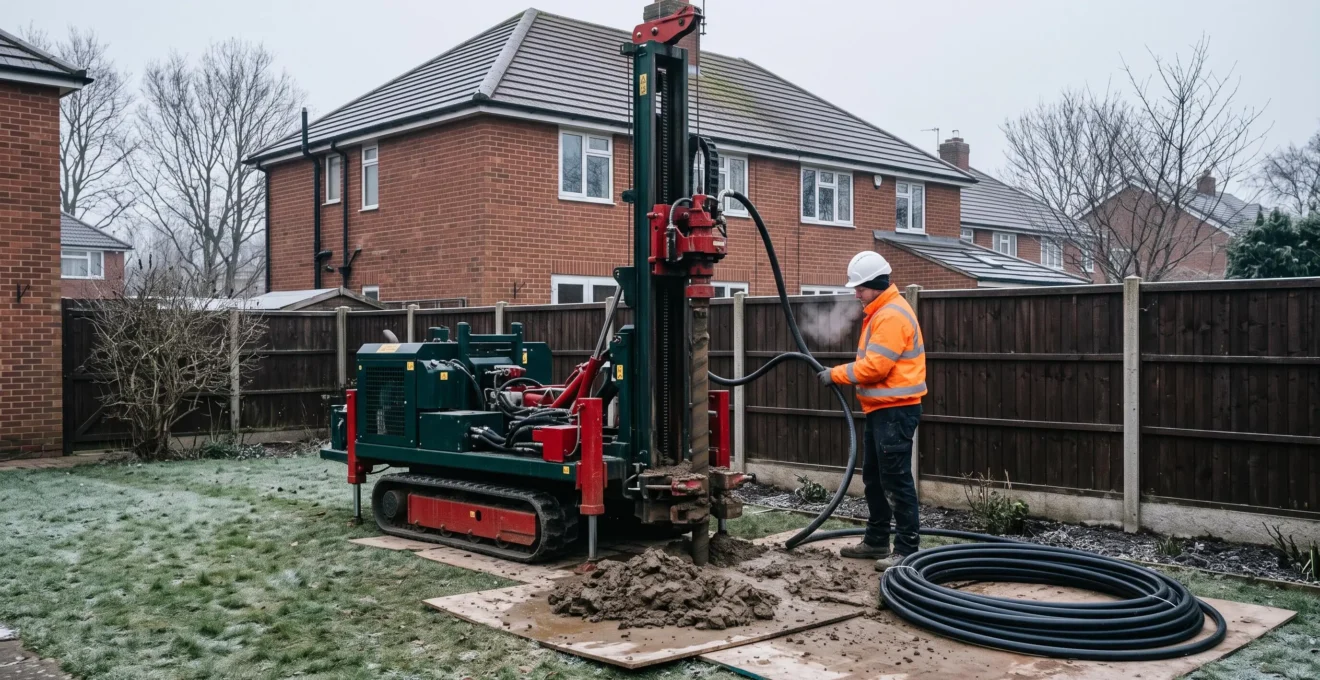
Yes, underground heat can keep a UK home comfortably warm when the outdoor temperature is just 2°C. A correctly designed ground-source heat pump draws energy from soil or rock that changes temperature much more slowly than the air. That makes it a dependable heating source throughout a British winter, even when outdoor conditions turn colder.
But the ground does not heat your radiators directly. A heat pump uses electricity to raise low-temperature energy collected underground to a useful temperature for central heating and hot water. Whether your rooms actually stay warm depends on the property’s heat loss, radiator sizes, heating controls and the underground collector.
For homeowners, the practical question is therefore not simply whether geothermal heating works in winter. It is whether the garden, ground conditions, installation budget and existing building can support a system designed to meet the home’s real heating demand.
Underground heating in a UK winter: the essentials
- Ground-source heat pumps can heat homes at 2°C outside because the ground provides a relatively stable source of energy, although efficiency still depends on system design.
- Horizontal collectors need substantial usable land; vertical boreholes offer an alternative when garden space is limited.
- Accurate heat-loss calculations, suitable radiators and properly sized ground collectors matter more than headline efficiency claims.
- Why Is Ground Temperature So Stable Compared With Air Temperature in Winter?
- How to Tell if Your Garden Is Big Enough for Horizontal Ground Loops?
- Ground-Source vs Air-Source Heat Pump: Which Performs Better in a Windy UK Spot?
- The Design Shortcut That Leaves a Ground-Source System Struggling After 6 Months
- When Should You Schedule Borehole Drilling to Avoid a Muddy, Delayed Installation?
- Gas Boiler Replacement vs Heat Pump: Which Fits a 1930s Semi With 2 Bathrooms?
- Insulate First or Electrify First: Which Works Better in a UK Solid-Wall Home?
- Which Heating System Keeps a 3-Bed UK Home Warm Without £300 Winter Bills?
Why Is Ground Temperature So Stable Compared With Air Temperature in Winter?
Ground temperature stays comparatively stable because soil and rock absorb, store and release heat slowly. While UK air temperatures can change sharply within hours, underground temperatures respond gradually. A ground-source heat pump therefore works with a less variable energy source, helping it maintain more consistent winter performance than a system exposed directly to outdoor air.
This stability comes from thermal inertia. The ground has significant heat-storage capacity, and heat moves through it relatively slowly. Daily weather fluctuations affect the surface most strongly; their influence becomes weaker and more delayed with increasing depth.
At roughly a metre underground, seasonal changes are still important. Shallow horizontal ground collectors do not experience a perfectly constant temperature, especially after prolonged winter extraction. Deeper soil typically fluctuates less, while sufficiently deep boreholes encounter temperatures that are much more consistent throughout the year.
The distinction explains why collector depth matters. A horizontal installation depends heavily on local soil conditions and seasonal heat recovery. A vertical borehole accesses a larger depth of ground, although its precise thermal performance depends on geology, groundwater conditions and the borehole design.
Despite the name, most heat collected by shallow domestic ground-source systems is not geothermal energy rising directly from the Earth’s core. Much of it originates from solar energy absorbed at the surface and transferred into the ground, alongside other environmental heat exchanges.
That is why soil moisture and thermal conductivity matter. Moist clay can transfer heat more effectively than dry, poorly conducting ground, though compactness, groundwater movement and local geology also influence the result.
On a 2°C day, a properly sized ground-source system can continue taking energy from the ground without the same immediate dependence on outdoor air temperature. Its coefficient of performance, or COP, describes how much heat the system supplies for each unit of electricity consumed. The COP still varies with ground temperature and required heating-water temperature.
Stable ground temperature provides a valuable advantage, but it cannot compensate for inadequate collectors or excessive building heat loss. The next question is whether the property has enough suitable land to collect the required energy.
How to Tell if Your Garden Is Big Enough for Horizontal Ground Loops?
Your garden may accommodate horizontal ground loops if it has a large, accessible area of suitable soil that can be excavated without damaging essential structures or services. As an initial screening estimate, homeowners can compare usable garden space with two to three times their heated floor area. However, the final collector area must be calculated from the home’s heat demand and local ground conditions.
Consider a hypothetical house with 120 m² of heated floor space. Applying that preliminary rule produces a screening range of 240–360 m² of available land. This is not a guaranteed installation requirement: different pipe layouts, soil properties and extraction rates can change the area substantially.
Start by measuring the garden’s approximate length and width. Then subtract areas that cannot realistically accommodate buried collectors, including patios, buildings, major tree-root zones, drainage features and necessary access routes.
The remaining area is more useful than the overall plot size. A garden that appears generous on an estate-agent floor plan may have limited usable ground once these constraints are considered.
Next, examine the ground itself. Moist clay often provides favourable heat-transfer characteristics, although excavation may be difficult when the soil is saturated. Dry sand or chalk can behave differently, and an installer must assess thermal properties rather than relying on visual soil identification alone.
Large trees introduce root-protection and excavation constraints. Shading may also influence seasonal ground warming, although its practical significance depends on collector depth and local conditions.
Horizontal pipes can be installed in straight trenches or coiled arrangements often called slinky loops. Coiled layouts can reduce the length of trench required, but they do not eliminate the need for sufficient ground volume and spacing to avoid excessive cooling.
Where usable land is insufficient, vertical boreholes may be more suitable. They occupy less surface area but introduce drilling costs, access requirements and site-specific geological considerations.
Before accepting a layout, account for septic systems, underground drains, existing utilities and future extensions. A proposed driveway or conservatory should not be allowed to conflict with the collector field without a specific engineering assessment.
A site survey and building heat-loss calculation should determine the final collector design. A small garden does not automatically rule out ground-source heating, but it may change the installation method and cost dramatically.
Ground-Source vs Air-Source Heat Pump: Which Performs Better in a Windy UK Spot?
Ground-source heat pumps generally offer more stable source temperatures in exposed UK locations because their underground collectors are unaffected by wind and outdoor frost. Air-source heat pumps remain viable in windy conditions when properly installed and sized, however. The best choice depends on local winter temperatures, equipment specifications, installation costs, available space and the building’s heating requirements.
An air-source heat pump collects heat from outdoor air passing over a heat exchanger. Wind is not inherently harmful: air movement supports heat exchange, and outdoor units are specifically designed to move air using fans.
The practical concern is more nuanced. Exposed locations may combine low air temperatures, rain, wind-driven precipitation and high humidity. Under suitable conditions, frost can accumulate on an outdoor heat exchanger, requiring a defrost cycle that temporarily affects heating efficiency.
Wind exposure alone does not prove that an air-source heat pump will suffer more defrost cycles. Frost behaviour depends on equipment operation, temperature, humidity and heat-exchanger conditions.
Ground-source equipment avoids outdoor-coil defrosting because the heat is collected through a buried fluid circuit. This gives it a potential performance advantage during difficult winter weather, provided underground temperatures remain within the system’s design limits.
The main trade-offs become clearer when the technologies are compared side by side.
| Decision factor | Ground-source heat pump | Air-source heat pump |
|---|---|---|
| Winter heat source | Relatively stable soil or rock temperature | Outdoor air temperature varies with weather |
| Wind exposure | Buried collector unaffected directly | Outdoor unit must be suitably positioned |
| Defrosting | No outdoor-air coil to defrost | Defrost operation may be necessary |
| Installation | Excavation or borehole drilling required | Outdoor unit and associated connections |
| Typical upfront cost | Generally higher, particularly with boreholes | Generally lower |
| Space requirements | Suitable land or drilling access | Suitable outdoor unit location |
| External noise | No outdoor fan unit | Outdoor fan and compressor noise must be considered |
| Maintenance and lifespan | Collector and heat pump have different service lives | Outdoor components exposed to weather |
Planning is another distinction. In England, England’s permitted development legislation for heat pumps addresses ground-source installations under Class C and air-source installations under separate Class G provisions.
Those rights are conditional and do not eliminate every possible consent or restriction. Wales, Scotland and Northern Ireland have their own planning frameworks, so England’s provisions should not be treated as UK-wide permission.
An air-source unit may be the more sensible investment for a sheltered urban property without excavation space. In an exposed rural location with suitable land, ground-source heating merits closer comparison.
Ask installers for projected seasonal performance and heat output at your property’s local design conditions, not just the manufacturer’s headline COP. Test-condition efficiency is not a household running-cost guarantee.
Whichever source is selected, correct sizing is essential. A poorly designed ground collector can erase the apparent winter advantage of ground-source technology.
The Design Shortcut That Leaves a Ground-Source System Struggling After 6 Months
One of the most damaging ground-source heating shortcuts is reducing collector length or borehole capacity without demonstrating that the ground can sustain the required heat extraction. The installation may initially appear satisfactory but experience declining source temperatures during a demanding heating season. After six months, disappointing efficiency may expose weaknesses that were present in the original design.
A ground loop removes thermal energy from surrounding soil or rock. As extraction continues, temperatures close to the collector fall. Heat from the surrounding ground gradually replenishes some of that energy.
Where extraction is excessive relative to thermal replenishment, a colder region develops around the collector. Over time, falling ground-loop temperatures can make the heat pump work harder to deliver the same indoor heating temperature.
This does not mean every temperature decline is a failure. Seasonal cooling is expected and should be included in an appropriate ground-array design. The warning sign is a decline beyond the temperatures allowed for in the engineering calculations, particularly if long-term recovery proves inadequate.
In an extreme case, an undersized collector may suffer repeated low-temperature operation and poor efficiency. Increasing the nominal capacity of the heat pump does not solve an insufficient underground heat source; it may increase the rate at which the remaining thermal resource is stressed.
Before installation, request evidence that the system was designed from a room-by-room heat-loss assessment rather than copied from the existing boiler’s rated output. A boiler sized for rapid hot-water production may be substantially larger than the building’s actual space-heating demand.
The ground design should also account for peak extraction, annual energy extraction, local thermal conditions and predicted source-fluid temperatures. For vertical boreholes, the proposed depth and number of boreholes need supporting calculations. For horizontal collectors, pipe configuration, spacing and available land are equally important.
Five checks before approving a ground-source installation
- Request the room-by-room design heat-loss calculation and retain the completed document showing the required heating capacity.
- Obtain a scaled ground-collector layout showing trench dimensions or borehole positions, depths and relevant site constraints.
- Ask for the predicted minimum and seasonal source-fluid temperatures, with the design assumptions recorded in writing.
- Request the design’s annual extraction and thermal-replenishment assumptions, including any long-term ground-temperature assessment considered necessary.
- Compare the collector calculations from competing quotations and ask each installer to explain significant differences in a written technical response.
Those documents make it easier to challenge an unusually inexpensive quotation. A smaller array is not automatically wrong, but a major unexplained reduction in collector capacity is a reasonable reason to seek independent technical clarification.
Once installed, recording brine inlet and outlet temperatures alongside operating conditions can help identify unusual behaviour. Interpretation requires professional judgement because readings naturally vary through the heating season.
The collector is a long-lived part of the investment and may be difficult to alter after landscaping is restored. That makes design verification especially important before expensive drilling or excavation begins.
When Should You Schedule Borehole Drilling to Avoid a Muddy, Delayed Installation?
For many UK properties, late spring through early autumn offers a practical opportunity for borehole drilling because ground access may be easier and prolonged winter saturation less likely. However, contractor availability, geology, surface conditions and permissions can matter more than the month. Arrange the ground survey and design well before choosing a drilling date.
Heavy equipment needs a stable route from the road to the proposed borehole positions. Saturated lawns and soft access tracks can make this difficult, particularly where machinery must cross narrow residential gardens.
Drier weather may reduce surface disruption, but summer is not automatically trouble-free. Rainfall can delay drilling in any season, while established contractors may have limited availability during popular installation periods.
A sensible sequence is to complete the building assessment, confirm the required borehole design, investigate ground conditions and identify the drilling contractor before agreeing to major site works.
Electrical capacity should also be reviewed. The electricity-network operator may need to assess the proposed installation, and any necessary network work can affect the schedule. Planning and other relevant consent checks need to be completed where applicable.
Site logistics deserve explicit written agreement. Confirm vehicle access, protection of paths and drainage, arrangements for excavated material, reinstatement of the garden and the party responsible for coordinating the drilling contractor with the heating installer.
Financial sequencing matters just as much. In England and Wales, the UK Government Boiler Upgrade Scheme grant details list £7,500 for an eligible ground-source heat pump and the same amount for an eligible air-source heat pump.
The scheme also identifies a potential additional £1,500 until March 2027 for qualifying homes without mains gas connections replacing oil or LPG heating. Eligibility and current terms must be confirmed before committing to expenditure. The scheme is not a UK-wide grant for all four nations.
£7,500
The Boiler Upgrade Scheme grant listed for an eligible ground-source heat pump in England and Wales. The amount is a contribution towards eligible installation costs, not a measure of the full project price.
UK Government — Boiler Upgrade Scheme
Do not book drilling solely because a contractor has an available slot. Borehole work represents a substantial upfront commitment and is not easily reversed if the heating design or funding arrangements later change.
Once the underground source and installation sequence are understood, attention can turn to the building itself, especially older UK homes with existing gas boilers and conventional radiators.
Gas Boiler Replacement vs Heat Pump: Which Fits a 1930s Semi With 2 Bathrooms?
A heat pump can suit a 1930s semi-detached house with two bathrooms, but the decision requires more than matching the old boiler’s rated capacity. The building’s insulation, radiator output, available cylinder space and simultaneous hot-water demand must be assessed. A replacement gas boiler may have a lower initial cost, while a properly designed heat pump offers a different long-term heating option.
Many homes from this period have characteristics that affect heating demand, including suspended timber floors, draught-prone junctions and walls with limited insulation. Wall construction varies between properties, so a survey is needed rather than assuming every 1930s semi has the same thermal performance.
Existing radiators may have been selected for relatively high boiler flow temperatures. Heat pumps generally achieve better efficiency when supplying lower-temperature water, so some radiators may require enlargement or replacement.
The heat-loss assessment identifies the heat each room needs on a cold design day. An installer can then determine whether existing emitters can provide sufficient output at the proposed flow temperature.
Two bathrooms introduce a separate hot-water decision. A gas combi boiler produces domestic hot water on demand, within its available flow capacity. Many heat-pump installations instead use a stored hot-water cylinder.
If two showers or a bath and shower are frequently used close together, cylinder capacity, recovery time, incoming water pressure and household routines become important. The requirement is not simply to choose the smallest cylinder that fits.
A homeowner replacing a combi boiler must also identify a suitable location for the cylinder and associated pipework. This may be a cupboard, utility room or another practical space, depending on the property’s layout and structural constraints.
Running costs require a separate assessment from installation costs. A heat pump delivers more heat than the electrical energy it consumes, but electricity generally costs more per purchased unit than gas. Actual savings depend on seasonal efficiency, tariff structure and boiler efficiency.
For a well-designed installation, heat-pump running costs can compete favourably with gas. That outcome is not automatic, particularly where the heat pump requires high water temperatures or the household pays an expensive electricity tariff.
The Boiler Upgrade Scheme can offset eligible heat-pump installation costs in England and Wales. It does not, however, establish whether the full project will be cheaper than replacing a gas boiler.
A modern boiler replacement may be a practical interim decision where immediate funds or building constraints prevent electrification. It is still a fossil-fuel investment. Hydrogen-ready labelling should not be interpreted as evidence that a domestic hydrogen network will become available.
Where insulation improvements and selected radiator replacements are feasible, a heat pump deserves serious consideration. The appropriate choice follows from a property-specific design and whole-life financial comparison, not the home’s age alone.
For older homes with substantial heat loss, the order of insulation and heating upgrades can determine how large and expensive the eventual system needs to be.
Insulate First or Electrify First: Which Works Better in a UK Solid-Wall Home?
Improving insulation before final heat-pump sizing is often the more efficient approach for a poorly insulated UK solid-wall home. Lower heat loss can reduce the required heat-pump capacity, collector size and radiator upgrades. However, insulation must be planned with moisture management and ventilation, and some properties benefit from a coordinated programme rather than postponing every heating improvement.
A solid-wall home may lose significant heat through walls, roofs, floors, windows and uncontrolled air leakage. The relative importance of these paths varies, so a property assessment should determine where improvements are worthwhile.
Installing a heat pump before deciding on major fabric upgrades can create a sizing problem. If the original heat loss is high, the system may need a larger heat pump, a greater underground extraction capacity and more powerful heat emitters.
After effective insulation work, that same specification may no longer be necessary. Oversizing can complicate operation and undermine the financial logic of the earlier installation.
That does not mean the entire home must be renovated before a heat pump can operate. A whole-house retrofit plan can define which fabric improvements should precede system sizing and which can reasonably follow.
Solid-wall insulation needs particular care. Internal wall insulation reduces usable room dimensions and can alter moisture movement through the existing wall. Inappropriate materials or poor detailing may increase the risk of trapped moisture and condensation.
External wall insulation keeps internal floor space largely unchanged but affects the building’s appearance and external junctions. Additional permission or design constraints may arise for listed buildings and properties in conservation areas.
A PAS 2035-style retrofit assessment provides a useful framework for identifying interactions between insulation, moisture, ventilation and heating improvements. Actual project requirements depend on the work, funding arrangements and applicable standards.
Ventilation must be considered alongside airtightness. Reducing uncontrolled draughts without providing adequate intentional ventilation can increase indoor humidity and condensation risk.
The practical sequence is therefore to assess the building, identify high-impact and moisture-safe fabric measures, plan ventilation, and size the heating system against the expected improved heat loss. Where future work is uncertain, designers should document the assumptions and avoid relying on improvements that may never happen.
With the building’s heat demand established, it becomes possible to compare what different heating systems might actually cost to operate through a UK winter.
Key takeaways before comparing heating bills
- Calculate the home’s space-heating and hot-water energy requirements before selecting heating equipment or comparing tariffs.
- Judge heat pumps by realistic seasonal efficiency and whole-system design, not a single advertised COP measurement.
- Compare complete household energy costs, including electricity tariffs, gas standing charges and any changes in hot-water consumption.
Which Heating System Keeps a 3-Bed UK Home Warm Without £300 Winter Bills?
A well-designed ground-source or air-source heat pump can keep a three-bedroom UK home warm without necessarily producing £300 monthly winter energy bills. But no technology can guarantee that threshold. Actual expenditure depends on the building’s heat demand, energy prices, system efficiency, hot-water use and other household electricity consumption.
The first step is separating the amount of heat required from the amount of purchased energy needed to produce it.
For a heat pump, the simplified relationship is:
Heating electricity cost = useful heat demand (kWh) ÷ seasonal performance factor × electricity unit price.
For a gas boiler, replace the seasonal performance factor with boiler efficiency and apply the gas tariff. Resistive electric heaters convert approximately one unit of purchased electricity into one unit of heat at the point of use, making them potentially expensive where electricity unit rates are high.
A ground-source heat pump may deliver a seasonal performance factor around 3–4 in a suitable design, but this range is illustrative, not a guaranteed result. A gas boiler operating at an efficiency around 0.85–0.90 uses more purchased fuel energy per unit of useful heat.
The following example is hypothetical and is intended to illustrate the calculation rather than predict a specific UK household’s bill.
Illustrative winter heating comparison
Assume a three-bedroom home requires 2,000 kWh of useful space heating during one winter month. For calculation purposes only, assume electricity costs £0.25/kWh and gas costs £0.07/kWh. These are hypothetical rates, not quoted current UK tariffs.
At a seasonal performance factor of 3.5, a heat pump needs approximately 571 kWh of electricity, costing about £143. A boiler operating at 90% efficiency needs approximately 2,222 kWh of gas, costing about £156. Direct electric heating uses approximately 2,000 kWh, costing £500.
The example excludes standing charges, domestic hot water, circulation and auxiliary loads, other household electricity use and fixed tariff costs. Different seasonal efficiencies or energy prices could change the ranking.
The comparison demonstrates why a heat pump can compete with gas despite a higher electricity unit price. It also shows why direct electric panel heating is often a poor whole-home economic substitute where heat demand remains substantial.
For homeowners facing expensive winter bills, reducing heat demand can be as important as changing the heating appliance. Insulation, appropriate heating controls and avoiding unnecessarily high flow temperatures can all affect energy consumption.
Electricity tariffs add another consideration. A time-of-use tariff may offer cheaper electricity during selected periods, but the household must be able to shift sufficient consumption without compromising comfort.
Heat pumps operate efficiently when maintaining relatively steady temperatures. Excessively aggressive scheduling that forces large recovery demands can reduce the benefit of cheaper tariff periods, especially in poorly insulated buildings.
Ground-source heating offers a comparatively stable underground energy source, which can support predictable performance during a 2°C outdoor day. Nevertheless, stable source temperature is not the same as a fixed bill. A prolonged cold spell can increase total heating demand even if the heat pump’s efficiency remains relatively consistent.
For a three-bedroom UK property, the most useful financial comparison is an annual and winter-month energy model covering the proposed system, expected heat demand, seasonal efficiency and actual tariffs. This avoids choosing equipment around an arbitrary monthly bill target.
Before committing to an installation, request a written room-by-room heat-loss calculation, a complete ground-array design where applicable, expected seasonal electricity use and a running-cost comparison using your household’s actual tariffs. Those documents provide a stronger basis for a heating decision than a promise of warmth or a headline monthly bill.
Can a ground-source heat pump work when the temperature falls below freezing?
Yes. A ground-source heat pump can continue operating in sub-zero outdoor temperatures because it draws energy from the ground rather than directly from freezing air. Its ability to meet indoor demand depends on the heat-pump capacity, collector design, available source temperatures and the home’s heat loss.
Does a ground-source heat pump need to run continuously?
Not necessarily. The compressor operates according to heating demand and system controls. Many installations benefit from relatively steady heating schedules because large temperature setbacks can require prolonged recovery at higher flow temperatures. The best control strategy depends on the building and equipment.
Can you install ground-source heating without replacing every radiator?
Yes, if the existing radiators can deliver sufficient heat at the proposed operating temperature. A room-by-room heat-loss and radiator-output assessment identifies which emitters can remain and which need upgrading. Some installations require only selected changes, while others need more extensive improvements.
Can horizontal ground collectors freeze the surrounding soil?
Localised ground cooling and freezing may occur in some horizontal collector designs during winter extraction. It is not automatically evidence of a fault, but excessive or persistent cooling can impair performance. Collector spacing, ground properties, extraction rates and seasonal recovery should all be assessed during design.
Does the Boiler Upgrade Scheme cover the entire ground-source installation?
No. The Boiler Upgrade Scheme provides a grant towards an eligible installation in England and Wales; it does not promise to cover the whole project. Homeowners must account for the remaining equipment, groundworks, drilling, heating-system modifications and other applicable costs, and confirm eligibility before proceeding.