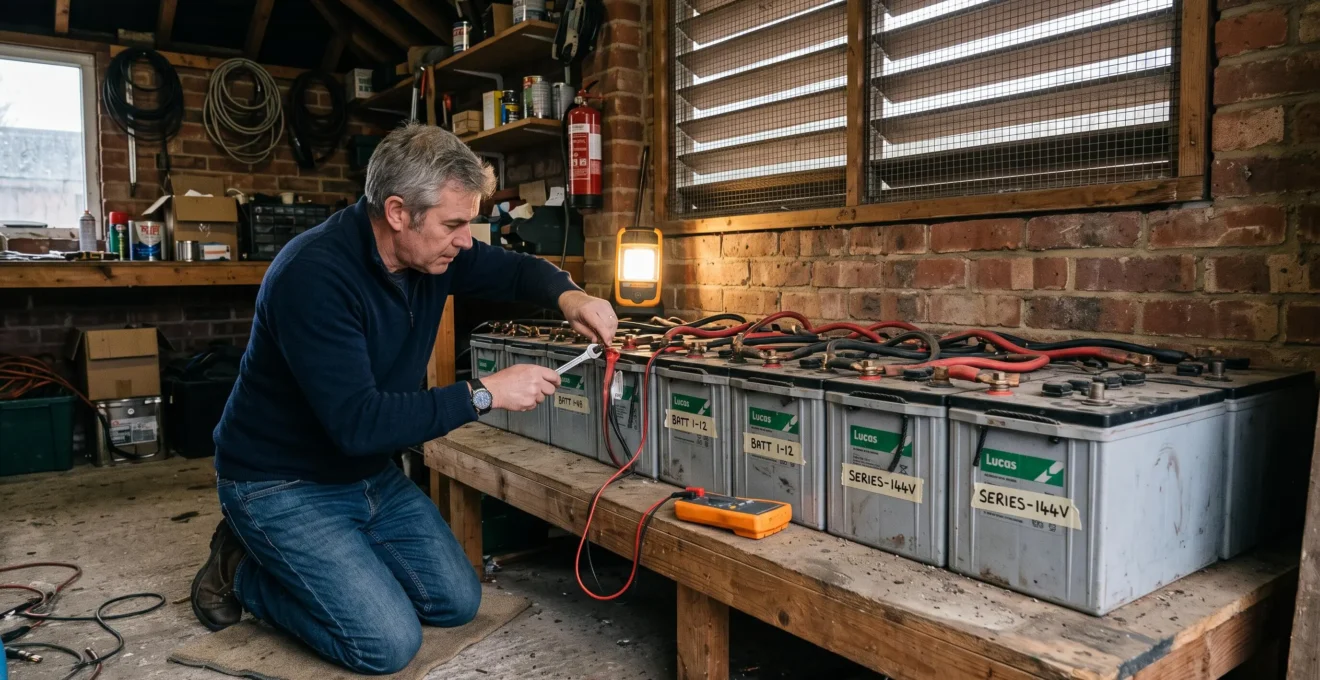
Lead-acid batteries can still beat lithium for budget backup power when outages are occasional, essential loads are modest and the battery spends most of its life properly charged. For a UK homeowner who needs to keep a fridge, router and a few lights running during a power cut, a suitable deep-cycle lead-acid bank can be a sensible purchase.
The calculation changes when that same battery is expected to power a home every night. Lead-acid offers less usable energy than its nameplate suggests, suffers disproportionately from deep cycling and needs disciplined charging. A cheap second-hand bank can become particularly expensive if its remaining capacity is unknown.
There is also a difference between surviving one 12-hour outage and supplying reliable electricity throughout a British winter. Battery capacity, inverter losses, ventilation, charging time and the availability of backup generation all matter.
The practical question is not whether lead-acid is better than lithium in general. It is whether the lower purchase cost still outweighs the maintenance, replacement and capacity penalties under your actual operating conditions.
Lead-acid backup power: the essentials
- Best budget use: occasional outages, shallow discharge and reliable recharging between events.
- Main ownership risk: regularly draining too deeply or leaving batteries partly charged can shorten their working life considerably.
- Before buying: calculate usable kWh, check the installation’s ventilation and charging arrangements, and compare total ownership costs rather than battery prices alone.
- Why Do Lead-Acid Batteries “Die” Quickly When You Discharge Them Too Deep?
- How to Calculate Usable Lead-Acid Capacity So You Don’t Run Flat Overnight?
- AGM vs Flooded Lead-Acid: Which Is Safer Indoors With Limited Ventilation?
- The Charging Mistake That Causes Sulphation and Kills Lead-Acid Banks Early
- When Should You Equalise Lead-Acid Batteries to Extend Life Without Overdoing It?
- How to Convert “2 Days of Backup” Into kWh and kW Without Guesswork?
- Home Battery or Backup Generator: Which Keeps You Running During a 12-Hour Cut?
- Can You Run a UK Home Off-Grid Without Cutting Usage by 50%?
Why Do Lead-Acid Batteries “Die” Quickly When You Discharge Them Too Deep?
Lead-acid batteries deteriorate faster under repeated deep discharge because they lose usable capacity and may develop persistent lead sulphate deposits on their plates. Deep cycling places greater stress on the battery than shallow cycling, while leaving it discharged encourages sulphation. A battery can therefore become unreliable long before it stops producing voltage altogether.
During normal discharge, lead sulphate forms on both battery plates. Proper recharging converts much of it back into the active materials needed for the next cycle. That reaction is normal. The problem develops when the battery remains discharged or repeatedly fails to reach full charge: sulphate deposits can become increasingly difficult to reverse.
Hardened sulphation reduces the active plate area available for energy storage. Once significant permanent damage has occurred, charging alone will not restore the original capacity.
Rated capacity is not the same as practical usable capacity. Consider a hypothetical 12V, 100Ah deep-cycle battery. Its nominal energy is approximately 1.2kWh. If you adopt a conservative 50% depth-of-discharge limit, only about 0.6kWh is available on the DC side before accounting for inverter losses.
That does not mean the battery was falsely labelled. It means the nominal rating describes capacity under specified test conditions, while a longevity-conscious backup design deliberately avoids using all of it.
The usable fraction can also vary with battery design and operating conditions. A conservative installation may plan around 30–50% of nominal capacity, but the actual limit must follow the manufacturer’s cycle-life and discharge specifications.
Lithium iron phosphate (LiFePO4) batteries generally tolerate deeper cycling much better. This makes an important difference in a frequently used system: two banks capable of delivering the same emergency energy may experience very different levels of wear over repeated outages.
Cold conditions create another problem. A discharged lead-acid battery has a more dilute electrolyte, which freezes at a higher temperature than the electrolyte in a fully charged battery. In an unheated UK shed or garage, a severely discharged battery can therefore face freezing damage that a fully charged equivalent would avoid.
For budget backup, avoiding deep discharge is not a minor maintenance preference. It determines how much battery capacity you must purchase in the first place.
How to Calculate Usable Lead-Acid Capacity So You Don’t Run Flat Overnight?
Calculate usable lead-acid capacity by adding the energy needed by essential appliances, allowing for inverter losses and dividing by the permitted depth of discharge. Then convert the required battery energy into ampere-hours at your bank voltage. Check the discharge-rate rating and battery condition before trusting the result, because the nameplate figure is not a guaranteed overnight runtime.
Start with energy consumption rather than battery size. For each appliance, multiply its average operating power in watts by its operating hours. Add those values and divide by 1,000 to obtain kWh.
The basic calculation is:
Required nominal battery energy (kWh) = AC load energy (kWh) ÷ inverter efficiency ÷ usable depth-of-discharge fraction.
Nominal capacity in Ah can then be estimated by multiplying the required kWh by 1,000 and dividing by the bank’s nominal voltage.
Hypothetical UK overnight backup calculation
Assume a 12-hour electricity cut and the following illustrative average loads. These are planning assumptions, not measurements of a particular household.
| Appliance | Assumed power and use | Energy required |
|---|---|---|
| Fridge | 40W average × 12h | 480Wh |
| LED lighting | 20W × 5h | 100Wh |
| Broadband router | 10W × 12h | 120Wh |
| Phone charging | 15W × 2h | 30Wh |
| Total | 12-hour outage | 730Wh |
With an assumed 90% inverter efficiency, the battery must supply approximately 730 ÷ 0.90 = 811Wh.
At a planned 50% depth of discharge, nominal battery energy becomes 811 ÷ 0.50 = 1,622Wh, or approximately 1.62kWh.
For a nominal 12V bank, that corresponds to about 135Ah. A 12V, 150Ah deep-cycle bank would exceed this simplified minimum, but it is not automatically sufficient once discharge-rate effects, ageing, inverter standby consumption and starting surges are considered.
The US Department of Energy lead-acid battery handbook explains why discharge rate matters: capacity falls as discharge current increases. A battery rated over a 20-hour discharge cannot necessarily deliver the same total ampere-hours when emptied much faster. Some products use different rating periods, so always read the applicable datasheet.
This discharge-rate effect is commonly associated with Peukert’s law. Running a large inverter load from a small bank can reduce available capacity beyond the simple watt-hour calculation. Inverter efficiency also changes with load, and a fridge compressor needs adequate starting power even if its average energy consumption is modest.
For second-hand batteries, the uncertainty is greater. An aged 150Ah battery might retain much less than its original rated capacity. A properly conducted capacity test under the manufacturer’s specified conditions is more informative than an open-circuit voltage reading alone.
Five checks before buying your backup battery bank
- Measure essential loads. Create an appliance table with observed watts, operating hours and daily Wh for every circuit you intend to support.
- Calculate usable energy. Record total required kWh, assumed inverter efficiency and the permitted depth of discharge.
- Specify the bank. Write down the required nominal voltage, Ah rating and battery discharge-rate specification.
- Verify charging and installation. Document charger compatibility, ventilation arrangements, cable protection and the applicable battery instructions.
- Check battery condition. Obtain the datasheet and, for used batteries, a credible capacity-test result before calculating cost per usable kWh.
Once the energy requirement is realistic, the next decision is where the bank can safely be installed and which lead-acid construction suits that location.
AGM vs Flooded Lead-Acid: Which Is Safer Indoors With Limited Ventilation?
AGM batteries are generally more practical than flooded lead-acid batteries for indoor backup installations because their valve-regulated construction normally recombines gases internally and requires no water topping-up. However, AGM does not mean gas-free or suitable for an airtight cupboard. Flooded batteries require more ventilation and maintenance, while both types depend on correct charging, electrical protection and installation conditions.
Flooded lead-acid batteries contain liquid electrolyte and commonly use removable vent caps. During charging, particularly near full charge or during overcharging, they can release hydrogen and oxygen. They need suitable ventilation, protection against acid exposure and periodic electrolyte checks according to the manufacturer’s instructions.
AGM stands for absorbed glass mat. Its electrolyte is immobilised in glass-fibre separators, and its sealed, valve-regulated design permits internal gas recombination during normal operation.
Recombination reduces routine gas release; it does not eliminate the possibility of venting. Overcharging, excessive temperature or internal faults may cause an AGM battery to release gas through its pressure-relief valves.
Hydrogen is lighter than air and can accumulate in poorly ventilated high spaces. Its flammability makes ventilation, ignition-source separation and suitable electrical equipment essential. Do not assume a small gap above an AGM battery provides adequate ventilation; follow the manufacturer’s installation requirements and obtain competent electrical advice for enclosed domestic spaces.
A useful comparison extends beyond purchase price:
| Criterion | Flooded lead-acid | AGM lead-acid |
|---|---|---|
| Initial purchase cost | Generally lower for comparable deep-cycle products | Generally higher |
| Routine maintenance | Electrolyte checks, suitable topping-up and terminal inspection | No routine water topping-up; inspection still required |
| Ventilation | Designed ventilation is essential | Ventilation still required according to installation guidance |
| Indoor suitability | Less convenient, particularly in confined living spaces | More practical where installation conditions permit |
| Charging risks | Gassing, water loss, corrosion and overheating | Valve venting, drying, swelling and overheating |
| Neglect-related failure | Low electrolyte levels and poor maintenance | Incorrect charging and undetected deterioration |
Flooded batteries may offer better value where a dedicated, appropriately ventilated outbuilding or battery room already exists. AGM can justify its premium where access is restricted and liquid-electrolyte maintenance would be inconvenient.
Neither construction belongs in an unventilated living cupboard simply because it fits. A properly protected installation must also account for battery short-circuit currents, cable sizing, fusing, temperature and accessibility.
The safer battery is the one whose ventilation, charging and protection requirements can actually be met. Once installed, charging practice becomes the main factor governing whether the investment lasts.
The Charging Mistake That Causes Sulphation and Kills Lead-Acid Banks Early
The charging mistake that most often accelerates lead-acid sulphation is repeatedly leaving the battery partly charged instead of completing an appropriate recharge. A battery may receive enough energy to operate again without reaching full charge. Over time, persistent lead sulphate reduces capacity, while an unsuitable charging profile can also cause corrosion, gas loss or overheating.
Lead-acid charging commonly follows three main stages: bulk, absorption and float. Bulk restores much of the discharged energy, absorption completes charging at a controlled voltage, and float maintains a charged battery during standby.
The distinction matters because reaching an apparently healthy voltage does not prove that charging has finished. During absorption, the charging current typically decreases as the battery approaches full charge. Cutting this stage short repeatedly leaves some active material insufficiently restored.
As described in the Victron Energy battery charger manual, batteries left insufficiently charged can deteriorate through sulphation. The manufacturer also warns that excessive charging can accelerate corrosion, so simply increasing voltage or extending charging indefinitely is not a safe solution.
For backup systems, two operating patterns need different attention.
- Occasionally used standby banks: the charger must maintain the correct float conditions over long periods, with temperature compensation where specified. After an outage, it must complete the recommended recharge rather than returning prematurely to standby.
- Frequently cycled banks: charging equipment must provide enough time and energy for regular full recharging. Repeated cloudy days or limited generator runtime can leave the bank in a damaging partial state of charge.
Check the charger’s battery-type setting, absorption and float parameters, temperature compensation and maximum charging current against the actual battery datasheet. Flooded, AGM and gel batteries must not be treated as interchangeable charging loads.
If mild sulphation is suspected, first check for other causes of lost capacity, including temperature, wiring faults, imbalance and battery ageing. Some manufacturers describe controlled conditioning procedures that can partially improve early sulphation. These are battery-specific interventions, not permission to raise voltage experimentally.
Hardened sulphation is not reliably reversible. A charger advertised as a universal desulphator cannot guarantee recovery, and attempting aggressive reconditioning can create additional hazards. Do not apply a flooded-battery equalisation procedure to AGM or gel batteries without explicit manufacturer authorisation.
A standby bank also needs periodic readiness checks. Confirm that the charger is functioning, the bank reaches its prescribed charged condition, connections remain sound and a supervised functional test demonstrates that essential loads can still run.
Correct charging prevents many avoidable failures. Flooded batteries may additionally benefit from equalisation, but only when their condition and the manufacturer’s instructions justify it.
When Should You Equalise Lead-Acid Batteries to Extend Life Without Overdoing It?
Equalise a flooded lead-acid battery when its manufacturer recommends the procedure and battery measurements indicate that it is appropriate, rather than automatically following a monthly calendar. Equalisation is a controlled overcharge that can address electrolyte stratification and cell imbalance. It produces significant gassing and must not be applied routinely to AGM, gel or other batteries that prohibit it.
Flooded batteries can develop unequal conditions between cells. Their liquid electrolyte may also stratify, with denser acid settling towards the bottom. A properly controlled equalisation charge produces gassing that helps mix the electrolyte and can bring undercharged cells closer to the others.
However, equalisation consumes water, generates heat and imposes additional stress. Doing it too often can accelerate deterioration instead of preventing it.
For suitable accessible flooded batteries, a temperature-corrected hydrometer reading provides useful evidence of cell condition. Readings should be interpreted under the conditions specified by the battery manufacturer, normally after a full charge.
Trojan Battery provides a concrete example: its maintenance guidance identifies low or widely differing specific-gravity readings, including a spread greater than 0.030, as a reason to consider equalisation on covered flooded batteries. That threshold is a manufacturer-specific criterion, not a universal trigger for every product.
Before considering equalisation, confirm that the battery is an eligible flooded model, has completed its normal charging cycle and is in a safe condition for further charging. Inspect electrolyte levels as directed, use appropriate eye and hand protection, and ensure adequate ventilation away from flames and sparks.
During an authorised equalisation, follow the prescribed charger settings and monitor battery temperature, electrolyte condition and specific gravity. Trojan’s procedure calls for hourly specific-gravity checks and identifies the point at which readings stop increasing during gassing as the completion criterion.
Stop the process if excessive temperature, abnormal behaviour or other manufacturer-defined limits are encountered. Do not continue charging simply because a fixed number of hours has not elapsed.
The Victron Energy charge controller operating instructions explicitly warn against equalisation charging for AGM, gel, VRLA and lithium batteries. Exceptional manufacturer-approved conditioning procedures are not equivalent to routine flooded-battery equalisation.
Equalisation can correct certain charging imbalances, but it cannot make a worn-out bank new. Proper maintenance only delivers value when the system is sized to avoid excessive discharge in the first place.
How to Convert “2 Days of Backup” Into kWh and kW Without Guesswork?
Two days of backup means supplying your essential loads for approximately 48 hours, not purchasing a battery labelled for two days. Calculate the energy those loads consume in kWh, then allow for permitted depth of discharge and electrical losses. Separately, calculate the highest simultaneous power demand in kW so the inverter can run your appliances without tripping.
The units describe different things:
- kW measures power: how quickly equipment consumes electricity at a particular moment.
- kWh measures energy: the total electricity consumed over a period.
- Ah measures electrical charge: it becomes useful for energy planning only when considered alongside voltage and relevant rating conditions.
A 1kW load running for one hour consumes 1kWh. A 100W load running for ten hours also consumes 1kWh. Their energy demand is identical, but their immediate inverter power requirements differ significantly.
Suppose a hypothetical household measures 1.5kWh of essential electricity use over 24 hours. Two days requires 3kWh delivered to those loads.
Using an illustrative 90% inverter efficiency and 50% usable depth of discharge:
Nominal battery capacity = 3kWh ÷ 0.90 ÷ 0.50 = approximately 6.67kWh.
At a nominal 24V, that represents approximately 278Ah of nominal bank capacity before allowances for ageing, discharge-rate effects, temperature and additional system losses.
By comparison, a household using only 0.8kWh of essentials per day would require about 3.56kWh of nominal lead-acid capacity under the same assumptions. A household consuming 3kWh per day would require approximately 13.33kWh. The label “two days of backup” therefore says little without a measured load figure.
For realistic inputs, use a plug-in energy monitor for suitable appliances, an inverter’s recorded consumption data, or a smart meter when its measurements can isolate the circuits concerned. A fridge’s rated compressor power is not its continuous average consumption, and heating or cooking loads can change the calculation dramatically.
Power sizing needs its own check. Add appliances that might operate simultaneously and account for motor-starting surges, particularly refrigeration equipment. A bank can contain enough total energy yet still fail to start a compressor if the inverter or battery cannot deliver the required short-term current.
The larger capacity requirement is one of lead-acid’s principal disadvantages against lithium. When a substantial share of the nominal energy is intentionally reserved to protect cycle life, additional batteries, space, cabling and structural support may be needed.
If the resulting battery bank is too large or expensive, the solution may be to combine a smaller bank with another source of electricity rather than buying still more storage.
Home Battery or Backup Generator: Which Keeps You Running During a 12-Hour Cut?
A properly sized home battery can maintain essential loads throughout a 12-hour power cut silently and without fuel handling. A generator can extend backup for as long as suitable fuel, maintenance and safe operating conditions permit, but it introduces noise, exhaust and refuelling requirements. On a limited budget, combining a modest battery with a compatible generator may provide better long-outage resilience than relying on one large battery bank.
Battery backup is particularly convenient for essential electronics. With a correctly configured UPS or automatic transfer system, suitable loads can continue operating without significant interruption. A basic manually switched inverter system, however, may not provide seamless operation.
A generator brings different strengths. It can supply power while operating and may recharge a battery bank through appropriate equipment. Its limitations include fuel availability, servicing, noise and the need to start and connect it safely.
Never run a combustion generator indoors, in a garage, in a shed or beside openings into occupied buildings. Carbon monoxide from the exhaust can be fatal. Operate it outdoors in accordance with its instructions, and use a professionally designed connection arrangement that prevents dangerous backfeeding into the electricity network.
The practical differences are easier to see side by side.
| Consideration | Lead-acid battery backup | Portable generator |
|---|---|---|
| Runtime | Limited by stored usable energy | Extended through refuelling where safe and practical |
| Noise | Generally quiet apart from equipment fans | Engine noise during operation |
| Response | Potentially immediate with suitable transfer equipment | Requires starting and transfer arrangements |
| Fuel | Electricity needed for recharge | Stored fuel required |
| Placement | Potential indoor installation with appropriate ventilation and protection | Outdoor operation only |
| Maintenance | Battery condition and charging checks | Engine servicing, fuel management and exercise runs |
| Main constraint | Finite stored energy and battery ageing | Fuel logistics, exhaust safety and operating noise |
Consider a hypothetical household that needs 730Wh of AC electricity during a 12-hour outage. A correctly sized battery bank could supply that energy without running an engine. If the outage continues for another day, however, the battery must either be recharged or the household must reduce consumption.
A compatible generator can then provide supplementary power and charge the bank, subject to charger ratings and fuel availability. The generator should be sized for its simultaneous loads and charging demand, not merely the battery’s nominal capacity.
A second-hand generator combined with a modest lead-acid bank may offer a lower purchase cost than an oversized battery system, but the comparison needs actual equipment prices, condition assessments, fuel costs and expected usage. No universal saving can be assumed.
Occasional emergency backup is one thing. Replacing grid electricity every day, especially through winter, exposes lead-acid batteries to a much more demanding operating pattern.
Key takeaways before choosing an off-grid system
- A low-cost lead-acid purchase makes the strongest financial case when discharge is infrequent and enough charging time is available between events.
- Winter generation, peak power demand and the ability to complete charging matter as much as the battery’s nominal kWh rating.
- Compare three distinct goals: emergency backup, substantial grid independence and permanent off-grid living. Each requires a different investment and reliability margin.
Can You Run a UK Home Off-Grid Without Cutting Usage by 50%?
A UK home can operate off-grid without halving electricity consumption, but doing so generally requires enough renewable or generator capacity, battery storage and backup provision to meet winter demand. Lead-acid alone rarely provides a cheap route to unrestricted year-round use. A grid-connected or hybrid system is often more practical because it avoids sizing every component around the most difficult winter conditions.
There is no universal requirement to reduce household consumption by exactly 50%. The necessary reduction depends on existing electricity use, available generation, the appliances being retained and the acceptable risk of running out of power.
For a household using substantial electric heating, cooking or hot-water loads, maintaining normal habits off-grid can demand a significantly larger power system than one supporting lighting, refrigeration and communications.
UK winter conditions make the decision harder. Short daylight hours and prolonged cloudy weather reduce solar generation at the same time that household electricity demand may increase. A lead-acid bank repeatedly charged only partway through these periods is exposed to the sulphation problems already described.
A large battery can store energy already generated; it cannot solve a prolonged generation shortfall by itself.
Three approaches offer different levels of independence.
| Approach | Battery and generation requirements | Practical compromise |
|---|---|---|
| Grid-connected emergency backup | Battery sized around essential outage loads and desired runtime | Normal grid supply remains available; suitable isolation and changeover equipment required |
| Mostly off-grid with grid fallback | Generation and storage sized to cover substantial everyday use | Grid electricity fills winter shortages and reduces prolonged undercharging risk |
| Fully off-grid | Generation, storage and supplementary supply sized for poor-weather conditions | Highest planning burden; demand management or backup generation remains important |
For scale, consider a purely hypothetical home consuming 10kWh per day. Two days without any generation would require 20kWh delivered to AC loads. At a planned 50% lead-acid depth of discharge and assumed 90% inverter efficiency, the simplified nominal storage requirement would be about 44.4kWh.
That is before battery ageing, high-rate discharge losses, cold-weather derating or extra reserve capacity. It also does not guarantee that winter solar generation could subsequently recharge the bank.
Reducing daily demand to 5kWh would halve the energy-related storage requirement under otherwise identical assumptions. But the household might achieve its objective more sensibly by retaining the grid, adding backup generation or selecting a battery chemistry better suited to daily cycling.
Lead-acid remains competitive when the installation is designed around its strengths: relatively low initial expenditure, infrequent shallow discharge, suitable ventilation and the ability to restore full charge reliably. A tested second-hand bank can sometimes reduce entry cost further, provided its remaining capacity, physical condition and safe charging requirements are understood.
By contrast, daily deep cycling makes lithium iron phosphate increasingly attractive because more of the nominal capacity can typically be used and cycle-life performance is generally better under suitable operating conditions. The precise economic break-even point depends on real product prices, warranted cycles, efficiency, installation costs and replacement needs. A universal cost advantage cannot be established without those figures.
Before spending money, write down the outage duration you genuinely need to cover, measure the appliances that must stay on and obtain manufacturer specifications for the batteries under consideration. Compare the complete installed cost of lead-acid, lithium and battery-generator options over the expected operating life. Choose lead-acid where its shallow-cycle economics still hold up, not simply because its purchase price is lowest.
Can you safely buy second-hand lead-acid batteries for home backup?
Second-hand deep-cycle batteries can be considered if their history, construction, age and measured remaining capacity are credible. Inspect for swelling, leaks, corrosion and damaged cases. A resting voltage reading alone cannot establish usable capacity or remaining service life. Avoid building a bank from mismatched batteries with unknown condition, and do not assume a low purchase price means low lifetime cost.
Are ordinary car batteries suitable for overnight backup?
Starter batteries are designed primarily to deliver high current for engine starting rather than withstand repeated sustained discharge. They may provide temporary emergency power when used within their ratings, but dedicated deep-cycle batteries are generally more appropriate for a system expected to support household loads over many hours and repeated outages.
Can a 12V lead-acid battery run a fridge through an inverter?
Yes, provided the inverter supplies the fridge’s required AC voltage, running power and compressor-starting surge, and the battery can supply the corresponding DC current. Runtime depends on the fridge’s measured energy consumption, battery condition, allowable discharge and inverter losses. Adequate fusing, cable sizing and compatible equipment are essential.
Should a standby lead-acid battery remain connected to a charger?
A compatible charger with an appropriate float or storage profile can maintain a standby lead-acid battery between outages. Its settings must match the battery type and manufacturer specifications, including temperature-related requirements where applicable. A basic charger lacking suitable charge control should not be assumed safe for permanent connection. Periodic condition checks remain necessary.
What is the first warning that a lead-acid backup bank is failing?
Reduced runtime under a comparable load is a useful warning, particularly when the bank appears charged but its voltage falls rapidly during discharge. Other warning signs include unusual heating, swelling, electrolyte problems and persistent charging imbalance. Stop using visibly damaged or abnormally hot batteries and arrange a suitable inspection. A controlled capacity test can help distinguish deterioration from incorrect sizing or charging faults.