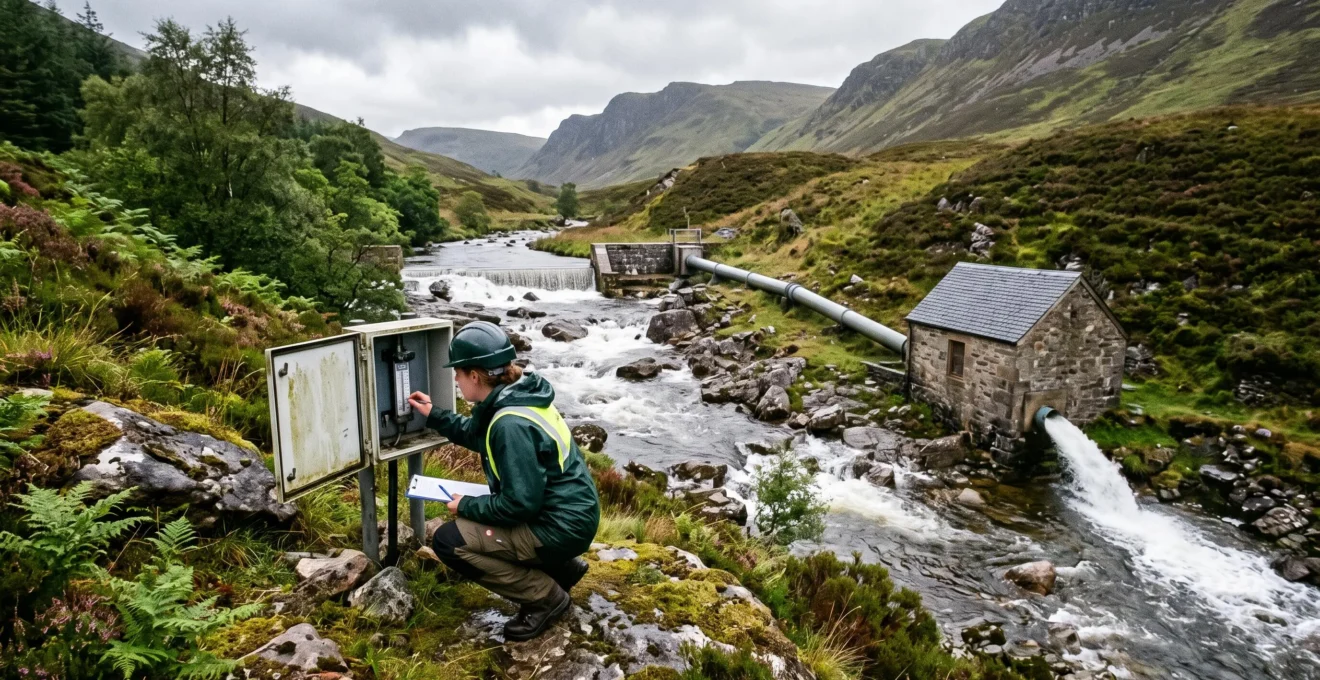
A small hydropower plant can generate electricity through the night, beneath cloud cover and throughout much of the winter because its energy comes from flowing water rather than immediate sunlight. Where river discharge remains sufficient, a turbine can operate continuously for extended periods, producing a steadier supply than an equivalent installation dependent on daylight.
That advantage is particularly relevant to the UK, where short winter days constrain solar generation while some upland catchments receive substantial rainfall. Yet the distinction is not simply that hydro works and solar stops. River flows change with rainfall, drought, upstream abstraction and environmental restrictions. Small run-of-river plants also behave differently from reservoir installations capable of storing water.
For property owners, developers and anyone comparing renewable technologies, the useful question is whether the available resource matches electricity demand over the year. Understanding capacity factor, hydraulic head, seasonal flow and ecological constraints makes that comparison considerably more meaningful than comparing installed kilowatts alone.
Small hydropower reliability: the essential points
- Steadier generation: Hydropower can operate day and night when river flow is adequate, whereas solar PV depends on daylight and irradiance.
- Site-dependent performance: Usable vertical head, available water flow and environmental restrictions determine how much electricity a small hydro scheme can produce.
- Different trade-offs: Hydro may suit continuous electricity demand, but suitable UK sites are uncommon and ecological requirements can substantially affect feasibility.
- Why Does Water Flow Create a Higher Capacity Factor Than Sun or Wind?
- How to Estimate Hydropower Output Using Only Head and Flow in 5 Minutes?
- Run-of-River vs Reservoir Hydro: Which Better Matches Steady Demand?
- The “Clean Hydro” Assumption That Ignores the Biggest Local Environmental Risk
- When Does Hydropower Output Drop Most: Late Summer or Mid-Winter?
- Why Is Water Height More Important Than Flow Speed in Many Hydro Setups?
- How to Shortlist Renewables for Your Home Using 5 Site Questions?
- Which Renewable Energy Source Works Best for UK Homes With Limited Roof Space?
Why Does Water Flow Create a Higher Capacity Factor Than Sun or Wind?
Hydropower can achieve a higher capacity factor than solar or wind when sufficient water is available for generation across more hours of the year. Unlike solar panels, a hydro turbine does not require daylight, and unlike a wind turbine, it does not depend on suitable wind speeds at the generating equipment. However, actual capacity factors depend on the site, plant design and operating restrictions.
Capacity factor measures the electricity a plant actually generates over a period against what it would produce if it operated at its rated capacity continuously. It is not the same as conversion efficiency, installed capacity or total annual generation.
Consider two hypothetical systems with the same rated power. One produces strongly during sunny afternoons but nothing overnight. The other operates at a lower, relatively stable output for most hours. The second may achieve a higher capacity factor because its generating hours are distributed more evenly.
That distinction matters for continuous electricity demand. A predictable hydro output can reduce the amount of energy that must be supplied by the grid or storage during periods without sunshine. Nevertheless, a larger solar installation could still deliver more total electricity over a year. Consistency and annual output are separate performance measures.
Reservoir hydropower adds another capability: stored water can be released to respond to demand. The US Department of Energy overview of hydropower plant types distinguishes reservoir-based impoundment from diversion systems that channel flowing water through turbines. These technical distinctions apply beyond the United States, although its plant-size classifications should not be treated as UK regulatory categories.
UK geography can favour hydro in suitable upland catchments. Parts of Scotland, Wales and northern England combine substantial rainfall with steep terrain, creating opportunities for usable hydraulic head and recurring river flow. Solar resource availability, meanwhile, changes considerably with day length and season.
Water availability is not guaranteed. Extended dry periods, competing abstractions, equipment outages and licence conditions can all reduce generation. A run-of-river turbine has no inherent ability to generate at full output when its stream runs low.
Hydro’s reliability advantage is therefore conditional: it arises from a suitable water resource and operating profile, not simply from installing a turbine. Quantifying that resource is the next step.
How to Estimate Hydropower Output Using Only Head and Flow in 5 Minutes?
A quick hydropower estimate requires two physical measurements: net head, the usable vertical drop in metres, and turbine flow in litres per second. Multiplying these by 9.81 and an assumed overall efficiency gives approximate electrical power in watts. The result provides an initial screening figure, not an annual generation forecast or evidence that a site is developable.
The simplified calculation is:
Power (W) ≈ Net head (m) × Turbine flow (L/s) × 9.81 × Overall efficiency
For a hypothetical UK stream with 10 metres of net head, 100 litres per second of usable turbine flow and an assumed overall efficiency of 60%:
Power ≈ 10 × 100 × 9.81 × 0.60 = 5,886 W, or approximately 5.9 kW.
This calculation uses the standard gravitational acceleration approximation and water density appropriate for an initial freshwater estimate. The 60% efficiency is an illustrative assumption within the 0.5–0.7 screening range, not a verified value for a particular turbine. Net head must already account for hydraulic losses; using the full gross elevation difference can overestimate output.
The result describes estimated power at that particular flow. It does not show how frequently that flow will be available. Multiplying 5.9 kW by every hour of the year would only represent a continuous-operation scenario, not realistic annual generation.
A useful desktop assessment begins with river gauging records from the Environment Agency or SEPA, where applicable, alongside Ordnance Survey mapping and elevation information. These resources can help identify potential flow and head, but a nearby gauging station may not represent the actual intake location.
More importantly, river flow is not the same as legally usable turbine flow. Water must remain in the watercourse to protect ecological functions, and abstraction conditions may restrict turbine operation during low-flow periods.
For example, the Environment Agency hydropower abstraction guidance explains how river sensitivity, hands-off flow thresholds and permitted abstraction affect hydropower projects in England.
The most common estimation error is choosing a peak discharge or annual average as though it were available continuously. A flow duration curve provides a better basis for modelling generation because it shows the proportion of time that different river flows are equalled or exceeded.
For a meaningful forecast, combine that curve with ecological restrictions, turbine operating limits, efficiency across different flow rates and expected downtime. Grid connection, abstraction permissions, fish passage, access and civil engineering costs then determine whether technically available power can become a viable project.
Once potential output has been estimated, the next engineering decision is whether the plant will simply follow river discharge or use water storage to control when electricity is delivered.
Run-of-River vs Reservoir Hydro: Which Better Matches Steady Demand?
Reservoir hydropower generally provides more control over electricity delivery because stored water can be released when demand rises, subject to storage and environmental limits. Run-of-river hydro usually follows natural river discharge, making output less controllable but potentially more continuous when flows remain adequate. For small UK projects, the better choice depends on land, permissions, economics and the required demand profile.
A run-of-river system typically diverts part of the stream through a channel or penstock, passes it through a turbine and returns it downstream. It may use an intake structure or weir but does not normally rely on a large storage reservoir. Generation therefore rises or falls with usable flow.
Reservoir hydropower stores water upstream, allowing operators to shift some generation between periods. This gives it greater potential to respond to peaks or supply during temporary inflow reductions, provided sufficient stored water remains available.
Storage comes with substantial additional considerations: inundated land, dam safety, civil construction, altered river habitat, sediment management and potentially more demanding approvals.
The operational differences can be summarised as follows.
| Decision factor | Run-of-river | Reservoir |
|---|---|---|
| Generation profile | Follows usable river flow | Can shift generation using stored water |
| Response to demand peaks | Limited without additional storage | Potentially more flexible |
| Low-flow periods | Output may fall sharply or stop | Stored water can temporarily support output |
| Construction | Typically smaller storage requirements | Additional storage infrastructure |
| Environmental impacts | May affect bypassed reaches and river connectivity | May also affect inundated habitat and flow regulation |
| Best operational fit | Demand that can use variable ongoing production | Demand requiring more controllable delivery |
A lower-impact design is not automatically harmless. Run-of-river installations can still reduce flow through bypassed reaches, interfere with fish movement and alter local sediment processes. Conversely, the ecological consequences of a reservoir depend on its design, location and operation.
New reservoir construction creates particularly difficult economic and environmental questions for small schemes. This helps explain the practical attraction of run-of-river layouts, although the supplied evidence does not establish the proportion of new UK projects using each design.
Existing weirs and former mill sites deserve attention because they may already contain usable hydraulic structures. Reusing them can reduce some construction requirements, but the condition of the structure, ecological effects and legal permissions still require assessment.
For a site seeking continuous self-consumption, compare the hydro output profile against actual hourly demand. For a project primarily exporting electricity, examine realistic annual generation, export arrangements and operating costs. Neither decision can be made reliably from installed capacity alone.
Storage can make hydropower more dispatchable, but it does not create additional rainfall or remove environmental constraints. Those constraints are often decisive long before turbine procurement begins.
The “Clean Hydro” Assumption That Ignores the Biggest Local Environmental Risk
Small hydropower generates electricity without burning fuel at the turbine, but its most important local environmental risks often involve river connectivity and aquatic habitats. Weirs, diversions and altered flows can obstruct fish migration, modify sediment movement and affect the ecological condition of downstream reaches. Renewable electricity benefits therefore need to be assessed alongside the river changes required to produce it.
Fish migration is a particularly significant concern. Species moving upstream to spawn or downstream during different life stages may encounter barriers, turbine intakes or stretches with reduced water depth.
Welsh regulatory guidance illustrates why a physically small installation still requires careful engineering. Natural Resources Wales guidance on fish passes for hydropower weirs explains the need to accommodate upstream and downstream movement, including arrangements for species such as salmon, trout and eels.
Fish passes, easements, suitable screening and protected downstream routes may all become relevant, depending on the species present and the design of the proposed scheme.
Other effects are less immediately visible. A diversion may change the amount of water moving through a natural channel between the intake and the return point. Changes in flow can influence habitat availability and sediment transport even when the plant operates quietly and has little visual impact.
Environmental flow requirements directly affect generation. In England, the Environment Agency’s hydropower abstraction framework uses sensitivity categories and flow thresholds to determine potential abstraction conditions.
35%–45%
The default percentage take above hands-off flow in Table A of the Environment Agency’s guidance ranges from 35% for high-sensitivity water bodies to 45% for low-sensitivity water bodies, with 40% for medium sensitivity. These are regulatory starting points for specified circumstances in England, not universal turbine-flow allowances or guaranteed annual water availability.
Environment Agency, hydropower abstraction guidance, 15 May 2026.
Such limits can substantially change the financial model. A turbine sized for unrestricted high flow may spend much of the year operating below its intended output, or may have to stop when the river reaches a protected threshold.
The relationship between environmental protection and production is not simply a choice between an unrestricted turbine and an ineffective one. Better intake design, appropriate turbine selection, operating controls and fish passage arrangements can improve outcomes. However, maintaining more water in sensitive reaches can reduce the amount available for generation.
The regulatory framework also differs across the UK. The Environment Agency regulates relevant activities in England, SEPA in Scotland, Natural Resources Wales in Wales, and the Northern Ireland Environment Agency handles relevant environmental controls in Northern Ireland. The required permissions and design obligations must be checked for the specific site and activity.
Catchment-wide effects matter as well. Several individually modest barriers can collectively fragment habitats or disrupt migration along a river system. Assessing only the immediate turbine site may overlook these wider consequences.
These restrictions become particularly important when water availability is already low, which makes seasonal hydrology central to both environmental protection and output forecasting.
When Does Hydropower Output Drop Most: Late Summer or Mid-Winter?
For many UK run-of-river schemes, late summer or early autumn can be the most difficult period because prolonged lower river flows restrict turbine output. Wetter winter conditions often improve water availability, creating a useful contrast with solar’s shorter winter generating days. However, the lowest-output month cannot be predicted reliably without local flow records and an understanding of the catchment.
The seasonal contrast reflects the different resources used by the technologies. Solar PV responds to available irradiance, daylight duration, panel orientation and shading. Run-of-river hydro responds primarily to the amount of water that can pass through its turbine at the available head.
Historical UK climate data illustrate the broader pattern. The Met Office’s 1991–2020 reference averages show substantial differences in sunshine and rainfall across the year, but rainfall cannot be translated directly into turbine discharge without considering local hydrology.
42.68 vs 192.15 hours
Average UK sunshine duration in December and May, respectively, within the 1991–2020 reference period. The contrast helps illustrate seasonal solar-resource variation, but sunshine hours alone do not establish solar PV capacity factor or electricity production.
In the same reference period, the supplied Met Office figures indicate average UK rainfall of 127.16 mm in December and 70.96 mm in May. These values support the existence of seasonal rainfall differences at national scale, not a specific monthly hydro generation forecast.
River response is shaped by catchment storage, groundwater, soil saturation, upstream water management and rainfall timing. A groundwater-fed stream may maintain flow longer through a dry summer than a small, rapidly responding upland catchment.
Low water levels can also create two simultaneous performance losses. First, less water is available to pass through the turbine. Second, some turbines operate less efficiently when flow falls significantly below their preferred operating range.
When usable flow drops below the equipment’s minimum operating requirement, generation may cease altogether. Ecological hands-off conditions can force a shutdown before the physical flow becomes insufficient to turn the turbine.
For mixed renewable systems, seasonal complementarity can be valuable. Stronger hydro production during wetter periods may partly offset weaker winter solar output, while solar can contribute during drier, brighter months. The effectiveness of this pairing must still be verified using matching site-specific records.
Climate variability introduces further uncertainty. Historical averages describe past conditions; they cannot guarantee future drought frequency, low-flow severity or seasonal timing.
Understanding seasonal flow establishes when water is available. The other essential variable is how much useful energy can be extracted from each unit of that water.
Why Is Water Height More Important Than Flow Speed in Many Hydro Setups?
In conventional head-based hydropower, the vertical drop between the water intake and turbine discharge determines the potential energy available per unit of water. A stream descending through a substantial height can therefore offer meaningful generating potential even if its visible surface flow seems modest. Fast-moving water on nearly level ground does not provide the same usable gravitational head.
This distinction is easy to miss when looking at a river. Turbulent water can appear powerful, but visible surface speed does not reveal how much pressure and elevation difference can be converted into electricity by a conventional hydro turbine.
Hydraulic head is measured in metres. Gross head is the elevation difference between the upstream and downstream water levels. Net head is the usable difference after accounting for losses in pipes, channels and associated equipment.
The power equation makes the relationship clear: with turbine flow and overall efficiency unchanged, doubling net head doubles calculated power. Doubling usable flow also doubles calculated power under the same assumptions.
For a hypothetical comparison, a site with 20 metres of net head and 50 litres per second of turbine flow has the same theoretical hydraulic power as one with 5 metres of net head and 200 litres per second. Both have a head-flow product of 1,000 before applying gravity and efficiency.
They may nevertheless have very different construction costs, turbine requirements and environmental constraints.
Higher-head sites can often obtain useful output with smaller water flows, making penstock-based layouts attractive where terrain provides sufficient elevation difference. Lower-head sites generally need larger flows for comparable output, which can require more substantial channels, intakes or turbine structures.
Head also helps narrow equipment selection:
- Pelton and Turgo turbines: Common candidates for higher-head applications where water is directed through jets.
- Crossflow turbines: Potentially suitable across a range of small hydro conditions, depending on manufacturer design and site characteristics.
- Archimedean screws: Often considered for low-head installations with suitable flow and civil arrangements.
- Kaplan-type turbines: Relevant to low-head, higher-flow applications where their operating characteristics justify the design.
These are engineering tendencies rather than fixed selection rules. Equipment choice requires consideration of operating flow range, efficiency, debris, fish protection, maintenance and capital cost.
Head-poor sites can be particularly challenging because large water volumes and civil works may be needed to produce relatively modest power. In lowland areas, an apparently energetic river may therefore fail economic feasibility checks even though usable water is present.
Flow duration remains equally important. A substantial vertical drop cannot compensate for a stream that lacks sufficient legally available flow through much of the year.
For household applications, that technical screening should form part of a broader comparison with other renewable options and the property’s actual constraints.
How to Shortlist Renewables for Your Home Using 5 Site Questions?
The most useful way to shortlist home renewables is to assess the property’s water resource, roof suitability, wind exposure, electricity demand and regulatory constraints. These five questions reveal whether hydro, solar or small wind has a realistic opportunity to perform well at the site. The preferred technology should match the available resource and consumption pattern, not simply offer attractive rated power.
Start with physical suitability. A property without access to a usable watercourse has no conventional on-site hydro opportunity, regardless of the theoretical reliability advantage. Similarly, a severely shaded roof may deliver disappointing solar generation despite ample panel space.
Wind requires a different assessment. Open terrain and exposure can be beneficial, while surrounding buildings, trees and terrain-induced turbulence may undermine the performance of a small turbine.
Next, examine when electricity is consumed. A home using most electricity in the evening has different requirements from a property with substantial daytime loads. A workshop, farm or off-grid installation with continuous consumption may place greater value on stable generation.
Finally, compare the practical barriers. Hydro can require water rights, environmental assessment and civil works. Small wind may involve planning and siting restrictions. Solar depends on roof condition, structural suitability, electrical design and installation constraints.
Planning rules differ across England, Scotland, Wales and Northern Ireland. Grid connection arrangements also depend on the local Distribution Network Operator (DNO), and export-payment eligibility should be checked against the applicable scheme and certification requirements, including MCS where relevant.
Five site checks to complete before choosing a renewable system
- Record the water opportunity. Identify any watercourse on or near the property, note possible access and water rights, and prepare a preliminary head-and-flow worksheet or document why hydro is unsuitable.
- Map usable solar space. Mark roof or ground areas, orientation, shading and visible structural concerns on a simple annotated property plan.
- Assess wind exposure. Record nearby obstructions, terrain and available wind information in a short site-exposure note, identifying where specialist measurement would be needed.
- Describe electricity demand. Use available meter or billing information to prepare a day-versus-night and seasonal consumption profile, distinguishing measured data from estimates.
- Check project constraints. Create a feasibility checklist identifying the relevant planning authority, DNO, environmental regulator and installer or technical specialist to consult.
These deliverables allow competing technologies to be compared on consistent grounds. They also expose uncertainty before installation quotes are treated as financial commitments.
A small hydro estimate should not be rejected solely because its rated output appears modest: long generating hours can make lower continuous power valuable. Equally, a solar design should not proceed without checking shading, roof structure and realistic seasonal production.
Demand matching is the final filter. Hydro can favour continuous consumption where water is reliably available; solar often favours accessible daylight generation; wind can suit genuinely exposed sites with adequate permissions and economics.
For many UK households, the decisive limitation is simpler than turbine performance: there is no viable watercourse, insufficient land for wind, or too little suitable roof area.
Key takeaways before choosing a home renewable system
- Separate technical potential from practical access: A highly reliable hydro resource has little household value if the property cannot legally or physically use it.
- Compare usable annual generation: Calculate likely self-consumption and seasonal availability rather than choosing the highest nameplate capacity.
- Keep alternatives open: Limited roof space does not necessarily prevent a household from supporting renewable generation elsewhere.
Which Renewable Energy Source Works Best for UK Homes With Limited Roof Space?
For UK homes with limited roof space, the best renewable option depends on what land, resource access and installation rights remain available. Small hydropower can be attractive where a suitable watercourse exists, while ground-mounted solar may suit properties with usable garden space. Without adequate roof, land or water access, community energy participation and renewable electricity tariffs may be more realistic than on-site generation.
Solar remains a practical starting point for many households because panels can use existing roof surfaces without requiring a river or large exposed plot. A suitable domestic array can generate several thousand kilowatt-hours annually, although actual production depends on system capacity, location, orientation, shading and other site conditions.
Limited roof space does not automatically eliminate solar. Smaller arrays may still be worthwhile where installation costs and electricity use support the case. Ground-mounted panels are another possibility for properties with sufficient unshaded land, subject to planning and installation requirements.
Hydro has a different physical requirement. A home near a viable stream may be able to use a relatively small turbine installation to produce electricity for many hours, including overnight and during periods of weak sunlight.
However, proximity to water is not enough. The scheme needs suitable head, adequate flow, permissions, safe access, workable civil engineering and an economically proportionate electrical connection. Most ordinary urban and suburban households do not have those conditions readily available.
Small wind presents similar site-selection challenges. Turbulence, neighbouring buildings, restricted space and planning considerations can make domestic turbines unattractive even where larger wind projects elsewhere perform well.
Where on-site generation is impractical, alternatives include:
- Community energy projects: Participate in locally organised renewable initiatives where membership or investment arrangements are available.
- Shared ownership models: Explore arrangements that provide a stake in renewable generation without installing equipment at home, while reviewing financial and contractual terms.
- Renewable electricity tariffs: Compare suppliers’ renewable claims, tariff terms and electricity sourcing arrangements rather than assuming every green tariff has the same environmental effect.
- Energy demand reduction: Improve efficiency and adjust flexible consumption where feasible, lowering the amount of electricity that must be purchased or generated.
Community participation and renewable tariffs can support the wider energy transition, but they are not equivalent to owning an on-site generator in terms of physical electricity supply, outage protection or direct bill savings.
For a property with a viable stream, hydro’s strongest advantage remains its generating profile: relatively stable output can serve ongoing demand when solar is unavailable. Yet a small installation must still be evaluated against ecological requirements, seasonal flow, installation costs and realistic alternatives.
Before selecting equipment, complete the site screening and obtain specialist assessments for any promising option. Compare estimated annual generation, timing, permissions, lifecycle costs and environmental effects against actual household electricity demand. The best renewable system is the one that can operate reliably and responsibly under the property’s real conditions.
Can a small hydropower plant supply electricity overnight?
Yes. A small hydropower plant can generate throughout the night because it does not depend on sunlight. Continuous output requires adequate water flow, suitable operating conditions and functioning equipment. A run-of-river installation may still reduce or stop generation during low-flow periods or when environmental restrictions apply.
Does a higher capacity factor make hydropower cheaper than solar?
Not necessarily. Capacity factor describes the proportion of theoretical maximum energy actually generated; it does not include construction, financing, maintenance, licensing or grid connection costs. Hydro may provide more operating hours but require expensive civil engineering. Comparing lifetime costs and the value of electricity consumed or exported is more useful than capacity factor alone.
Can a small stream support an off-grid hydropower system?
Potentially, if the stream provides sufficient usable head and legally available flow throughout the periods when electricity is needed. Off-grid feasibility also depends on peak demand, equipment availability, electrical controls and any necessary battery or backup system. A preliminary head-and-flow estimate should be followed by seasonal flow analysis and a technical assessment.
Do all UK small hydropower schemes need the same environmental permissions?
No. Requirements vary by UK nation, site characteristics, river ecology and proposed works. Abstraction, impoundment, fish passage, construction and planning controls may all be relevant. A scheme in England should not automatically apply Welsh or Scottish guidance as though it were the same legal framework. The appropriate regulators should be consulted before development decisions are made.
Can solar panels and small hydropower work together on the same property?
Yes. Where both resources are available, solar can contribute during daylight and brighter seasons while hydro may provide generation at night and during wetter periods. Their combined value depends on site-specific production profiles, electricity consumption, electrical integration and any storage or grid connection arrangements. Seasonal complementarity should be verified with local data rather than assumed.