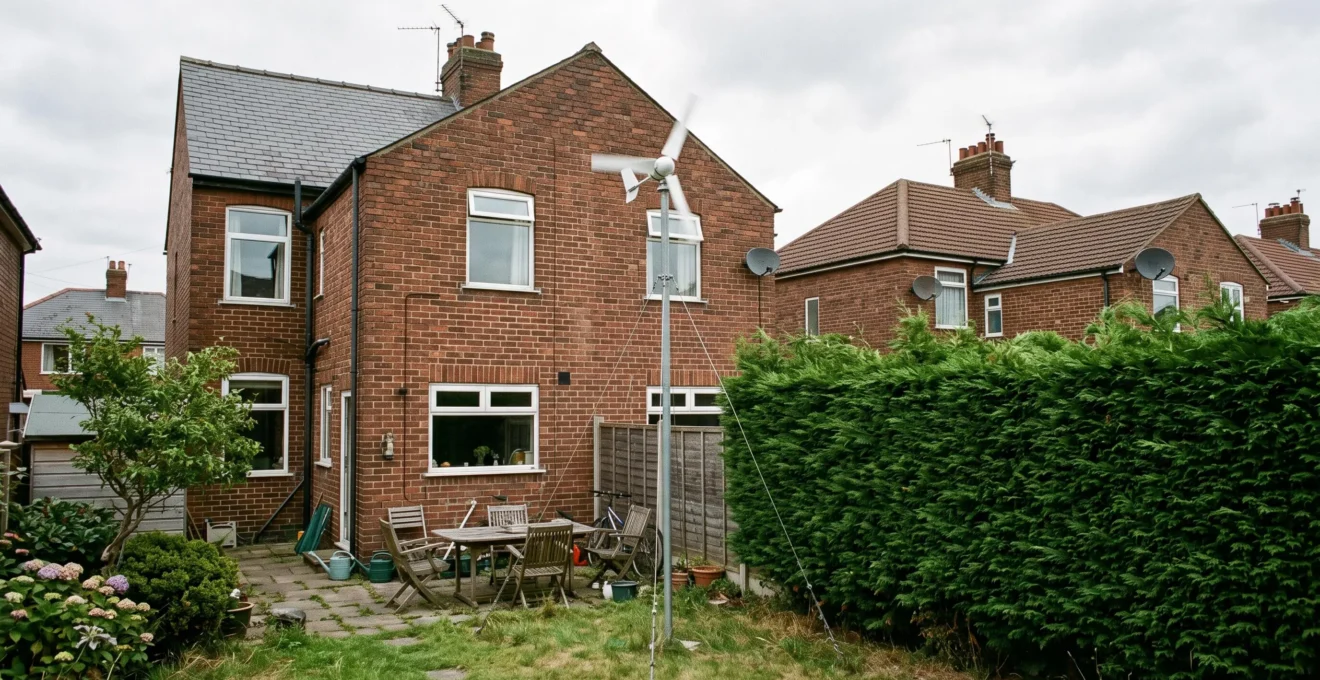
A domestic wind turbine on 0.2 acres is possible in principle, but it is rarely a straightforward investment. The difficulty is not simply finding enough garden space for the equipment. It is finding enough unobstructed wind at a practical height while complying with planning restrictions and avoiding disturbance to neighbouring properties.
At approximately 809 square metres, a 0.2-acre plot can look spacious from the ground. For a wind turbine, however, nearby houses, trees, fences and hedges can make that space much less useful than it appears. A turbine that looks powerful in a manufacturer’s brochure may generate disappointingly little electricity when installed close to these obstacles.
The relevant question is therefore not whether a small turbine will fit, but whether it can operate efficiently, legally and acceptably on that particular site. For a UK homeowner, three considerations dominate: realistic annual electricity production, the planning route and the likelihood of noise affecting neighbours.
Those considerations can be tested before paying for equipment or committing to an installation.
Domestic wind turbines on small UK plots: the essentials
- Wind exposure matters more than land area alone. A turbine on 0.2 acres needs sufficiently smooth, productive airflow at its proposed hub height.
- Planning can rule out an otherwise attractive installation. In England, permitted development conditions include strict overall-height and boundary-distance limits.
- Annual kWh is the figure that matters. Compare realistic generation, maintenance requirements and neighbour impacts before judging whether wind offers better value than solar or another alternative.
- Why Do Rooftop Wind Turbines Usually Fail to Match Their Rated Output?
- How to Read a Turbine Power Curve So You Don’t Fall for ‘Rated kW’ Marketing?
- 10 m Mast or 15 m Mast: Which Is the Better Choice When Neighbours Are Close?
- The Maintenance Oversight That Turns a Quiet Turbine Into a Constant Nuisance
- When Should You Start Planning Checks for a Domestic Turbine to Avoid a Rejection?
- How to Vet Your Wind Resource Over 30 Days Without Buying Sensors?
- How to Shortlist Renewables for Your Home Using 5 Site Questions?
- Which Renewable Energy Source Works Best for UK Homes With Limited Roof Space?
Why Do Rooftop Wind Turbines Usually Fail to Match Their Rated Output?
Rooftop wind turbines often produce less electricity than buyers expect because buildings interrupt the smooth airflow needed for efficient generation. The rated output advertised by a manufacturer describes performance at a specified wind speed, not typical production on a domestic roof. On a 0.2-acre plot, nearby buildings and limited installation height can make this difference particularly significant.
Wind approaching a house does not simply accelerate neatly over the roof. It separates around roof edges, changes direction and creates turbulent zones. A turbine positioned within these disturbed flows experiences rapidly changing wind speed and direction rather than the consistent airflow assumed in idealised performance comparisons.
That distinction matters because a turbine extracts energy from moving air. Brief gusts do not compensate automatically for prolonged periods of weak wind or rapidly fluctuating airflow.
The US Department of Energy‘s Small Wind Guidebook explains why turbine output should be assessed using annual energy production, turbine characteristics, tower height and local wind conditions rather than rated capacity alone. Its technical principles are relevant to British installations, although its regulatory guidance is not.
Rated power and annual generation are different quantities. A turbine advertised as 2 kW does not continuously produce 2 kW. It reaches that rated output only under the operating conditions specified for the equipment.
For a purely hypothetical illustration, a 2 kW turbine operating at a 10% annual capacity factor would generate approximately 1,752 kWh in a year. That figure is an arithmetic example, not a predicted capacity factor or yield for a British garden.
Small plots introduce another problem: turbulent airflow can increase fluctuating mechanical loads on blades, bearings and supporting structures. Persistent loading may accelerate fatigue and component wear, particularly where the turbine is poorly positioned or maintained.
A roof-mounted installation may also transmit vibration into the building. A separate mast can reduce some building-transmission issues, but it does not automatically solve poor wind exposure.
The key distinction is between available wind and usable wind. A visibly windy garden can still have a poor resource at the rotor because surrounding obstacles disrupt the airflow.
The next step is to examine the turbine’s actual output across different wind speeds rather than treating its advertised kilowatt rating as an annual performance promise.
How to Read a Turbine Power Curve So You Don’t Fall for ‘Rated kW’ Marketing?
A turbine power curve shows how much electrical power a specific model produces at different wind speeds. To judge a turbine for a 0.2-acre property, identify its cut-in speed, the speed required to reach rated output and its high-wind operating limit. Then compare those values with the wind conditions expected at the proposed hub height.
Manufacturers commonly emphasise rated capacity because it is easy to compare. Yet two turbines with the same rated capacity can deliver substantially different annual electricity production if their power curves or operating conditions differ.
Read the curve from left to right, checking four features:
- Cut-in speed: the wind speed at which the turbine begins generating useful electrical power. Output below this threshold is effectively unavailable.
- Low- and medium-speed output: the part of the curve most relevant when the site experiences moderate winds rather than consistently strong conditions.
- Rated wind speed: the speed at which the advertised rated power is achieved. Check whether that speed is realistic for the proposed installation.
- High-wind behaviour: the cut-out speed, where applicable, and any output-limiting or shutdown mechanism used to protect the equipment.
For a rough annual energy calculation, combine the curve with an estimated distribution of wind speeds at hub height. Divide the year into wind-speed bands, multiply the turbine’s output in each band by the estimated number of hours in that band, and add the resulting energy figures.
For example, if a hypothetical turbine produces 200 W during 1,000 hours in a particular wind-speed band, that band contributes 200 kWh. Other bands must be calculated separately. This example demonstrates the method, not the expected yield of a real turbine.
Using average wind speed alone is insufficient for a reliable estimate because wind energy depends strongly on the distribution of speeds. The estimate must also account for losses, availability and uncertainty where supporting data exist.
Watch for specifications that advertise peak power without explaining the rated wind speed, provide no usable curve or rely on idealised conditions without discussing turbulence.
Request independent performance evidence or credible field data. A generic curve is not automatically valid for every installation environment, and a curve does not itself establish the wind available at your hub height.
Once realistic output becomes clearer, compare the installation heights that might make that output achievable without creating disproportionate planning or neighbour-related problems.
10 m Mast or 15 m Mast: Which Is the Better Choice When Neighbours Are Close?
A 15 m mast can offer faster, less turbulent wind than a 10 m mast, but it is not automatically the better choice on a small residential plot. The additional height may improve electricity production while increasing visual impact and planning complexity. The decision depends on surrounding obstacles, boundary distances, the available wind direction and neighbouring homes.
Wind generally becomes stronger and smoother with height because the influence of surface obstacles diminishes. However, the benefit of moving from 10 m to 15 m varies greatly by site. It is not the same as doubling the tower height, and there is no universal percentage increase in annual output.
In a densely built residential area, either mast might remain exposed to substantial turbulence. Conversely, a well-positioned 10 m installation facing open countryside may enjoy more useful wind than a taller installation surrounded by buildings.
The engineering comparison therefore needs a planning comparison. In England, the Planning Portal‘s stand-alone permitted development guidance identifies an overall height limit of 11.1 m and a boundary setback of at least 110% of the turbine’s overall height. These are conditions for the specified permitted development route, not universal limits on every installation that might receive full planning permission.
A 15 m stand-alone turbine would exceed that permitted development height limit. Even an installation described commercially as having a 10 m mast needs its overall turbine height, including the relevant rotor extent, checked separately.
Consider the following site-specific comparison.
| Site factor | 10 m mast | 15 m mast |
|---|---|---|
| Surrounding buildings and trees | May remain within disturbed airflow | May achieve better clearance, depending on obstacle heights |
| Wind exposure | Potentially lower or more turbulent | Potentially stronger and smoother, requiring verification |
| Visual impact | Usually less prominent | Generally more conspicuous to neighbours |
| Planning in England | Overall turbine height and all other conditions still require checking | Exceeds the stand-alone permitted development overall-height limit |
| Installation footprint | Foundation, access and any guy wires need space | Potentially greater structural and siting demands |
On 0.2 acres, a key constraint is the relationship between tower height, rotor clearance and property boundaries. A taller structure may be advantageous aerodynamically but impossible to position within the available compliant area.
Nearby dwellings also influence the decision. Turbine sound depends on equipment, operating conditions and receiver location; taller mounting does not guarantee either greater or lower noise at a particular neighbouring property. Blade shadow flicker, where relevant, should likewise be evaluated against actual geometry and sunlight conditions.
Even if the taller option appears technically attractive, the installation must remain acceptable throughout its operating life. That makes maintenance and changing noise characteristics part of the decision.
The Maintenance Oversight That Turns a Quiet Turbine Into a Constant Nuisance
A domestic turbine can become noticeably noisier when bearings deteriorate, fasteners loosen or blades become damaged or unbalanced. These faults may increase vibration and produce new humming, whining or repetitive sounds. On a 0.2-acre plot, where neighbouring properties may be close, failing to investigate a change in noise can turn an equipment problem into a persistent nuisance.
New turbines are generally assessed or described under particular operating and acoustic conditions. Their sound characteristics can change as components age, suffer damage or become misaligned.
Blade imbalance can produce cyclical vibration. Worn bearings may introduce mechanical noise, while loose components can amplify vibration or cause rattling. Depending on the turbine and installation, vibrations may also be transmitted through the mast or supporting building.
Not every low-frequency sound indicates a mechanical fault. Wind-related aerodynamic noise can occur during normal operation, and identifying the cause of a nuisance requires more than hearing a hum. Nevertheless, a new or changing sound pattern deserves investigation.
A practical monitoring routine starts with observations from a safe position on the ground. Record changes in:
- Sound character, including new hums, thumps, rattles or whines.
- Wind conditions during which unusual noise occurs.
- Visible vibration, blade irregularities or unexpected stopping behaviour.
- Whether the sound appears near the turbine, inside the house or at a neighbouring boundary.
These observations are useful for reporting faults, but they do not replace professional inspection or acoustic measurements where required.
Maintenance should follow the manufacturer’s documented schedule, with appropriate checks of blade condition and balance, fasteners, bearings, electrical systems and structural components. Inspection intervals and authorised procedures vary by turbine.
Do not attempt to inspect rotating equipment, climb a mast or tighten components without the specified safe isolation arrangements and suitable competence.
For small plots, preventative maintenance also protects neighbour relationships. A fault that might attract little attention at a remote rural installation can be much more intrusive near a bedroom window or garden seating area.
Maintenance can control avoidable deterioration, but it cannot rescue an unsuitable location. Planning, acoustic suitability and boundary constraints need consideration before equipment is installed.
When Should You Start Planning Checks for a Domestic Turbine to Avoid a Rejection?
Start planning checks before choosing a turbine model, paying a deposit or committing to a mast location. On a 0.2-acre plot, height limits and boundary distances may remove much of the usable installation area. A preliminary eligibility assessment should establish whether the proposal qualifies for permitted development or needs a planning application.
In England, stand-alone and building-mounted wind turbines have different permitted development conditions. Neither category should be assumed to qualify simply because the turbine is small or intended for domestic use.
The Planning Portal’s stand-alone wind turbine planning rules describe several relevant conditions, including:
- An overall turbine height not exceeding 11.1 m.
- A minimum blade-tip clearance of 5 m above ground.
- A boundary separation of at least 110% of the turbine’s overall height.
- A maximum swept blade area of 3.8 square metres.
- Compliance with the applicable MCS 020 planning standard or equivalent requirements.
These conditions must be considered together with the other eligibility restrictions and any applicable local limitations.
110%
Under the described English stand-alone permitted development conditions, the closest part of the turbine must be at least 110% of its overall height from the property boundary. This is a specific planning condition, not a general engineering setback recommendation or a guarantee of permission.
Planning Portal, stand-alone domestic wind turbine guidance for England.
For a hypothetical stand-alone turbine with an overall height of 10 m, the stated boundary condition would require 11 m of separation. For a hypothetical 11 m overall height, it would require 12.1 m. These calculations illustrate the restriction; they do not establish eligibility for a particular garden.
Roof-mounted turbines require a separate check. The Planning Portal’s building-mounted wind turbine requirements describe conditions for specified detached buildings, including limits on projection above the roof, overall height, blade clearance, swept area and boundary proximity.
The described building-mounted conditions include a maximum projection of 3 m above the highest roof point, excluding the chimney, and an overall height limit of 15 m, whichever is lower. No part of the turbine, including its blades, may be within 5 m of a boundary. These provisions must not be confused with permission for a 15 m stand-alone mast.
Before proceeding, verify whether the property is listed, lies within a conservation area or another designated location, or faces restrictions that affect permitted development rights. The visual impact on neighbours and surrounding properties may also matter during a full planning assessment.
Scotland, Wales and Northern Ireland have their own planning frameworks. Do not apply England’s permitted development figures automatically elsewhere in the UK.
Five planning checks to complete before buying a turbine
- Draw the site. Produce a dimensioned plot sketch showing boundaries, the house, neighbouring buildings, major trees and possible turbine locations.
- Specify the complete turbine dimensions. Record overall height, rotor diameter, lowest blade position, swept area and support arrangement in a specification sheet.
- Test the relevant planning conditions. Create a comparison sheet identifying which requirements appear satisfied and which need clarification.
- Check property restrictions and neighbour exposure. Record listed-building or designated-area status, nearby dwellings and potential visual or noise concerns.
- Contact the local planning authority. Obtain an initial written response or a record of the formal route for determining whether permission is required, and retain it with the project documents.
A pre-application discussion can reveal likely obstacles but should not be treated as formal permission or a binding legal determination. Where appropriate, seek a formal lawful development certificate or planning decision through the relevant authority.
Once a viable installation location and planning route have been identified, the next uncertainty is whether that location receives enough usable wind to justify further expenditure.
How to Vet Your Wind Resource Over 30 Days Without Buying Sensors?
A 30-day wind assessment without purchased sensors can help screen whether a small domestic turbine is worth investigating. Combine freely available historical wind information with observations of surrounding obstacles, wind direction and gustiness. The result is a preliminary suitability assessment, not a reliable prediction of annual electricity production or a substitute for hub-height measurements.
Start with the proposed turbine position rather than the general reputation of the area. A windy coastal region, for example, does not guarantee productive airflow behind a house or tall hedge.
Use available historical observations or wind-resource mapping to establish broad regional wind characteristics. Check the location, period, measurement height and exposure represented by each dataset.
The US Department of Energy’s Small Community Wind Handbook explains why regional wind maps cannot capture every local obstacle, terrain effect, wind-direction pattern or source of turbulence. Its assessment principles are transferable, but its US-specific information should not be treated as UK planning guidance.
During the 30-day screening period, record the wind direction, visible movement of trees and hedges, likely obstruction effects and any noticeably turbulent conditions. These are qualitative observations, not measured hub-height wind speeds.
If suitable historical hourly data are available, compare the recorded wind speeds with the candidate turbine’s cut-in and higher-output operating ranges. The percentage of time within a useful operating range can be more informative than isolated peak gusts.
However, wind speeds recorded at an exposed weather station cannot be assumed to match those in a sheltered domestic garden. Differences in measurement height, topography and surrounding obstacles may be substantial.
The following is a practical observation schedule, not a validated scientific wind-resource measurement protocol:
- Days 1–7: map obstacles, possible turbine positions and exposure to prevailing winds.
- Days 8–14: record daily observations, particularly changing wind directions and visible signs of turbulent flow.
- Days 15–21: compare the observations with free historical information and the candidate power curve.
- Days 22–30: identify whether the available evidence supports further assessment or reveals obvious suitability concerns.
Seasonality remains a major limitation. A single month may be unusually windy or calm and cannot represent the full annual distribution without additional evidence.
Likewise, moving low-level observations mathematically to a higher proposed hub height introduces uncertainty. No single adjustment can reliably describe the effects of nearby rooftops, hedges and turbulent wakes.
If the site appears promising, a competent wind assessment can address remaining uncertainties. If it does not, the same early screening effort can help redirect investment towards a more suitable renewable technology.
How to Shortlist Renewables for Your Home Using 5 Site Questions?
The most practical way to shortlist renewable technologies for a 0.2-acre UK property is to ask five site-specific questions before comparing products. Evaluate usable wind, available roof or ground space, shading and orientation, proximity to neighbours, and acceptable cost or disruption. This approach can eliminate unsuitable options early without assuming that wind or solar must be the answer.
Start with physical constraints. A small garden does not necessarily rule out wind, and limited roof space does not automatically rule out solar. The decisive issue is how much useful energy each system could deliver from the installation space actually available.
Use these five questions as an initial decision filter:
- Is there adequate wind at a practical hub height? If buildings and trees disrupt most available airflow, domestic wind becomes a weaker candidate regardless of rated turbine capacity.
- How much roof and ground space is genuinely usable? Consider structural suitability, roof obstructions, access, garden use and the space needed for equipment and maintenance.
- What are the shading and orientation conditions? Solar generation depends partly on sunlight exposure, while wind depends on directional wind resource and surrounding obstacles.
- How close are neighbouring properties? Turbine noise, visual effects, setbacks and possible objections may be more restrictive than they are for unobtrusive rooftop solar panels.
- What disruption and budget are acceptable? Compare installation complexity, professional assessments, ongoing servicing, expected electricity generation and potential planning requirements.
Consider a hypothetical 0.2-acre detached property with a small unshaded roof section, tall neighbouring houses and a hedge surrounding the rear garden.
Hypothetical site comparison: a compact suburban garden
A homeowner has restricted roof space and wants to maximise renewable electricity generation. A small ground-mounted turbine initially appears attractive because it leaves the roof untouched.
However, the available mast positions are close to boundaries, and the surrounding buildings disrupt the wind. A compact rooftop solar installation may deserve closer assessment despite its limited area. This is a decision-filter example, not a measured property assessment or verified financial outcome.
On a different 0.2-acre property, open exposure on one side, limited shading and an acceptable turbine location might keep wind on the shortlist. The acreage is the same, but the physical constraints produce a different result.
The filter should therefore produce a shortlist with reasons for inclusion or exclusion, not a technology winner based on generic assumptions.
Once clearly unsuitable options have been removed, the final comparison should consider energy yield, planning friction and neighbour effects alongside cost and available roof space.
Key takeaways before choosing a technology
- Reject unsuitable locations early. Strong regional wind does not overcome poor exposure or boundary constraints at the installation point.
- Compare annual energy rather than equipment ratings. A realistic kWh estimate is more useful than advertised turbine capacity or solar panel wattage alone.
- Include approval and neighbour impacts. The system with the highest theoretical output is not necessarily the best practical investment for a small residential property.
Which Renewable Energy Source Works Best for UK Homes With Limited Roof Space?
For many UK homes with limited roof space and a 0.2-acre garden, a carefully sized solar installation is likely to be a more practical starting point than a domestic wind turbine. Solar generally avoids rotating equipment and introduces fewer wind-specific noise and turbulence concerns. Small wind remains worth considering where verified wind exposure, feasible siting and acceptable planning conditions align.
Limited roof space changes the comparison because a conventional rooftop solar system may not have room for many panels. Yet installing a wind turbine is not automatically the next-best solution.
Wind generation is unusually sensitive to local airflow. The same domestic turbine can experience very different operating conditions depending on nearby buildings, vegetation, terrain and installation height.
Solar has its own limitations, including shading, orientation and usable surface area, but the assessment does not depend on achieving smooth airflow around neighbouring houses.
Ground-mounted solar may be another option where garden space, sunlight exposure and planning requirements permit. However, it competes directly with outdoor living space and other uses of a small plot.
Other household energy improvements should not be overlooked. Measures that reduce electricity consumption or improve the efficiency of existing heating and electrical systems may sometimes offer greater practical value than adding generation equipment at an unsuitable location. Their suitability depends on the home’s actual energy needs and existing systems.
The comparison becomes clearer when considered against the three main constraints.
| Decision factor | Domestic wind turbine | Solar PV |
|---|---|---|
| Energy yield | Highly dependent on hub-height wind distribution and turbulence | Dependent on solar exposure, shading, orientation and installed capacity |
| Space constraints | Needs acceptable rotor clearance, structural support and siting | Needs suitable roof or ground area |
| Planning | Specific turbine height, siting, noise and other requirements may apply | Separate solar planning requirements apply according to installation type and location |
| Neighbour considerations | Rotating machinery, sound, vibration and visual effects require assessment | No rotor-related noise or shadow flicker; appearance and siting may still matter |
| Maintenance | Moving components require turbine-specific inspection and servicing | No exposed rotating generation components; electrical and mounting maintenance still required |
Neither technology should be judged on installed capacity alone. Ask installers for comparable annual kWh estimates, the assumptions behind those estimates, ongoing costs and relevant site limitations.
For domestic wind, an attractive quotation is insufficient unless a credible wind assessment supports the proposed production. Installation height must also be viable within the property’s physical and planning constraints.
Where a property has genuinely good wind exposure and a suitable installation position, a small turbine could complement solar generation. However, the benefits of a mixed system require an assessment of each technology’s production pattern, consumption matching and total cost rather than an assumption that combining technologies automatically improves value.
A workable decision rule is to consider domestic wind only after the site passes three tests: a credible productive wind resource, an acceptable planning and installation route, and manageable noise and neighbour impacts. If any of those tests fails, assess solar and energy-demand reduction options before revisiting wind.
Before spending money, prepare a dimensioned site sketch, screen the wind resource, confirm the planning route with the relevant authority and request comparable annual-yield estimates. That converts the original question from whether a turbine will fit on 0.2 acres into whether it can deliver worthwhile electricity without unacceptable cost, planning difficulty or disturbance.
Can a domestic wind turbine supply electricity when the house is not using it?
Yes. A suitably designed system may export surplus electricity, subject to the equipment, grid connection arrangements and applicable requirements. Alternatively, compatible battery storage may retain some surplus generation for later use. The financial outcome depends on actual generation, household consumption, system costs and the terms of any applicable export arrangement.
Does a domestic wind turbine need a battery?
Not necessarily. A grid-connected wind installation can be designed to operate without battery storage, provided the turbine and associated electrical equipment are suitable and the relevant connection requirements are met. Battery storage may improve the ability to use electricity generated at different times, but it adds cost and requires a system-specific assessment.
Can a small wind turbine be installed next to a garden fence?
Do not assume so. In England, the described stand-alone permitted development route includes a boundary setback of at least 110% of the turbine’s overall height. Building-mounted turbines have different conditions. A location close to a fence may also create clearance, maintenance or neighbour-related concerns. The applicable requirements should be confirmed for the actual property.
Will a domestic wind turbine generate electricity during a power cut?
Only if the electrical system is specifically designed and appropriately configured for backup or independent operation. A conventional grid-connected installation should not be assumed to provide electricity during an outage. Confirm the turbine, inverter, isolation arrangements and any storage requirements with a competent installer.
How can a homeowner compare wind turbine quotations fairly?
Request the proposed turbine model, full installation dimensions, power curve, estimated annual kWh at the proposed hub height, supporting wind-resource assumptions, installation scope and expected maintenance requirements. Compare those details with each quotation’s total cost and planning responsibilities. Do not treat a higher rated kW figure as proof that one quotation provides better value.