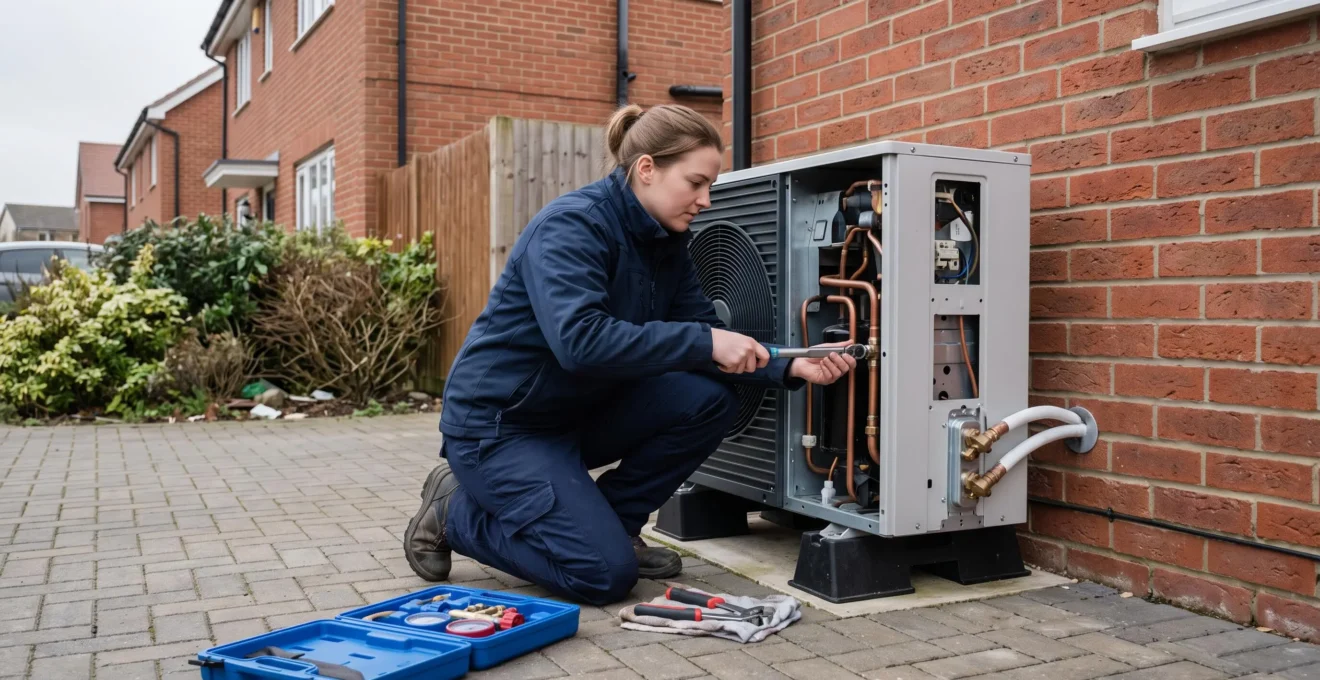
The energy technologies most likely to matter in UK homes between now and 2029 are not necessarily the newest inventions. They are established heat pumps with improving controls, solar panels combined with appropriately sized battery storage, smart electricity tariffs and technologies that help households shift consumption away from expensive periods.
Solid-state batteries, domestic hydrogen boilers and experimental heating systems attract headlines, but technological promise is different from something a homeowner can buy, insure, maintain and repair locally. A breakthrough that performs brilliantly in a laboratory may have little practical relevance to a household replacing its boiler next winter.
The useful question is not simply which technology will become more efficient. It is whether a particular investment improves your home today, remains serviceable tomorrow and avoids expensive rework as the UK energy system changes. That requires looking at installation capacity, running costs, household suitability and the risks of waiting.
UK home energy innovations: what matters most
- Ready now: Established heat pumps, insulation improvements, solar PV, suitable battery storage and smart tariffs offer practical options, although financial returns depend on the property.
- Worth watching: Better heating controls, flexible electricity tariffs and integrated home energy management may improve how existing equipment performs over the next 2–3 years.
- Not a reason to delay: Laboratory-stage batteries, speculative hydrogen heating and unsupported prototype systems should not dictate essential household replacement decisions.
- Why Do Energy Breakthroughs Take So Long to Reach Homes?
- How to Tell if a New Energy Tech Is Market-Ready Using 6 Checks?
- Upgrade Now or Wait: Which Is Smarter if Your Heating System Has 2–5 Years Left?
- The Early-Adopter Mistake That Leaves You With Unsupported Kit and No Installer
- When Should You Pilot New Energy Tech Before Rolling It Out Across a Building?
- Why Does Waiting for “Better Tech” Often Cost More Over 24 Months?
- How to Build a Home Energy Transition Plan in 4 Steps Without Overcapitalising?
- What Does the UK Energy Transition Change for Households Over the Next 5–10 Years?
Why Do Energy Breakthroughs Take So Long to Reach Homes?
Energy breakthroughs take years to reach homes because laboratory performance is only the first milestone. Manufacturers must turn prototypes into reliable products, obtain relevant approvals, establish manufacturing and spare-parts supply, and develop a network of competent installers. For UK homeowners, the decisive milestone is not a successful demonstration but a system that can be installed, maintained and insured in ordinary properties.
Consider a heat pump that achieves promising efficiency in controlled tests. That result says little about whether it can operate reliably with existing British radiators, fit within a particular property’s electrical capacity or receive prompt repairs during a cold spell.
Commercial deployment involves several separate hurdles:
- Installation competence: Engineers need training appropriate to the technology, including electrical and refrigerant requirements where applicable.
- Certification: Relevant product and installer certification must meet the requirements of the installation and any applicable funding scheme.
- Property compliance: Building regulations, planning considerations and installation standards may affect suitability.
- Financial acceptance: Insurers, lenders and future buyers may need evidence that unfamiliar equipment is properly installed and maintainable.
- Ongoing support: Replacement components, diagnostic software and competent servicing must remain available.
The gap between certification and practical deployment matters. Ofgem’s Boiler Upgrade Scheme Product Eligibility List identifies products against specified eligibility criteria, but Ofgem makes clear that appearing on the list does not establish compliance with every scheme requirement. It does not independently guarantee local servicing, future parts availability or real-world efficiency.
For household decisions, innovations can be grouped by maturity rather than publicity.
| Technology maturity | UK-relevant examples | Practical interpretation |
|---|---|---|
| Available now | Established heat pumps, solar PV, domestic batteries, smart controls and insulation | Compare installation quotes, operating conditions, suitability and servicing arrangements. |
| Developing over the next 2–3 years | More integrated controls, improved smart charging and increasingly sophisticated energy management | Watch actual product availability, interoperability and installer support rather than assuming future savings. |
| Speculative for ordinary domestic deployment | Residential solid-state batteries and widespread domestic hydrogen boiler conversion | Do not base essential replacement plans on an unconfirmed commercial timetable. |
A pilot scheme belongs in a separate category from a commercially established installation. A small, publicly funded trial may show that engineers can operate a system under supervised conditions. It does not prove that ordinary households can obtain competitive quotations, long-term warranties or replacement parts.
The next challenge is assessing whether an advertised innovation has crossed that commercial threshold, rather than simply trusting a certificate or an impressive performance claim.
How to Tell if a New Energy Tech Is Market-Ready Using 6 Checks?
A home energy technology is market-ready when a homeowner can obtain a compliant installation, independently assess its performance, secure meaningful warranty protection and arrange ongoing support. Six checks covering installers, warranties, certification, replacement parts, financial acceptance and real-user evidence can expose most practical weaknesses. The process can take under an hour for established products, although unfamiliar systems may require follow-up enquiries.
Start with a specific make and model, not a generic technology category. A heat pump may be widely supported while a particular manufacturer’s system remains difficult to service in your postcode.
- Check local installer availability. Identify appropriately qualified installers covering your postcode. Ask which technicians can both install and service the exact product. A regional sales partner is not necessarily a repair network.
- Read the written warranty. Check the coverage period, exclusions, labour costs, transfer conditions and responsibility for claims if the original installer closes.
- Verify independent certification. Confirm relevant product and installation standards using the appropriate certification records. Treat manufacturer-reported savings as claims requiring separate evidence.
- Confirm spare parts and software support. Ask who stocks critical components, who can access diagnostic systems and whether the manufacturer provides a stated firmware-support commitment.
- Check insurance and property acceptance. Ask your insurer whether the proposed installation raises specific requirements. Where relevant, consult your lender, managing agent or letting adviser.
- Request evidence from actual installations. Seek measured consumption, maintenance records and user feedback covering at least one complete heating season in a reasonably comparable property.
A product warranty protects against specified defects. A performance guarantee, if provided, concerns defined operating outcomes. Neither should be confused with an unconditional promise of lower bills. Annual servicing requirements, unauthorised modifications, third-party work and software alterations may affect coverage depending on the written terms.
Marketing language also reveals maturity. “Patent pending performance” describes intellectual property activity, not independently verified household results. “Pre-launch pricing” may indicate that delivery terms are unsettled. “Limited UK beta” suggests restricted deployment, while “installer partner programme opening soon” means the support network may not yet exist.
These phrases are not automatic grounds for rejection. They are reasons to request written evidence before paying a deposit.
Complete a five-part purchase evidence file
- Contact two independent installers covering your postcode and save their written confirmation of product support.
- Obtain the full warranty and highlight conditions relating to servicing, exclusions and transferability.
- Record the relevant product certification reference and retain evidence of installer qualifications.
- Request written answers about spare-parts supply, software access and support duration.
- Collect an insurer response and one documented real-world operating example, noting any unanswered questions.
Keep the findings alongside the installation quotation. A missing answer does not necessarily mean the technology is defective, but it identifies a risk that deserves consideration in the purchase decision.
Passing the checks makes a technology a credible option. It does not automatically make replacement financially sensible, particularly when existing equipment still has several useful years remaining.
Upgrade Now or Wait: Which Is Smarter if Your Heating System Has 2–5 Years Left?
If your heating system has two to five years of expected life remaining, replacing it immediately is not automatically the smartest choice. A reliable boiler with affordable repairs may justify continued use while you prepare the property. However, recurring faults, changing grant eligibility or a likely winter breakdown can favour earlier action. The best decision depends on costs, readiness and replacement timing.
The crucial distinction is between planning early and purchasing early. You can assess heat loss, compare installation options and prepare electrical capacity without removing equipment that still works well.
Many homeowners face their worst purchasing conditions after an unexpected breakdown. With no heating and limited time, they may accept the first available replacement rather than obtaining competing quotations or assessing changes to radiators and insulation.
The following grid provides a practical starting point.
| Current situation | More sensible direction | Immediate action |
|---|---|---|
| Reliable heating with modest servicing costs | Usually assess and prepare before replacing | Obtain heat-loss and retrofit assessments; set an annual review. |
| Repeated breakdowns or uncertain parts availability | Bring replacement planning forward | Compare repair costs, replacement quotations and installation lead times. |
| Eligible funding available for a suitable installation | Compare upgrading now with retaining the current system | Verify grant terms, complete quotes and expected operating costs. |
| Expected property sale or letting change | Consider the property’s wider requirements | Check applicable EPC, lender, buyer or letting considerations. |
| Waiting for an experimental heating product | Do not rely on an unconfirmed launch | Identify a supported alternative and a latest decision date. |
Funding can materially change the calculation. Under the rules described in Ofgem’s Boiler Upgrade Scheme guidance for property owners, eligible installations in England and Wales can receive £7,500 towards qualifying air-to-water or ground-source heat pumps. Eligible air-to-air systems can receive £2,500, while qualifying off-gas-grid properties may access £9,000 for specified heat pumps between 21 July 2026 and 31 March 2027.
£7,500
The Boiler Upgrade Scheme contribution towards eligible air-to-water and ground-source heat pumps in England and Wales under the rules described for October 2026. Eligibility depends on the property, installation and technology; the scheme is not UK-wide.
Ofgem, Boiler Upgrade Scheme guidance for property owners.
These amounts are not a reason to rush into an unsuitable installation. Relevant grant conditions must be checked when committing, and BUS installations require MCS-certified installers. Hybrid fossil-fuel and heat-pump systems are not eligible under the cited scheme rules.
Waiting may also improve your options if electricity tariffs become more suitable, your property receives insulation upgrades or local installer capacity expands. These are observable developments. An unsupported promise that a revolutionary heating system will arrive within two years is not.
Review the decision annually using current repair expenditure, estimated equipment life, live installation quotes, tariffs and grant eligibility. Include whether the anticipated innovation actually replaces the function of your existing system.
The objective is to preserve choices while avoiding unnecessary expense. That also means recognising that an innovative product can remain a poor investment if its manufacturer or installer support disappears.
The Early-Adopter Mistake That Leaves You With Unsupported Kit and No Installer
The most expensive early-adopter mistake is buying equipment whose continued operation depends on one installer, manufacturer or proprietary software platform. If that support disappears, a mechanically functional system may become difficult to repair or control. The danger is not necessarily poor engineering: it is becoming dependent on a commercial network that has not developed enough resilience to support the product.
Imagine a homeowner buying an unfamiliar connected heating system through a single specialist supplier. The installer later stops supporting the brand. The manufacturer withdraws from the UK market, leaving diagnostic tools unavailable. Other engineers decline maintenance because they cannot access software, obtain components or establish responsibility for earlier work.
The homeowner could face the cost of removing otherwise usable equipment and installing a conventional replacement. This is a hypothetical failure scenario, not a documented outcome attributed to a particular manufacturer.
Installer reluctance is not always unreasonable. A company servicing unfamiliar equipment may inherit liability for work it did not design or commission. Specific products can require manufacturer training, dedicated diagnostic access or specialist refrigerant competence.
Before buying, investigate four structural risks:
- Manufacturer presence: Is there an identifiable UK legal entity or documented arrangement for warranty and technical support?
- Service independence: Can multiple unrelated installers receive training, obtain components and perform repairs?
- Control-system access: Does essential functionality depend on a proprietary cloud service, or can the equipment continue operating locally?
- Exit options: Can compatible components replace failed parts, and is there a realistic removal and replacement route?
Open communication standards can reduce dependence on a single supplier, but an advertised open interface does not establish that the entire product is independently maintainable. Likewise, software escrow or an open-source fallback is valuable only when an actual, enforceable arrangement exists and provides usable access.
Consider the secondary consequences as well. An unfamiliar installation may require additional documentation during a property sale. Surveyors, purchasers or insurers could ask questions about maintenance, certification or insurability. This is not evidence that all experimental systems will be rejected; it is a reason to obtain relevant assurances rather than assume acceptance.
Hypothetical example: when the cheapest quote creates the greatest exposure
Two installers quote for comparable home energy equipment. Supplier A offers a lower installation price but provides no written spare-parts commitment and controls all diagnostic access. Supplier B costs more initially but supports an established installer network and provides clearly documented maintenance arrangements.
Neither price alone establishes the better investment. The homeowner should compare the initial difference with the potential cost and inconvenience of specialist repairs, downtime or premature replacement.
For a poorly supported product, the downside may extend well beyond the original purchase price. A credible budget should include the possibility of reverting to a mainstream system if essential service arrangements fail.
Where a technology still carries substantial support uncertainty, testing it in a controlled and reversible setting can be more sensible than committing an entire building.
When Should You Pilot New Energy Tech Before Rolling It Out Across a Building?
Piloting new energy technology is worthwhile when a failed installation would expose several occupants, properties or essential building systems to disruption. Landlords, multi-occupancy buildings and owners of small rental portfolios may benefit from a representative trial. For an ordinary single-family home, a smaller reversible test is usually more realistic than installing an experimental whole-house system.
A useful pilot tests more than energy efficiency. It examines installation time, comfort, maintenance responsiveness, software reliability and whether the supplier can support normal operation without special intervention.
Start with a property or zone that resembles the wider deployment but allows equipment to be isolated, removed or replaced if necessary. Avoid selecting only the easiest test location if other buildings have materially different insulation, heating loads or electrical infrastructure.
Record conditions before installation so that results have a meaningful baseline. Weather, occupancy and usage patterns must be considered when interpreting consumption differences.
| Test dimension | Evidence to collect | Question before rollout |
|---|---|---|
| Energy performance | Metered consumption, tariffs, comparable operating conditions | Does performance remain useful outside ideal conditions? |
| Comfort | Room temperatures and recorded occupant complaints | Are the required comfort standards maintained? |
| Installation | Quotation dates, installation time and additional work | Could the process be repeated across other properties? |
| Maintenance | Fault records, engineer response and warranty handling | Is ongoing support dependable? |
| Software and controls | Update behaviour, connectivity problems and manual operation | Does the equipment work reliably without constant intervention? |
For heating technologies, run the evaluation through a full heating season where feasible. A successful summer demonstration cannot establish reliable winter comfort or seasonal heating performance.
Set success thresholds before the trial. For example, the owner might require comfort to remain within a documented acceptable range and all critical faults to receive an agreed support response. Thresholds should reflect the building’s actual requirements rather than arbitrary figures.
Agree on an exit route as well. The pilot might stop after repeated unresolved faults, unacceptable comfort disruption or loss of essential supplier support. Document who pays for removal, reinstatement and any necessary remedial work.
A single homeowner can adopt a similar principle by testing supplementary devices, controls or tariff arrangements that do not compromise essential heating. A reversible trial of one room or separable zone is more informative than a demonstration conducted under unrelated conditions.
Pilots are valuable when they prevent a large, difficult-to-reverse commitment. For established household upgrades, however, waiting for still more evidence can also carry costs of its own.
Why Does Waiting for “Better Tech” Often Cost More Over 24 Months?
Waiting for better home energy technology can cost more over 24 months when the existing system requires expensive repairs, consumes more energy than a suitable replacement or causes the household to miss valuable funding opportunities. But waiting is not always costly: products may improve, quotations may change and retaining functioning equipment avoids immediate capital expenditure. The comparison must account for both sides.
The phrase “cost of waiting” should never be treated as a universal amount. It is a household-specific calculation based on current expenditure, expected alternatives and actual investment costs.
Start with the energy bills you are paying now. Estimate what an alternative installation would cost to operate using realistic heat demand, tariffs and independently supportable efficiency assumptions. Then account for likely repairs, servicing differences and any other relevant expenses.
The waiting calculation should distinguish unavoidable expenditure from costs that an upgrade would genuinely eliminate. Continuing to pay a gas bill, for example, is not itself a loss: the relevant difference is between that expenditure and the electricity and maintenance costs of a suitable alternative.
A simple comparison uses two ownership scenarios over the same period:
- Replace now: Installation cost after applicable support, financing costs if relevant, electricity consumption, maintenance and estimated remaining asset value.
- Wait 24 months: Continued current-system running costs, expected repairs, any eventual replacement expenditure and the value of retaining cash in the meantime.
Consider an explicitly hypothetical example. A household estimates that an alternative heating arrangement could reduce combined annual operating and maintenance expenditure by £300. Over two years, that would represent £600 before considering installation costs, financing, unexpected repairs, changing tariffs or equipment performance. It would not justify a substantial purchase on its own.
Likewise, a homeowner who expects new equipment to become cheaper should not simply assume the forecast reduction will occur. A credible roadmap has verifiable milestones, including manufacturing capacity, published product specifications, relevant certification and installer training. Repeated announcements that a breakthrough is “two years away” provide a weaker basis for delaying an essential purchase.
Some delays have a genuine option value. Waiting can preserve capital while product reliability improves or property renovations reduce the required heating capacity. Grant changes, electricity prices and installation costs could also move in either direction, so predicted savings should be tested against more than one scenario.
There is a practical middle path. Draught-proofing, suitable insulation, correctly configured controls and tariff reviews can provide benefits without depending on a particular future heating technology. Their actual financial returns still depend on cost, building condition and usage.
Once the cost of waiting has been considered, the more useful question becomes how to make progress without investing too much capital in equipment that may later need changing.
How to Build a Home Energy Transition Plan in 4 Steps Without Overcapitalising?
Build a home energy transition plan by auditing current energy use, improving the building fabric, sizing replacement equipment for the home’s future condition and spreading investment across useful stages. This reduces the risk of buying an oversized heating system or paying twice for related work. The most resilient improvements remain valuable even if future tariffs, products or government incentives change.
Overcapitalisation occurs when spending exceeds what a property can reasonably justify or when investment is poorly sequenced. An obvious example is specifying expensive heating equipment for a draughty house, then reducing its heat demand substantially through insulation and discovering that the original system was unnecessarily large.
The four steps below help prevent that sequence.
- Audit the property. Gather the Energy Performance Certificate, recent energy bills, equipment ages, maintenance history and known building-fabric problems. Use actual consumption where possible, recognising that historical usage may not reflect future occupancy or heating requirements.
- Assess the fabric first. Identify suitable insulation, draught-proofing and ventilation measures. Consider moisture, existing construction and professional advice before altering the building envelope.
- Size equipment for the improved property. Obtain a room-by-room heat-loss assessment and ensure proposed heating capacity reflects planned, credible fabric improvements rather than assumptions based only on current boiler size.
- Stage spending deliberately. Prioritise improvements that work independently, prepare for future electrical needs when justified and postpone technology-specific purchases until their timing and suitability are clearer.
For example, replacing a consumer unit solely because a future battery installation might require it could be premature. However, when electrical works are already planned, an electrician can assess safe capacity, suitable cable routes and whether modest preparation would reduce later disruption.
The latest hardware is not necessarily the most effective next investment. Energy Saving Trust‘s advice on efficient heat-pump operation highlights how lower flow temperatures, suitable heating curves, appropriate controls and complementary technologies can improve the performance of existing heat-pump systems.
That makes commissioning and operating settings part of the investment decision, rather than minor adjustments to revisit after buying new equipment.
Funding and tariffs must also fit the sequence. A homeowner in England or Wales may have access to support schemes that differ from arrangements in Scotland or Northern Ireland. Scheme eligibility, approved technologies, installation conditions and tariff availability can change with policy or supplier decisions.
Match each proposed improvement with its current eligibility requirements and obtain confirmation before committing funds. Do not assume a grant that exists for one property or technology applies to another.
Record a budget ceiling for each stage and identify which investments depend on later work. Where possible, avoid installing equipment that must be removed or substantially modified to complete already-planned insulation or electrical upgrades.
A well-sequenced plan leaves the household better prepared for technologies that mature later, without making present-day comfort and affordability dependent on uncertain product launches.
Key takeaways for the next decade
- Building efficiency and reliable equipment support are more durable investments than betting on a particular breakthrough.
- Electricity tariffs and the ability to shift consumption may become increasingly important alongside appliance efficiency.
- Future policy and technology announcements should trigger a review of household plans, not an automatic purchase.
What Does the UK Energy Transition Change for Households Over the Next 5–10 Years?
Over the next five to ten years, the UK energy transition is likely to change how households heat their homes, purchase electricity and manage consumption. More homes may rely on electrically powered heating, while smart tariffs, batteries and flexible charging become increasingly relevant. However, the financial benefits will depend on electricity and gas prices, household demand, building efficiency and policies that can change over time.
The most important structural shift is the relationship between fossil-fuel heating and electricity-based alternatives. A heat pump can supply several units of heat per unit of electricity under suitable conditions, but that physical efficiency does not automatically guarantee a lower bill than gas heating.
The actual comparison depends on seasonal system performance, standing charges, tariff structures, the home’s heat requirements and the relative prices of gas and electricity.
As electricity generation becomes less carbon-intensive, electrified heating may deliver further emissions advantages. Future electricity tariffs could also reward households that can move flexible consumption to periods when supply is abundant or prices are lower.
That explains why the energy transition involves more than choosing a heating appliance. A well-designed household system may coordinate heating, solar generation, battery storage and electric-vehicle charging without requiring every technology to operate independently.
Energy Saving Trust’s report on low-carbon technology and tariff combinations examines the role of heat pumps, solar panels, batteries and time-of-use tariffs in household decarbonisation, while recognising that running costs are an important consideration for adoption.
Such combinations are not universally economical. A household with limited daytime electricity demand, restricted roof suitability or expensive battery installation costs could see a different outcome from a property with substantial flexible consumption.
Policy is another changing factor. Building efficiency standards, EPC-related requirements, heating incentives and the treatment of low-carbon technologies may influence future renovations, property transactions and letting arrangements. Exact requirements depend on the UK nation, property circumstances and rules in force at the relevant date.
Rather than assuming a particular future prohibition or grant, homeowners should preserve practical flexibility. Suitable insulation, accurate heat-loss information, sensible electrical planning and well-documented maintenance can remain useful across several plausible technology pathways.
Expensive new investment in gas-dependent equipment also deserves scrutiny when the property is likely to undergo substantial electrification or efficiency improvements. That does not mean every functioning gas boiler should be discarded early. It means expected equipment life and future compatibility should be part of the replacement calculation.
For the next two to three years, the innovations that deserve most attention are those with real installations, accessible service networks and measurable household benefits. Heat pumps, suitable solar and storage systems, better controls and tariff flexibility meet that practical test more readily than speculative technologies waiting for commercial scale.
Set a specific date for your next home energy review, ideally before the next heating season or a major planned renovation. Update your consumption figures, repair history, grant eligibility and installer quotations. The most useful energy innovation is the one that solves a real household problem, at an acceptable lifetime cost, with support available when you need it.
Will solid-state batteries make today’s home battery systems obsolete?
There is no established basis in the supplied evidence for predicting when solid-state batteries will become a mainstream UK household storage option or what they will cost. Existing battery technologies should be judged on their current performance, warranty, compatibility and economics. Delaying a purchase may make sense if the financial case is weak, but an unconfirmed future breakthrough is not a dependable investment timetable.
Can a home energy system keep working if its internet connection fails?
Some connected systems retain essential local functions without internet access, while others depend on remote services for scheduling, monitoring or advanced optimisation. Behaviour varies by manufacturer and model. Before buying, ask which functions remain available offline, how updates are delivered and whether critical heating controls depend on the supplier’s cloud platform.
Does an MCS-certified heat pump automatically qualify for a grant?
No. Product certification is not sufficient by itself to establish Boiler Upgrade Scheme eligibility. The installation, property, technology and installer must meet the applicable requirements. The scheme’s geographical scope also matters. Confirm current eligibility through the relevant official guidance and an appropriately certified installer before committing to the work.
Should a homeowner buy battery storage before installing solar panels?
Not necessarily. A battery can potentially support tariff-based electricity shifting without solar panels, but the financial result depends on consumption patterns, available tariffs, battery efficiency, installation cost and expected lifespan. Comparing current bills and realistic charging opportunities is more useful than assuming that storage always produces savings. Where solar installation is planned, assess both systems together to avoid unnecessary duplication.
How often should homeowners review their energy upgrade plans?
An annual review is a practical starting point, with additional checks before major renovation work, heating-system replacement or the expiry of a relevant funding opportunity. Compare current energy consumption, equipment condition, installation quotes, tariff choices and applicable incentives. Review sooner if the existing system becomes unreliable or if a planned property change affects the investment decision.