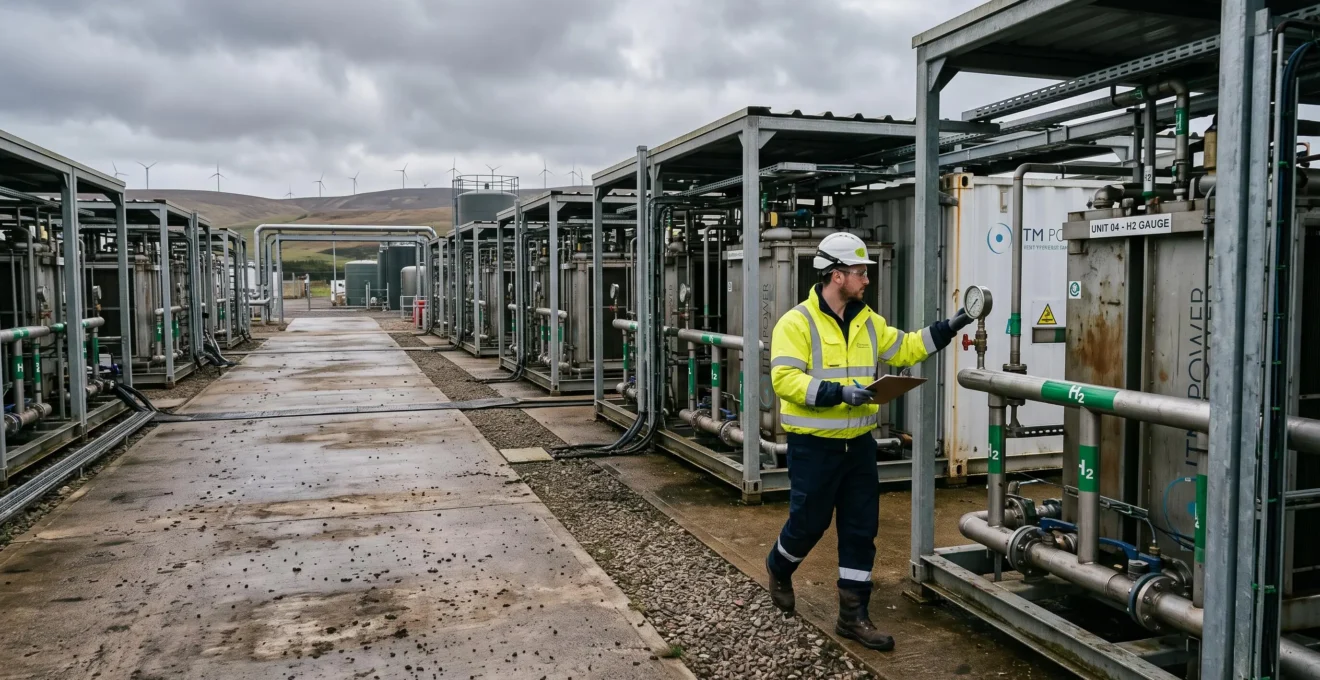
Turning renewable electricity into hydrogen sounds straightforward: use surplus wind or solar power to split water, store the hydrogen and recover the energy when needed. The difficulty is that each conversion consumes some of the original electricity. By the time stored hydrogen produces electricity again, substantially less usable energy remains.
The losses are not confined to electrolysis. Compressing or liquefying hydrogen consumes energy, moving and storing it introduces further requirements, and fuel cells cannot convert all its chemical energy back into electricity. A system can therefore perform reasonably well at one stage while delivering poor overall efficiency.
For a UK homeowner comparing backup power and heating options, that distinction matters. Hydrogen may help certain industrial processes or long-duration energy systems, but it is rarely the simplest route for storing renewable electricity over a few days. The right comparison is between useful energy delivered, not the amount initially produced or stored.
Hydrogen conversion losses: the essential facts
- Hydrogen production, conditioning and reconversion losses compound. Electrolyser efficiency alone cannot describe complete storage performance.
- A hypothetical 100 kWh electricity input can deliver far less than 50 kWh when hydrogen is converted back into electricity.
- For UK household heating and short multi-day gaps, heat pumps, thermal storage and batteries generally offer more direct energy pathways.
- Why Does Each Hydrogen Step Add Up to a Big Efficiency Hit?
- How to Estimate Delivered kWh After Electrolysis Using 3 Realistic Assumptions?
- Hydrogen Storage or Thermal Store: Which Makes More Sense for 3–7 Day Gaps?
- The Label Trap: When “Green Hydrogen” Doesn’t Mean Low-Carbon in Practice
- When Is Converting Surplus Renewables to Hydrogen Actually Justified?
- Why Does Hydrogen Usually Deliver Less Useful Heat per kWh Than Direct Electrification?
- Battery, Thermal Store, Hydrogen, or Generator: Which Works Best for 48–120 Hours?
- What Counts as Long-Term Energy Storage When You Need Power for Days, Not Hours?
Why Does Each Hydrogen Step Add Up to a Big Efficiency Hit?
Hydrogen energy losses become substantial because electricity must pass through several imperfect processes before it becomes useful again. Electrolysis converts electrical energy into chemical energy, conditioning prepares hydrogen for storage, and a fuel cell or another device converts it into the required output. Each stage operates on the energy left by the previous stage, so efficiencies multiply rather than add.
Consider the physical chain. Electricity first powers an electrolyser, which splits water into hydrogen and oxygen. The hydrogen must then be dried and, where required, purified and compressed. It enters a storage vessel or distribution system before reaching the final user. If the goal is electricity, a fuel cell or another conversion device completes the journey.
The US Department of Energy’s PEM electrolysis technical targets report a 2022 system energy consumption of 55 kWh per kilogram of hydrogen, equivalent to approximately 61% efficiency on a lower heating value basis. The 2026 target is 51 kWh/kg, or 65%, but this is a technical target rather than a verified industry-wide average.
Even reaching that target would leave subsequent storage and reconversion losses untouched.
61%
US Department of Energy’s reported 2022 PEM electrolyser system efficiency, measured using hydrogen’s lower heating value. This excludes downstream conversion back into electricity.
US Department of Energy, PEM electrolysis technical performance data.
The distinction between equipment boundaries is important. Stack efficiency measures the electrochemical core; system efficiency includes additional equipment within the specified electrolyser boundary. Neither necessarily covers compression, external storage or fuel-cell reconversion.
Some losses reflect fundamental thermodynamic limits: electrochemical reactions cannot deliver perfect conversion under real operating conditions. Other losses depend strongly on engineering design, including operating pressure, storage temperature, transport distance and auxiliary equipment.
Hydrogen is an energy carrier, not a primary energy source. It can be stored as a gas or liquid, but its production requires an earlier energy input. This makes it different from merely charging a battery, although both systems involve storage and unavoidable losses.
Published hydrogen efficiencies vary partly because researchers measure different parts of this chain. Always check whether a figure is based on lower or higher heating value, whether it refers to a stack or complete installation, and whether the final output is hydrogen, heat or electricity.
Once the measurement boundary is clear, a numerical example makes the consequences much easier to evaluate.
How to Estimate Delivered kWh After Electrolysis Using 3 Realistic Assumptions?
To estimate delivered electricity from hydrogen, begin with the electricity consumed, then apply three assumptions: electrolyser efficiency, energy used for hydrogen conditioning, and final reconversion efficiency. Multiplying these factors produces a transparent electricity-to-electricity estimate. The calculation must also disclose whether storage, transport and auxiliary consumption are included; otherwise it may overstate the useful energy available.
Use this basic equation:
Delivered electricity = Initial electricity × Electrolyser efficiency × Conditioning factor × Reconversion efficiency.
The following calculation is an explicitly hypothetical teaching example. It uses the Department of Energy’s reported 2022 PEM system efficiency for electrolysis. The other percentages are illustrative modelling assumptions, not measured performance or sourced industry averages.
| Stage | Assumption | Energy remaining |
|---|---|---|
| Renewable electricity input | 100 kWh | 100 kWh |
| PEM electrolysis | 61% LHV efficiency | 61 kWh hydrogen energy |
| Conditioning and delivery | 90% hypothetical retained-energy factor | 54.9 kWh |
| Fuel-cell reconversion | 50% hypothetical electrical efficiency | 27.45 kWh electricity |
Under these assumptions, 100 kWh initially supplied produces approximately 27.5 kWh of recovered electricity. This is not a prediction for a particular installation. The conditioning factor is a simplified bookkeeping assumption, and a detailed design must account for external electricity consumed by compressors and other equipment.
The three assumptions deserve separate attention.
- Electrolysis: Alkaline, proton exchange membrane (PEM) and solid oxide electrolysers operate differently. Solid oxide comparisons must also account for thermal energy supplied to the process.
- Conditioning: Compressed-gas storage requires compression work. Liquefaction requires much deeper cooling and an additional energy-intensive process.
- Reconversion: Fuel cells generate electricity, whereas a boiler produces heat. Their output quantities cannot be compared as though a kilowatt-hour of electricity and a kilowatt-hour of useful heat were interchangeable.
For perspective, the Department of Energy’s explanation of liquid hydrogen delivery reports that the liquefaction technology described consumes more than 30% of the hydrogen’s energy content. This is a process-specific energy requirement, not a universal liquefaction penalty or a percentage that can simply be substituted into every compression model.
Sensitivity testing demonstrates why optimistic assumptions matter. Holding the illustrative 90% conditioning factor constant, changing electrolysis from 61% to the Department of Energy’s 65% target increases calculated output from 27.45 to 29.25 kWh. If the hypothetical fuel-cell efficiency also rises from 50% to 60%, output reaches 35.1 kWh.
These changes improve the result, but they do not remove the main conversion losses.
Actual installations must additionally assess standby electricity consumption, drying and purification, maintenance, and long-term electrolyser degradation. The Department of Energy’s 2022 stack data report an average degradation rate of 0.25% per 1,000 operating hours, which should not be treated as the degradation rate of an entire plant.
The next decision is whether hydrogen should store energy at all when the intended output is heat rather than electricity.
Hydrogen Storage or Thermal Store: Which Makes More Sense for 3–7 Day Gaps?
For a three-to-seven-day gap in domestic heating, thermal storage is generally the more direct option, provided the storage system has adequate capacity and insulation. Hydrogen first requires electricity-to-gas conversion and later combustion or reconversion. A thermal store can use electricity to retain heat without those chemical conversion steps. However, heat leakage and store size determine whether it can realistically cover the full gap.
A hot-water cylinder, insulated thermal mass or purpose-built heat battery can store energy when electricity is available and release it during a later heating period. These systems are particularly relevant when the final requirement is domestic hot water or space heating.
Hydrogen behaves differently. Compressed hydrogen can retain chemical energy without the continuous heat losses inherent to a hot-water store, assuming suitable containment. But its tanks, safety controls, pressure management and conversion equipment create substantial practical requirements.
For a UK home, a thermal store also has an important compatibility advantage: it can work with a heat pump or other conventional heating equipment without requiring a dedicated hydrogen production and distribution system.
| Decision factor | Thermal storage | Hydrogen storage |
|---|---|---|
| Useful output | Heat | Heat or electricity after conversion |
| Primary energy penalty | Heat loss during storage | Production, conditioning and final conversion |
| Storage requirements | Insulation and thermal capacity | Pressure-rated or specialised containment and safety systems |
| Best-fit context | Heating and hot-water demand | Selected long-duration or hydrogen-consuming applications |
| Major limitation | Large capacity and duration can be difficult | Low overall electricity recovery and infrastructure complexity |
Neither technology automatically provides seven days of useful energy. A thermal store that performs well over several hours may be insufficient over several days. Its suitability depends on stored temperature, insulation, demand and acceptable final delivery temperature.
Timing creates another trap. If surplus renewable electricity is available now but heating is needed tomorrow, direct electrical heating of a thermal store may be attractive. If the requirement arrives a week later, standing heat losses may change the comparison. A heat pump charging the store may improve energy utilisation further, but achievable storage temperatures and heat-pump performance must be considered.
Hydrogen can become more interesting when storage duration is much longer or the eventual consumer already needs hydrogen as a chemical feedstock. That advantage cannot be transferred automatically to household heating.
Efficiency alone also does not establish environmental performance: the electricity used to produce hydrogen matters just as much.
The Label Trap: When “Green Hydrogen” Doesn’t Mean Low-Carbon in Practice
The label “green hydrogen” usually indicates hydrogen produced through electrolysis using renewable electricity, but it does not automatically establish low emissions across the complete supply chain. Grid electricity sourcing, production timing, equipment energy consumption, transport and hydrogen leakage can all affect its climate impact. A credible assessment requires defined emissions boundaries and evidence, not merely a colour-based description.
Consider an electrolyser connected to the British electricity grid. Its operator might purchase renewable electricity contractually, but that does not necessarily mean every operating hour corresponds to additional renewable production available at the same time.
This is where additionality becomes important. If an electrolyser consumes renewable electricity that could otherwise displace fossil-fuel generation or power a heat pump, the wider system consequences differ from using electricity that genuinely could not be accommodated.
Electricity accounting must therefore consider the production arrangement, relevant contractual evidence and the timing of consumption. Claims about additionality should be checked against the particular certification framework rather than assumed from a generic renewable-energy label.
Hydrogen leakage introduces another issue. Hydrogen is not itself a direct carbon dioxide emission, but its release can influence atmospheric chemistry and indirectly contribute to warming, including through effects on methane lifetime. The climate significance depends on leakage quantities and the assessed system boundary. A specific project’s leakage rate cannot be inferred from its green classification.
The UK’s regulatory framework provides a more formal basis for assessment. The UK government’s Low Carbon Hydrogen Standard includes emissions reporting methodology and calculation resources. Version 4, published in January 2026, updates technical parameters, emissions factors and accounting methodology.
Compliance with a defined production standard should not be represented as proof of zero emissions at the final consumer. Nor should UK methodology be treated as interchangeable with the EU’s separate rules for renewable fuels of non-biological origin.
Five checks before accepting a low-carbon hydrogen claim
- Identify the electricity source and operating arrangement. Record the generation contract, grid connection or dedicated supply evidence.
- Check production timing and additionality claims. Produce a short explanation of whether the electricity is matched to renewable generation and under which rules.
- Request the applicable emissions methodology. Record the standard version, assessment boundary and available calculation documentation.
- Document downstream handling. Create a process map identifying compression, storage, transport and their energy requirements.
- Ask how hydrogen losses and leakage are assessed. Prepare a written list of measured values, assumptions and missing data.
The aim is not to reject renewable hydrogen categorically. It is to distinguish a meaningful reduction in emissions from a label that leaves the system’s most important assumptions unexplained.
That same evidence helps determine when surplus renewable power should be converted to hydrogen rather than used directly.
When Is Converting Surplus Renewables to Hydrogen Actually Justified?
Converting surplus renewable electricity into hydrogen is most defensible when the electricity would otherwise be curtailed, a useful hydrogen demand exists, and alternative energy uses or storage methods are less suitable. It may also make sense when energy must be held for very long periods. However, low electricity prices alone do not prove that a project consumes genuinely otherwise-unused renewable generation.
Britain’s wind generation creates periods when available output can exceed what parts of the network can transport or accommodate economically. Curtailment may occur because of transmission constraints or wider system operating requirements.
An electrolyser located appropriately and operated at the right times could turn some otherwise-unused generation into a saleable energy carrier. But the quantity available depends on network conditions, project location and frequency of curtailment.
There is a fundamental economic tension. An electrolyser intended to run only during rare surplus events may receive cheap electricity, yet its capital equipment could remain idle much of the year. Higher utilisation improves the opportunity to recover equipment costs but can require electricity purchased outside genuine curtailment periods.
Surplus has two different meanings that should not be confused:
- Physical or operational surplus: Generation cannot be accommodated in a particular network or operating situation and may otherwise be constrained.
- Economic surplus: Electricity trades at a low or negative market price, which does not by itself establish that every additional unit consumed would otherwise have been wasted.
There are also uses where hydrogen’s chemical properties provide value that electricity cannot replace simply. Ammonia production requires a hydrogen feedstock; some industrial processes may require particular fuels or molecules; and certain shipping fuels can be produced from hydrogen-derived pathways.
Those cases still require assessment of production emissions, conversion costs, infrastructure and alternatives. Industrial heat should not automatically be classified as impossible to electrify, since feasible electrical technologies depend on process temperature, scale and site conditions.
For domestic hot water, conventional space heating and battery-electric transport, additional conversions typically create avoidable energy losses. The fact that renewable electricity is abundant during some hours does not remove those losses.
A sound project appraisal therefore compares hydrogen production with grid reinforcement, flexible electricity demand, batteries, thermal storage and direct industrial electrification where relevant.
For heating, this comparison becomes especially clear when a hydrogen boiler is placed beside a heat pump.
Why Does Hydrogen Usually Deliver Less Useful Heat per kWh Than Direct Electrification?
Hydrogen usually delivers less useful household heat per initial kilowatt-hour of electricity because producing hydrogen already consumes substantial energy, and a boiler cannot recover all of its chemical energy as useful heat. A heat pump works differently: it transfers heat from outside into a building, so it can deliver several kilowatt-hours of heat for each kilowatt-hour of electricity consumed.
That distinction is physical rather than merely a question of product maturity. A hydrogen boiler releases heat from fuel that had to be produced first. A heat pump uses electricity to move existing environmental heat, drawing additional energy from the air, ground or water.
The International Energy Agency’s Future of Heat Pumps report states that commercially available heat pumps are three to five times more energy efficient than natural gas boilers. This is a comparison with gas boilers, not a direct measurement of a complete hydrogen-to-heat supply chain.
To understand the difference, consider a separate hypothetical calculation using 100 kWh of initial renewable electricity.
| Energy pathway | Illustrative assumptions | Useful heat |
|---|---|---|
| Direct electric resistance heating | 100% point-of-use conversion assumption | 100 kWh |
| Air-source heat pump | Hypothetical coefficient of performance of 3 | 300 kWh |
| Electrolysis and hydrogen boiler | 61% electrolysis, 90% retained-energy factor and 90% boiler efficiency | 49.41 kWh |
These are illustrative pathway calculations, not verified equipment measurements or forecasts of UK household performance. The hydrogen figures use hypothetical downstream assumptions, while actual heat-pump efficiency varies with external temperature, heating-system design and required water temperature.
Nevertheless, the example exposes the energy asymmetry. The heat pump obtains extra thermal energy from its surroundings, while the hydrogen pathway must account for chemical production and delivery before combustion even begins.
The practical implication for Britain is substantial. Supplying a national heating load through electrolytic hydrogen would require considerably more electricity generation than supplying equivalent useful heat through efficiently operated heat pumps, all else being equal.
This does not mean every UK building is immediately suitable for a heat pump. Insulation, radiator sizing, electrical connection capacity and installation conditions affect the engineering solution.
Hydrogen-based heat may be worth investigating for certain industrial processes requiring temperatures or operating characteristics that are difficult to satisfy using available electrical equipment. This sector-specific possibility does not establish an efficiency advantage for ordinary domestic boilers.
Once the form of demand is established, choosing storage for an extended outage becomes a more manageable engineering problem.
Battery, Thermal Store, Hydrogen, or Generator: Which Works Best for 48–120 Hours?
For a 48–120-hour interruption, the best technology depends on whether the requirement is electricity, heat or both. Batteries offer fast electrical delivery but can become expensive when sized for several days. Thermal stores support heating if sufficient energy can be retained. Generators supply electricity while fuel remains available, whereas hydrogen generally requires more complex equipment and is rarely the first choice for household backup.
The first task is to separate critical loads from normal household demand. A refrigerator, lighting, communications equipment and essential controls create a different requirement from continuously powering an entire home with electric cooking, heating and vehicle charging.
Calculate energy as average power multiplied by duration. For example, a hypothetical critical load averaging 250 W over 72 hours requires 18 kWh before allowing for system losses and reserve capacity.
That result is not the same as selecting an 18 kWh battery. A battery system must also meet peak power requirements, account for inverter losses and provide adequate usable capacity within its permitted depth of discharge.
| Technology | Useful strengths | Principal constraint |
|---|---|---|
| Battery | Rapid electrical response, daily cycling, no on-site combustion | Usable capacity and cost increase with required duration |
| Thermal store | Direct supply of stored heat | Cannot independently supply general electrical loads; heat leaks over time |
| Hydrogen | Chemical energy can be retained for extended periods in suitable containment | Production losses, equipment complexity and reconversion requirements |
| Fuelled generator | Electricity production while suitable fuel and equipment remain available | Fuel dependence, exhaust emissions, noise and maintenance |
Duration alone is insufficient. A backup system also requires a defined discharge profile and an assessment of what happens when stored energy runs out.
A battery with substantial nominal capacity may have less usable capacity after applying operating limits, degradation allowances and inverter losses. A thermal store steadily loses energy through its insulation. Hydrogen held in suitable gas storage avoids the same mechanism of standing heat loss, although leakage prevention and system auxiliaries remain important. Liquid hydrogen requires particular attention to evaporation losses.
Generators raise different considerations. Fuel must remain available and suitable for storage, equipment must be maintained, and exhaust gases must be safely managed. Combustion generators must never be operated inside a home, garage or enclosed occupied space because of carbon monoxide hazards.
For many households, a hybrid strategy is worth testing: a smaller battery handles frequent electrical fluctuations, while thermal storage supports heating or an appropriately installed generator covers rare extended emergencies.
Economic comparison should therefore include installed cost, usable delivered kilowatt-hours, cycle frequency, maintenance, expected degradation, fuel expenditure and the consequences of a failed backup event. Equipment purchase price divided by nominal storage capacity is not enough.
These decisions lead to a broader question: when does an interruption become long enough to justify a different class of energy storage?
Key takeaways before sizing long-duration storage
- Estimate the actual uninterrupted energy requirement, not merely the number of hours without normal supply.
- Separate everyday storage cycles from rare emergency events; they need not use the same equipment.
- Prioritise solutions that provide the required form of energy with manageable standby losses, infrastructure and operational risk.
What Counts as Long-Term Energy Storage When You Need Power for Days, Not Hours?
Long-term energy storage refers to systems capable of retaining useful energy beyond ordinary short charging and discharging cycles, potentially over several days, weeks or seasons. There is no single duration that makes hydrogen the correct option. The relevant boundary depends on how much energy is needed, how often the store cycles, how long energy must be held and what happens if supply is interrupted.
Short-duration systems commonly address intraday fluctuations. A household battery might shift solar generation from afternoon to evening, while a thermal store shifts heat production to another part of the day.
Multi-day storage faces a different economic problem: the equipment must hold enough energy for a long interval, even if such events are rare. Seasonal storage extends that challenge further by separating energy production and consumption across much longer periods.
For frequently cycled equipment, conversion efficiency and the number of useful cycles strongly influence lifetime economics. For rarely used long-duration systems, storage capacity, containment cost, standing losses and reliability become particularly important.
Hydrogen is relevant to this second category because it can provide large-scale chemical energy storage where suitable infrastructure is available. But it still incurs substantial production and reconversion penalties, and its economic attractiveness depends heavily on storage geology or vessels, energy supply, conversion assets and utilisation.
It should not be described as the only viable form of long-duration energy storage. Other options, including pumped hydro and various thermal, mechanical or electrical storage systems, can also serve extended durations where local conditions and infrastructure permit.
A practical assessment begins with three questions:
- What is the actual gap? Establish the longest relevant interruption and how frequently comparable events occur. A rare five-day gap is different from a daily overnight requirement.
- What must remain available? Separate electricity, space heat, hot water and any industrial process demand. Record both required peak power and total energy.
- What is the consequence of failure? Determine whether load reduction, temporary interruption or an alternative supply is acceptable. Critical services may require redundancy beyond ordinary energy storage.
These variables establish the appropriate class of technology before an equipment supplier is selected. They also help prevent overinvestment in a system designed around an extreme scenario that occurs infrequently.
For UK domestic applications, hydrogen normally belongs behind direct electricity use, demand reduction, efficient heating, batteries and more conventional backup arrangements in the initial comparison. Large energy systems and industrial users may reach different conclusions because their storage volumes, hydrogen demand and infrastructure differ fundamentally from those of a home.
For a real project, the next step is to prepare a simple demand-and-duration worksheet showing peak power, required delivered kilowatt-hours, frequency of interruption and acceptable backup arrangements. Use those figures to request comparable designs and whole-system performance estimates rather than comparing storage capacities in isolation.
Can an electrolyser’s efficiency exceed 100%?
Some reported figures can appear unusually high if electricity consumption is compared with hydrogen’s heating value while external heat input is omitted. Electrolysis cannot produce more total energy than it receives. Check whether efficiency uses lower or higher heating value and whether thermal inputs are included, particularly for high-temperature electrolysis.
Does storing hydrogen at higher pressure always improve storage performance?
Higher pressure increases the quantity of hydrogen that can be held in a given vessel volume, but additional compression requires work and imposes equipment requirements. An optimal pressure depends on storage volume, delivery pressure, compressor design and the overall application. Greater storage density does not automatically mean higher energy efficiency.
Can waste heat from electrolysis and fuel cells reduce overall losses?
Recovering otherwise-unused heat can increase the total useful energy supplied by a hydrogen installation, particularly where a suitable heat consumer operates nearby. However, recovered heat is not equivalent to recovered electricity. The useful heat must be available at the required temperature and time, and combined heat-and-power efficiency should be reported separately from electrical round-trip efficiency.
Is hydrogen practical for storing electricity from a typical UK rooftop solar system?
It is technically possible with appropriate specialist equipment, but household electrolysis, compression, gas storage and reconversion introduce complexity and significant energy losses. Batteries and direct use of solar electricity usually provide a more straightforward starting point. Any home hydrogen proposal also needs a suitable safety and regulatory assessment rather than assuming industrial equipment can simply be scaled down.
Why might an efficient hydrogen project still have poor economics?
Energy efficiency is only one cost driver. Electrolysers, compressors, storage equipment, fuel cells, maintenance and electricity supply all affect costs. A project that operates only during occasional curtailment periods may also struggle to spread capital costs across enough hydrogen output. Economic performance therefore depends on utilisation, delivered demand and the value of alternatives, not solely on conversion percentages.