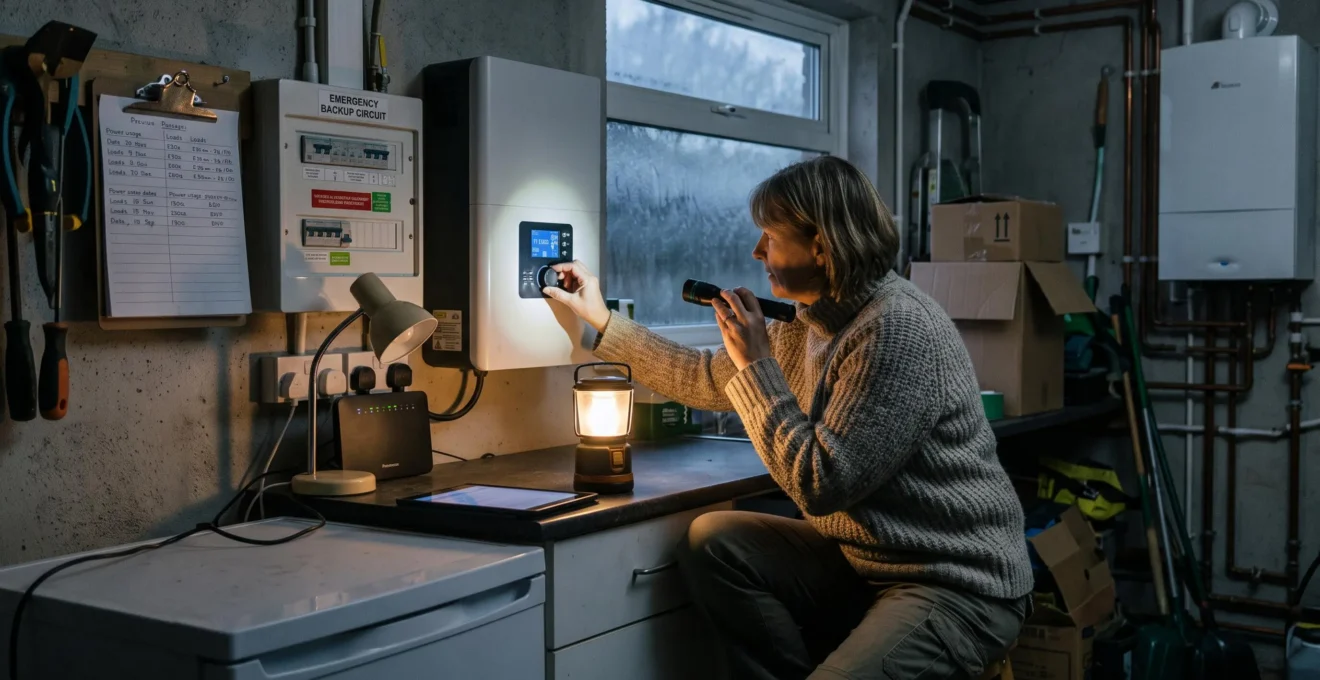
A home battery that keeps the lights on for three hours is not necessarily a long-term energy storage solution. When electricity must remain available for two, three or five days, the challenge changes: stored energy, essential demand, winter weather and recharge opportunities become more important than the battery’s headline capacity.
For UK homes and small businesses, long-term energy storage means having enough usable energy to support a defined load over an extended period. There is no single domestic duration threshold that automatically makes a system long-term. A 48-hour emergency backup system and a grid-scale storage facility address different problems, even though both may be described as long-duration storage.
Ofgem‘s long-duration electricity storage framework concerns large electricity-system projects, while household resilience depends on individual circuits, equipment and outage conditions. A practical domestic target is therefore not a particular technology or battery size, but a verified ability to supply critical loads for the intended duration.
The relevant question is whether your chosen combination of batteries, stored heat, renewable generation or emergency backup can maintain essential services when the grid is unavailable and winter recharge is limited.
Long-term energy storage: the essentials
- Duration depends on demand: a battery’s usable kWh divided by your critical load determines how long it can support that load, subject to conversion losses and power limits.
- Multi-day backup requires selective loads: protecting essential circuits can be substantially more economical than attempting to power an entire property for 72 hours.
- Resilience needs several layers: batteries, thermal storage, demand reduction and dependable replenishment each solve different parts of the problem.
- Why Does Storing Energy for 3 Days Cost So Much More Than for 3 Hours?
- How to Convert “2 Days of Backup” Into kWh and kW Without Guesswork?
- Battery, Thermal Store, Hydrogen, or Generator: Which Works Best for 48–120 Hours?
- The Backup Design Mistake That Doubles Cost With Almost No Real Benefit
- When Should You Upgrade From Short Backup to Long-Duration Storage Without Overspending?
- How to Calculate How Many Battery kWh You Need for 24–72 Hours of Autonomy?
- How to Build a Home Resilience Plan Without Relying on Fossil Backup?
- Are Conventional Energy Sources Still the Most Reliable Option During Cold Snaps?
Why Does Storing Energy for 3 Days Cost So Much More Than for 3 Hours?
Storing enough electricity for three days generally requires far more energy capacity than covering three hours at the same power demand. That increases upfront expenditure, while a system reserved for rare emergencies may deliver very little electricity over its lifetime. The financial challenge is not just buying extra kWh, but paying to keep them available.
Consider a hypothetical home whose protected circuits consume an average of 0.5 kW. Three hours require 1.5 kWh delivered to those circuits. Seventy-two hours require 36 kWh. The duration is 24 times greater, so the required delivered energy is also 24 times greater, before allowing for system losses.
That does not mean the installation price automatically becomes 24 times higher. A system includes components whose costs do not scale directly with stored energy, such as switchgear, communications and some installation work. Other requirements, including additional battery modules, enclosure space and electrical upgrades, may increase costs as capacity grows.
Energy Saving Trust‘s battery storage advice gives an indicative price of approximately £4,600 for a 5 kWh battery system and describes a broader home battery price range of £1,500–£10,000, depending on size and type. These figures are consumer guidance, not quotations for a bespoke multi-day backup installation.
Three financial measurements help explain the difference:
- Capital cost: the amount paid for equipment, installation and any necessary electrical modifications.
- Lifetime cost per delivered kWh: total ownership cost divided by the electricity actually supplied during the system’s service life.
- Standby capacity cost: money committed to keeping energy available even when the reserve is rarely used.
A battery cycled regularly for tariff savings can distribute its capital cost across many useful discharges. A larger emergency-only reserve might remain almost full for months. Its value is primarily the disruption avoided, not the quantity of electricity sold or consumed.
Battery discharge restrictions and inverter losses further distinguish nameplate capacity from useful energy. However, doubling required autonomy does not inherently more than double total system cost: the result depends on the existing hardware, permitted discharge range and installation design.
UK winter weather adds another constraint. The National Energy System Operator‘s Dunkelflaute research project examines periods when wind and solar electricity production are simultaneously low, including their interaction with cold conditions and high demand.
This national electricity-system challenge is not the same as a local household outage. Nevertheless, it illustrates why optimistic assumptions about renewable replenishment can be inappropriate during prolonged winter conditions.
The next decision is therefore to define the essential electrical demand before choosing any battery size. Otherwise, additional storage may protect appliances that do not need to operate during an emergency.
How to Convert “2 Days of Backup” Into kWh and kW Without Guesswork?
To calculate two days of backup, identify essential appliances, estimate their combined daily electricity consumption in kWh, and multiply by two. Then adjust for battery discharge limits and conversion losses. Separately, calculate the highest simultaneous power demand in kW to establish the required inverter output. Both calculations are necessary for a workable system.
Start by deciding what the outage plan must achieve. Keeping refrigeration, communications and a few lights working through an overnight interruption is different from maintaining space heating during a three-day winter outage.
A useful calculation follows five stages:
- Define essential circuits. Include equipment that must operate during an outage, rather than every appliance normally used.
- Estimate daily consumption. Multiply each appliance’s operating power in kW by its daily running hours, accounting for cycling equipment.
- Select the autonomy period. Multiply daily critical-load demand by the intended number of days without reliable recharge.
- Correct for usable battery capacity. Account for manufacturer-specified discharge limits and the efficiency of delivering energy to the loads.
- Check instantaneous demand. Ensure the backup inverter can support simultaneous loads and relevant appliance starting surges.
The distinction between kWh and kW is fundamental. kWh measures energy available over time; kW measures the rate at which electricity must be supplied. A large battery connected to an undersized inverter may contain sufficient energy but fail to operate essential appliances simultaneously.
Suppose a household needs 4 kWh each day to operate essential equipment. For 48 hours, the loads require 8 kWh. If the battery permits 80% usable discharge and the assumed delivery efficiency is 90%, the illustrative nameplate capacity becomes 8 ÷ (0.80 × 0.90), or approximately 11.1 kWh.
Those percentages are hypothetical calculation inputs, not specifications for a particular battery. The real figures must come from the manufacturer and the intended operating configuration. Battery warranties may also impose conditions on operating temperature, cycling and discharge behaviour.
Autonomy can be extended without increasing storage if some demand is deliberately removed. Turning off discretionary sockets, delaying laundry and managing lighting can reduce daily consumption while retaining essential services.
Five checks before requesting a backup installation quote
- List essential appliances and create a labelled critical-load inventory.
- Measure or estimate daily consumption and prepare a kWh-per-day worksheet.
- Calculate required energy for the chosen duration and record the resulting capacity figure.
- Identify simultaneous and starting loads and produce a maximum-power schedule in kW.
- Request manufacturer capacity, efficiency, backup functionality and warranty documentation, then assemble a specification checklist for the installer.
Once these requirements are established, the next question is whether electricity batteries are the most appropriate way to meet every part of the demand.
Battery, Thermal Store, Hydrogen, or Generator: Which Works Best for 48–120 Hours?
For 48–120 hours, no single storage technology is automatically best. Batteries provide immediate electrical backup, thermal stores reduce electricity needed for heating, hydrogen can store energy for later conversion but is difficult to justify domestically, and generators provide electricity while fuel remains available. The strongest design often separates these functions instead of relying on one oversized device.
The practical comparison should consider installation space, energy losses, maintenance, available charging or refuelling, and whether equipment can continue serving essential loads after the original outage forecast is exceeded.
| Option | Best application | Main limitation over 48–120 hours |
|---|---|---|
| Lithium battery storage | Immediate, quiet backup for essential electrical circuits | Substantial energy capacity may be required without replenishment |
| Thermal storage | Hot water or space-heating support where suitable | Cannot directly operate ordinary electrical appliances |
| Hydrogen storage | Specialist systems designed for extended energy storage and conversion | Domestic cost, conversion losses, equipment complexity and storage safety |
| Fuel-powered generator | Extended electrical backup where safe operation and fuel supply are possible | Fuel dependence, exhaust, noise, maintenance and safe changeover requirements |
A lithium battery can deliver electricity without requiring a combustion engine to start. With suitable backup switching, it may support sensitive equipment almost immediately. However, an ordinary grid-connected solar battery does not necessarily operate during a power cut; that capability must be designed and verified.
Thermal storage addresses a different problem. If a significant proportion of household electricity demand is associated with heating or hot water, storing useful heat can reduce what the electrical battery must supply. Its effectiveness depends on available heat, insulation, temperature requirements and the heating system’s electrical dependencies.
Hydrogen potentially separates the amount of energy stored from the electrical conversion equipment’s output. But a domestic system would need appropriate production or supply, storage, conversion, ventilation and safety arrangements. Conversion losses and specialist infrastructure make it an emerging rather than routine choice for UK household backup.
A generator can deliver further electricity as long as it has a suitable fuel supply and remains operational. It is therefore a different kind of resilience resource from a battery with fixed stored energy. It is not unlimited backup: fuel availability, maintenance and adverse weather still constrain endurance.
Never run a combustion generator indoors, in a garage or near openings where exhaust can enter occupied spaces. Carbon monoxide poisoning is a potentially fatal hazard. Any changeover arrangement must also prevent dangerous backfeeding into the electricity distribution network.
For grid-connected equipment, UK government guidance on registering home energy devices distinguishes installations requiring notification to the Distribution Network Operator (DNO) from those requiring prior connection approval. The guidance covers England, Scotland and Wales and references G98, G99 and G100. Applicable procedures, wiring requirements, backup changeover design and islanding arrangements should be confirmed with a competent installer.
For many properties, a practical hybrid arrangement is a modest battery for immediate critical loads, useful thermal storage for heating demand, and a separately assessed emergency supply for circumstances beyond the system’s stored-energy limit.
Technology selection becomes easier once the property is no longer expected to operate exactly as it would on a normal grid-connected day.
The Backup Design Mistake That Doubles Cost With Almost No Real Benefit
The most expensive design mistake is sizing backup storage to power every household circuit for several days, even though only a small number of appliances are essential. This can force larger battery capacity, higher inverter output and additional electrical work. In some projects, costs may become dramatically higher without a comparable improvement in practical resilience.
Consider the difference between keeping refrigeration, lighting, heating controls and internet access operational, and also accommodating an electric shower, tumble dryer, oven and vehicle charger. The latter group can impose substantial power and energy requirements that may not be necessary during an emergency.
Two separate constraints then increase system expenditure. High simultaneous demand may require a larger inverter, while sustained use of energy-intensive appliances requires more stored kWh.
A critical-loads circuit avoids much of this problem. Selected essential equipment is connected through an appropriately designed backup distribution arrangement, while non-essential circuits remain disconnected during an outage.
The solution does not require accepting poor resilience. It requires defining the minimum acceptable service level and providing enough energy to sustain it.
For example, a hypothetical home might operate its essential circuits at an average of 0.25 kW instead of maintaining a wider household demand averaging 1 kW. Over 72 hours, those two scenarios require 18 kWh and 72 kWh respectively, before losses. That is a fourfold energy difference, not a verified fourfold price difference.
A second error is designing every component around the most severe imaginable winter event. Resilience planning should acknowledge rare extreme conditions, but that does not mean the battery itself must carry every load throughout them.
A tiered design instead separates normal outages, prolonged interruptions and exceptional emergencies. The battery can handle the first stage, while progressively tighter consumption limits or a separate contingency apply when the event persists.
Future demand deserves similar restraint. A possible electric vehicle, later heat pump installation or hypothetical business expansion should influence system compatibility, but does not automatically justify purchasing all eventual capacity immediately.
Modular expansion can be valuable where explicitly supported. Some systems permit additional compatible battery modules, but that depends on manufacturer rules, battery management electronics, installation limits and the inverter’s supported capacity.
Buying an expandable platform can therefore preserve options without paying immediately for unused energy storage. It is not a guarantee that any future battery can be connected to existing equipment.
A resilient design protects the functions that matter and makes the unavoidable limitations visible, rather than hiding them behind an oversized nameplate rating.
When Should You Upgrade From Short Backup to Long-Duration Storage Without Overspending?
Upgrade when an identifiable change makes existing backup capacity inadequate, rather than simply because larger batteries are available. Relevant triggers include outages exceeding current endurance, new essential electrical loads, or a financially demonstrable benefit from storing additional energy. Without those conditions, retaining a functional system and monitoring its performance may be more economical.
The most useful evidence comes from actual operation. Record the duration of outages, which appliances were required, the battery’s starting and ending state of charge, and whether any essential service was interrupted.
If a battery consistently retains a substantial reserve after outages, additional capacity may offer limited immediate benefit. If it repeatedly reaches its minimum permitted charge while important circuits still need electricity, the system has a demonstrable endurance problem.
One winter of records can provide an initial evidence base, although it cannot establish performance during rare storms or unusually prolonged cold spells. Such events still require contingency planning.
Three circumstances particularly justify reassessment:
- Actual outage experience changes: the existing reserve no longer covers interruptions relevant to the property.
- Essential demand changes: home working, medical equipment, heating alterations or business-critical systems increase the load that must remain powered.
- Storage economics change: an available tariff or operating arrangement creates a sufficiently substantiated additional benefit to justify investment.
An extension may be possible if the original battery platform was designed for expansion. However, compatibility is more complex than finding another module with a similar voltage. Battery management communications, firmware, permitted configurations, installation age and warranty terms all matter.
The inverter can also limit an upgrade. Adding battery capacity may increase potential runtime without increasing maximum supported load power. Conversely, replacing the inverter could require further electrical work or updated network-connection arrangements.
Compare an expansion quotation with a replacement quotation on the same basis: usable capacity, supported backup power, installed cost, warranty coverage, expected operating life and any additional switchgear.
Future storage technology may offer better economic or technical options, but price reductions are not guaranteed for a particular product or installation. Waiting is sensible only when the cost of remaining underprotected is acceptable.
The most convincing reason to add storage is a measured shortfall against a defined resilience requirement. A detailed capacity calculation then establishes how much additional energy is actually needed.
How to Calculate How Many Battery kWh You Need for 24–72 Hours of Autonomy?
Calculate battery capacity by multiplying the essential daily electricity demand by the number of backup days, then dividing by the usable discharge fraction and delivery efficiency. For a hypothetical household using 3 kWh per day on essential circuits, the energy requirement is 3, 6 or 9 kWh over 24, 48 or 72 hours before these corrections.
Consider a simplified UK household with a fridge-freezer, gas boiler controls and circulation equipment, basic lighting, an internet router and device charging. The figures below are illustrative assumptions, not measured appliance consumption or national household averages.
| Essential load | Assumed daily electricity use |
|---|---|
| Fridge-freezer | 0.9 kWh |
| Boiler controls and circulation equipment | 1.0 kWh |
| Essential lighting | 0.3 kWh |
| Router and communications | 0.4 kWh |
| Device charging and small essentials | 0.4 kWh |
| Total | 3.0 kWh |
Assume the battery permits 80% usable discharge and the backup system delivers 90% of that energy to the household circuits. The combined usable fraction is 0.80 × 0.90 = 0.72.
The calculation becomes:
Required nameplate capacity (kWh) = daily critical-load demand (kWh) × autonomy days ÷ (usable discharge fraction × delivery efficiency).
| Backup duration | Energy required by loads | Calculated nominal battery capacity |
|---|---|---|
| 24 hours | 3 kWh | 4.17 kWh |
| 48 hours | 6 kWh | 8.33 kWh |
| 72 hours | 9 kWh | 12.50 kWh |
These results assume a fully charged battery at the start, constant daily consumption, no replenishment and the specified illustrative efficiency. They exclude additional design margins, long-term capacity degradation, temperature-related performance changes and equipment-specific standby consumption not already reflected in the assumptions.
The heating system can change the answer substantially. A gas boiler may require electricity for controls and pumps, while a heat pump requires electrical input to provide heat. Direct electric heating can impose still different demands. Hot water, property insulation, outdoor temperature and occupancy also influence real consumption.
As a result, an installed battery described as 10 kWh should never be assumed to deliver exactly 10 kWh to household appliances during a blackout.
Solar generation changes the energy balance when the photovoltaic system is designed to operate during grid outages. Electricity generated during the event can supply loads or recharge batteries, reducing the amount that must come from initial storage.
But solar recharge should be treated conservatively for UK winter resilience. Short daylight periods, cloud cover, roof orientation and prolonged poor weather may sharply limit production. An annual average generation estimate is unsuitable for guaranteeing December autonomy.
For a dependable design, calculate a no-recharge baseline first. Then assess a separately documented scenario using realistic local winter generation assumptions.
Calculating energy is only part of the exercise. The resilience plan also needs to explain what happens when electricity demand rises, storage becomes depleted or the outage lasts longer than expected.
How to Build a Home Resilience Plan Without Relying on Fossil Backup?
A fossil-free home resilience plan starts by reducing essential energy demand, then combining efficient heating, suitable electrical storage, thermal reserves and outage-capable renewable generation. It must also define what the home can support when renewable production is minimal. Without sufficient stored energy, a prolonged winter outage may require strict rationing rather than uninterrupted normal living.
The lowest-cost unit of backup energy is often the unit that never needs to be consumed. Improved insulation, draught reduction and sensible heating controls can reduce the energy needed to maintain safe indoor conditions.
Efficient electric heating may reduce normal energy demand compared with direct resistance heating, but it also introduces a dependency on electrical supply. That dependency must be included when designing backup for a heat pump.
A layered approach provides greater flexibility:
- Reduce heat loss and identify the smallest set of electrical services that must remain available.
- Use efficient heating and appliance operation to minimise daily energy consumption.
- Provide batteries for critical electrical circuits and thermal storage where useful.
- Configure renewable generation and charging equipment for verified outage operation, where technically feasible.
- Set explicit contingency rules for consumption restrictions and exhaustion of stored energy.
Non-storage measures also matter. Before a forecast severe-weather event, safely pre-heating an adequately insulated building may provide a temporary thermal buffer. Keeping refrigerator and freezer doors closed helps preserve stored cooling, while offline documents, charged communications equipment and drinking-water arrangements reduce secondary disruption.
Properties dependent on electric water pumps must consider water availability separately from lighting and heating.
During an outage, the household can progressively reduce demand. Discretionary sockets and entertainment equipment are disconnected first, while refrigeration, essential communications, required medical equipment and minimum safe heating receive priority according to household needs.
Thermal reserves are then managed alongside the remaining battery charge. A documented daily energy allowance can help prevent all stored electricity being consumed during the first day of a longer interruption.
A genuinely fossil-free plan contains no combustion-generator dependency. A generator kept for exceptional emergency use may be a pragmatic additional contingency, but a plan that relies on it is not fully fossil-free. That distinction should remain explicit.
The critical limitation is endurance during prolonged periods of weak renewable generation. A small battery combined with rooftop solar cannot guarantee multi-day power if neither sufficient sunlight nor another usable energy source is available.
Resilience should be defined in operating modes: normal critical-load backup, reduced-service operation and the point at which safe external assistance or alternative arrangements become necessary.
The purpose is not to promise complete independence under every possible condition. It is to establish a realistic, testable response to the outages a property needs to withstand.
Key takeaways before choosing an energy source
- Reliability depends on every essential dependency: the energy source, conversion equipment, controls, distribution network and available backup.
- National electricity-system resilience and uninterrupted supply to an individual property are different questions.
- The most useful comparison is whether essential services can survive a defined 48–120-hour winter interruption, including realistic limits on replenishment.
Are Conventional Energy Sources Still the Most Reliable Option During Cold Snaps?
Conventional energy sources can provide dependable energy during cold weather, but they do not guarantee uninterrupted heating or electricity at home. Gas boilers commonly need electricity for controls and circulation, while electric heating and heat pumps depend on electrical supply. Reliability therefore depends on the complete system, including local networks and suitable backup arrangements.
The distinction becomes especially important during storms. A property may retain access to a gas network but lose power to the equipment required to operate its central heating. A gas boiler is not necessarily useful during an electricity outage unless its electrical requirements are independently supported.
A heat pump paired with a properly sized, outage-capable battery can also continue operating for a period, provided the inverter can handle its electrical requirements and enough stored energy remains.
Neither technology is inherently immune to prolonged supply interruptions. Their resilience depends on what is stored, how much power the equipment needs, and which parts of the energy supply chain remain operational.
At national level, Great Britain’s electricity system uses a combination of generation technologies, network infrastructure, interconnection, storage and operational flexibility to balance demand and supply. The reliability question for an individual home, however, concerns whether electricity reaches that property’s circuits when needed.
A weather-related distribution fault can disconnect a household even when the wider electricity system has adequate generation. Conversely, a national period of low renewable production does not mean individual homes must experience power cuts.
NESO’s Dunkelflaute research identifies simultaneous low wind and solar generation as a system-level planning issue. It does not establish that such weather causes every local outage or that any fixed number of storage days guarantees reliability.
For the homeowner, comparing conventional and low-carbon systems therefore requires examining several practical factors:
- Which fuel or electricity networks does the system require?
- Which essential components stop working during a grid outage?
- What independent electrical power can the system deliver, and for how long?
- Can stored energy be replenished during the interruption?
- What happens if adverse weather continues beyond the planned autonomy period?
For many properties, 48–120 hours is a useful multi-day stress-test scenario, not a universal UK backup requirement. The appropriate target depends on local exposure, critical services, acceptable disruption and the feasibility of alternative arrangements.
A battery sized for essential circuits may provide effective resilience without supporting an entire property’s usual energy consumption. Thermal storage can reduce heating-related electricity needs, while other backup technologies may address longer interruptions where their risks and operating requirements are acceptable.
For households with medically essential electrical equipment, specialised contingency planning is particularly important. A generic home battery duration estimate should not be treated as a sufficient medical power continuity plan.
The practical next step is to document the electricity your essential circuits require over a realistic winter outage, verify the capability of your proposed equipment, and have a qualified installer assess safe backup switching and network requirements. The best long-term storage system is the one whose endurance and limits are understood before the power goes off.
Does a standard solar battery automatically provide power during a blackout?
No. Some solar battery installations disconnect during grid outages unless they include suitable backup or islanding capability. Confirm that the inverter, switching arrangement and protected circuits are specifically designed for power-cut operation.
Can a battery remain charged until an emergency?
Some battery systems support reserving a proportion of stored energy for backup. Available settings, standby consumption, charging behaviour and long-term operating restrictions depend on the product. Check the manufacturer’s documentation rather than assuming a battery will always remain at full charge.
Does a bigger inverter make a battery last longer?
Not by itself. Inverter power determines the electrical load the system can support at a given moment. Runtime primarily depends on usable stored energy and consumption. A larger inverter may allow additional appliances to operate, potentially increasing demand and reducing autonomy.
Can a small business use the same approach as a household?
Yes, the core method of identifying critical loads, calculating kWh and checking peak kW remains useful. However, businesses may need additional assessments for refrigeration, IT systems, emergency lighting, operational continuity and equipment starting currents. Safety and compliance requirements must be assessed for the specific premises.
Is five days of backup always better than two days?
Five days of verified autonomy provides longer endurance at the same critical demand, but it is not automatically the most economical design. If reduced consumption, thermal storage or dependable replenishment can cover an extended interruption, buying a large additional battery reserve may offer limited value. The decision should reflect outage risk, consequences and total ownership cost.