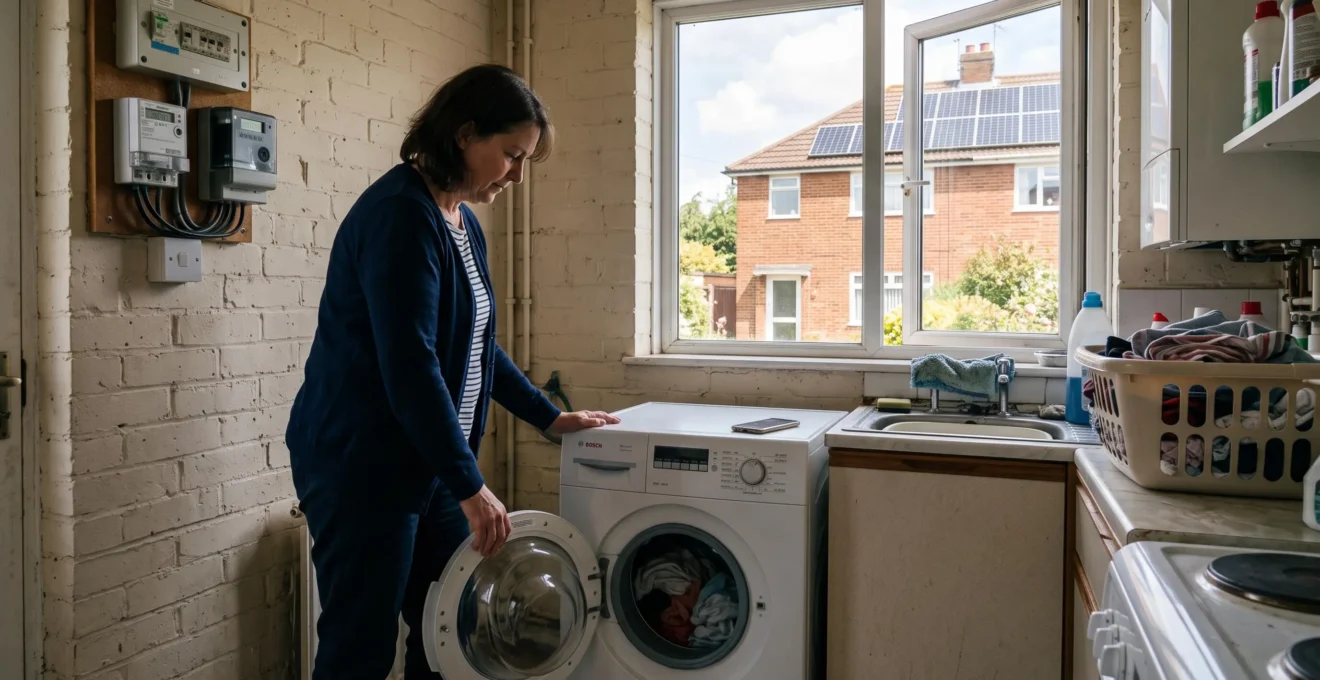
Using more of your own solar electricity does not require working from home, constantly checking an inverter or buying a collection of smart devices. For most working households, the starting point is to move existing electricity demand into the hours when the panels are generating, then decide whether storing the remaining surplus makes financial sense.
The difficulty is that a typical British household’s routine does not match its solar production curve. Breakfast, evening cooking, laundry and entertainment can account for substantial electricity demand outside the strongest generation hours. Meanwhile, unused solar electricity flows into the grid while everyone is at work or school.
Exporting electricity is not necessarily a problem, particularly if you receive a competitive export tariff. The objective is to reduce the combined cost of buying electricity and giving up export income, rather than achieving the highest possible self-consumption percentage. Understanding that distinction helps you make better decisions about appliance scheduling, hot water, electric vehicle charging and battery storage without reorganising family life around the weather.
Making your solar electricity work around your routine
- High annual electricity consumption does not guarantee high solar self-consumption: the timing of demand matters more than the total alone.
- Start by rescheduling existing electricity demand where practical and safe, before investing in additional equipment.
- Compare avoided import costs with lost export payments when deciding whether to consume, store or export surplus generation.
- Adjust appliance schedules and battery settings as daylight hours, household routines and electricity tariffs change.
- Why Does Solar Export Stay High Even With “High Usage” Households?
- How to Shift 3 Key Loads Into Solar Hours Without Changing Your Routine?
- Battery, Immersion Diverter, or Smart EV Charging: Which Boosts Self-Use Most?
- The Self-Consumption Trap That Quietly Increases Your Annual kWh
- When Should You Optimise Self-Consumption: Spring Shoulder Months or Mid-Summer?
- How to Estimate Your Solar Self-Use Rate Without Any Apps or Monitoring Gear?
- How to Set Battery Charge Windows So You Cover the 5–10pm Peak Properly?
- How Do You Use a Home Battery Without Killing the Savings With Bad Settings?
Why Does Solar Export Stay High Even With “High Usage” Households?
Solar export remains high in households with substantial electricity consumption when their demand occurs outside the main generation hours. A family can consume large amounts of electricity annually while exporting most of its daytime solar production. Without sufficient simultaneous demand or storage, midday generation cannot directly offset electricity purchased for evening activities.
According to the Centre for Sustainable Energy’s advice on making the most of solar panels, solar generation on a typical sunny day is strongest between approximately 11am and 3pm. Domestic electricity demand, by contrast, tends to be concentrated around morning and evening activities.
This creates a mismatch for households that leave home after breakfast and return in time to prepare dinner. Running several appliances after work increases annual consumption without necessarily improving daytime solar utilisation.
Before buying equipment, compare the half-hourly import information available through your energy supplier, where provided, with generation readings from your inverter. Export readings provide another useful indication of how much electricity leaves the property during the same period. Without a battery, the difference between generation and export provides an estimate of electricity used directly within the home.
It is also worth distinguishing between two reasons for exporting:
- Unavoidable surplus: generation exceeds the electricity demand that can reasonably be accommodated at that time.
- Strategic export: selling surplus electricity provides greater financial value than consuming or storing it under the available tariff arrangements.
Roof orientation influences this balance. South-facing panels generally concentrate production around the middle of the day, whereas west-facing panels tend to generate a greater share of their electricity later. A west-facing installation may therefore overlap more closely with the early evening routine, reducing surplus exports during those hours without additional equipment. The effect depends on shading, system size, season and actual demand.
Households with daytime immersion heating or a heat pump operating during solar hours should also check how much demand already coincides with generation. There may be less unused potential than their annual figures suggest.
Once the timing of imports and exports becomes clear, the next step is to identify existing household activities that can move into the available generation window without introducing unnecessary consumption.
How to Shift 3 Key Loads Into Solar Hours Without Changing Your Routine?
The washing machine, dishwasher and electric immersion heater are useful starting points for shifting household electricity demand into solar hours. Their operation can often be scheduled using existing controls, provided the equipment and household circumstances allow safe use. The best schedule follows the property’s actual generation pattern rather than a fixed midday timetable throughout the year.
Start with appliances and heating systems that do not require electricity at the exact moment their output is needed. Laundry can sometimes be prepared earlier, dishes can wait until a suitable washing window, and a hot water cylinder can store heat for later use.
- Washing machine: prepare the laundry in advance and use an appropriate delayed-start programme when someone can be at home during operation.
- Dishwasher: load it after the evening meal and schedule its next suitable supervised cycle around expected solar production.
- Immersion heater: where an appropriate cylinder and timer are installed, schedule water heating to overlap with surplus generation while retaining necessary temperature and hygiene controls.
Built-in appliance timers can avoid the expense of additional smart plugs or energy management devices. However, delayed-start functionality does not establish that an appliance is suitable for unattended operation. Follow manufacturer instructions and electrical and fire safety guidance, particularly for washing machines, dishwashers and tumble dryers.
Scheduling also needs to account for instantaneous power. In an illustrative example provided by the Centre for Sustainable Energy, panels generating 1,000 W leave 900 W available after supplying a refrigerator consuming 100 W. A washing machine drawing 2,500 W at that moment would still require 1,600 W from the grid.
Running appliances consecutively rather than simultaneously can therefore make better use of moderate solar output. The precise benefit depends on how their heating stages overlap with generation.
To prioritise loads, multiply the electricity that could realistically be shifted per use by the frequency of use, then assess how easily each change fits the household’s routine. An occasional high-consumption activity may offer less annual benefit than a moderately demanding appliance used regularly.
Review the schedule in spring and autumn. A start time that works well during long summer afternoons may coincide with weak generation in winter.
For households that are empty throughout the working day, safe appliance scheduling may have limited potential. Automated water heating, compatible EV charging or battery storage can then provide additional flexibility without requiring someone to be present.
Battery, Immersion Diverter, or Smart EV Charging: Which Boosts Self-Use Most?
The most effective equipment depends on which form of energy your household needs and when it needs it. A home battery suits substantial evening electricity demand, an immersion diverter converts surplus generation into useful hot water, and smart solar EV charging can absorb daytime surplus when a compatible vehicle is connected. None is universally the best investment.
Each technology addresses a different limitation of direct solar consumption. A battery makes stored electricity available to household circuits later, while an immersion diverter stores energy as heat. An EV charger transfers electricity into the vehicle’s battery primarily for driving.
Consider the following household profiles before comparing installation costs.
| Equipment | Best suited to | How it uses surplus solar | Main limitation |
|---|---|---|---|
| Home battery | Households with substantial electricity demand after sunset | Stores electricity for later domestic use | Installation costs, conversion losses and limited usable capacity |
| Immersion diverter | Homes with a compatible hot water cylinder and regular hot water demand | Converts surplus electricity into stored heat | Limited by cylinder capacity, heat losses and useful hot water demand |
| Smart solar EV charger | EV owners whose vehicles are regularly parked at home during daylight | Adjusts compatible charging operations around available solar surplus | Vehicle availability, minimum charging power and departure requirements |
These technologies can complement one another. For example, a household could use direct solar electricity for its existing demand, allocate surplus to a connected EV or hot water cylinder, and store the remaining electricity for evening use. The appropriate priority depends on the financial value of each use and the capabilities of the installed equipment.
Under the Smart Export Guarantee (SEG), eligible generators in Great Britain receive payments for metered exports. As explained in Ofgem’s official Smart Export Guarantee guidance, suppliers determine their export rates and contractual terms. Northern Ireland has separate arrangements.
For direct consumption that replaces imported electricity, the basic financial calculation is:
Value per additional kWh self-consumed = avoided import unit rate − forgone export unit rate.
For battery storage, adjust the avoided import value to account for round-trip efficiency. For immersion heating, calculate the actual cost of the alternative water heating being displaced rather than automatically using the electricity import rate.
Estimate the annual value of the additional useful energy, deduct operating costs where relevant, and compare the result with the installed price. A simple payback calculation can help screen options, although it does not capture equipment degradation, future tariff changes or replacement costs.
An immersion diverter deserves particular scrutiny where hot water demand is concentrated in the morning. Water heated around midday must remain sufficiently hot until its next use. Standing heat losses, insufficient storage capacity or conventional heating that has already brought the cylinder to temperature can substantially reduce the benefit.
Whichever technology fits your home, absorbing more solar generation only creates financial value when it replaces a worthwhile energy expense. Increasing consumption simply to avoid exporting can have the opposite effect.
The Self-Consumption Trap That Quietly Increases Your Annual kWh
Solar electricity can feel free once the panels are installed, encouraging households to run appliances more frequently than they otherwise would. This behavioural response is known as the rebound effect. It differs from load shifting because the household is adding electricity demand rather than moving an existing activity to a more suitable time.
Using a tumble dryer instead of drying clothes naturally, running additional washing cycles or switching on unnecessary electric heating may all increase the proportion of solar generation consumed at home. Nevertheless, these activities can reduce export revenue and increase grid imports whenever their demand exceeds available generation.
7.7%
The estimated solar PV rebound effect in a 2023 study of Dutch households. This finding illustrates the potential for behavioural changes following solar adoption; it is not an estimate for UK households.
The Energy Economics study on the solar rebound effect in Dutch households.
The distinction becomes clearer when comparing two performance measures:
- Solar self-consumption rate: the percentage of generated solar electricity retained and used on site, subject to the measurement convention used for storage.
- Net electricity cost: the amount paid for imported electricity, including applicable charges, less income received for exported electricity.
A higher self-consumption percentage does not guarantee a lower net electricity cost.
Hypothetical example: using surplus solar without creating savings
Consider a household that normally dries its clothes outdoors but begins using an electric tumble dryer whenever its solar panels generate a surplus. Its self-consumption rate increases, yet the dryer has not replaced an existing electricity expense. The household gives up export income and may purchase additional electricity if solar production falls during the drying cycle.
The higher self-consumption figure therefore conceals an additional cost rather than demonstrating a saving.
Compare total household electricity consumption over equivalent annual periods before and after changing your routine. For a solar installation without battery storage, total consumption can be estimated by adding grid imports and solar generation, then subtracting exports.
An unexplained increase is a reason to investigate, not proof of a rebound effect. Weather, occupancy, electric vehicle adoption and changes to heating arrangements can also influence annual demand.
Avoid spending disproportionate effort scheduling phone chargers or other minor loads while overlooking appliances with substantial heating elements or longer operating cycles.
Keeping total demand under control also makes seasonal comparisons more useful. Changes in solar production should guide the timing of existing activities rather than become an incentive to consume more electricity.
When Should You Optimise Self-Consumption: Spring Shoulder Months or Mid-Summer?
Spring and early autumn are generally useful periods for calibrating solar self-consumption because generation is less consistently abundant than during mid-summer. Moderate output makes it easier to identify which household loads genuinely benefit from rescheduling. Summer and winter checks should then confirm whether the same routine remains appropriate under substantially different generation conditions.
During a sunny summer period, several appliances may operate within the available solar output without particularly careful scheduling. That apparent success can obscure weaknesses in the routine that become visible when daylight hours shorten or cloud cover reduces generation.
Use a reasonably representative spring week to establish when your installation produces enough electricity to accommodate flexible demand. Include different weather conditions rather than selecting only the brightest days.
| Period | Generation conditions | Recommended focus |
|---|---|---|
| Spring | Increasing daylight and variable generation | Establish practical appliance schedules and identify recurring surplus |
| Summer | Longer generation windows and generally higher output | Assess remaining export opportunities and useful storage demand |
| Autumn | Shortening daylight and changing heating requirements | Review appliance timing, hot water demand and evening battery requirements |
| Winter | Generally lower generation and potentially higher heating demand | Prioritise available direct solar use and assess off-peak import opportunities |
Winter presents a structural limitation, particularly for households with electric heating. The Centre for Sustainable Energy highlights the seasonal mismatch between stronger summer solar generation and greater winter heat pump demand. Rescheduling cannot create solar electricity that the panels are not producing.
For homes with suitable batteries and time-of-use tariffs, cheaper grid charging may become more relevant during darker months. In that situation, the main benefit may come from reducing the cost of imported electricity rather than increasing solar self-consumption.
Spring can also produce periods of substantial aggregate solar exports across electricity networks. Such conditions may influence the value of electricity at particular times under dynamic tariffs, although future export rates cannot be predicted from seasonal generation alone. Check the actual tariff arrangements rather than assuming that midday exports will become less valuable.
A useful seasonal review requires comparable generation, import and export information. Fortunately, homeowners can establish a workable baseline using existing meter readings without installing a dedicated monitoring system.
How to Estimate Your Solar Self-Use Rate Without Any Apps or Monitoring Gear?
You can estimate solar self-consumption using the generation reading from your existing inverter or generation meter and the export reading from your electricity meter or supplier statement. For a solar installation without battery storage or another generating source, subtract exported electricity from total generation over the same period, then divide the result by generation.
Use cumulative energy readings expressed in kWh rather than instantaneous power readings expressed in kW. The starting and ending readings must cover matching periods to produce a meaningful result.
Estimated self-consumed solar electricity (kWh) = solar generation (kWh) − grid exports (kWh).
Estimated solar self-consumption rate (%) = self-consumed solar electricity ÷ solar generation × 100.
Import readings are not required for this particular percentage, but they help identify how much electricity your home continues to purchase during solar hours and after production declines.
For a more useful picture of household routines, record the import meter at the beginning and end of the main solar window and again later in the evening. Comparing consecutive readings helps distinguish daytime imports from evening demand. A reading carried forward from the previous evening also helps identify overnight and morning consumption.
Five steps to establish your household’s solar self-consumption baseline
- Record your cumulative solar generation and export readings at the same starting time, creating a dated baseline with both values in kWh.
- Read the import meter around the beginning and end of useful solar production and again in the evening on representative days, creating a log of electricity purchased during each period.
- Repeat the generation and export readings after one week, producing matched weekly totals for electricity generated and exported.
- Subtract weekly exports from weekly generation and calculate the self-consumption percentage, recording both the estimated retained kWh and the percentage.
- Repeat the process across several weeks and combine the corresponding generation and export totals, creating a monthly baseline against which future changes can be assessed.
A simple appliance test can provide additional evidence. When the panels are generating and the property is exporting, switch on an existing load that can be operated safely. If the export power decreases or the import power remains at zero, solar electricity is covering at least part of that additional demand. If grid imports increase, the available surplus is insufficient to meet the entire load.
Where export data are available only through supplier statements, use the reported export quantity in kWh rather than the payment amount. Converting payments back into energy can be unreliable when export rates vary.
Weekly readings support monthly estimates, but interpolating between them does not reveal exactly when electricity was consumed. Cloud cover and household behaviour can change significantly from day to day.
A battery complicates the calculation because retained electricity may include stored energy, conversion losses or electricity originating from the grid. An immersion diverter does not invalidate the basic calculation for a battery-free solar system, but the result will include electricity converted into heat. Installing either device warrants a new measurement baseline.
Once you understand how much electricity remains available during the day and how much the household purchases in the evening, you can make more informed decisions about battery charging and discharge schedules.
How to Set Battery Charge Windows So You Cover the 5–10pm Peak Properly?
To cover household electricity demand between 5pm and 10pm, configure a compatible battery to retain sufficient usable energy for that period instead of discharging unnecessarily earlier in the day. Prioritise available solar charging where financially appropriate, then consider off-peak grid charging when expected generation is insufficient and the tariff differential justifies the conversion losses.
The first step is to establish how much electricity your household typically requires during the evening. Cooking, lighting, entertainment and other appliances contribute to this demand, while electric heating and EV charging can substantially increase it.
Use representative import and consumption information to estimate the evening requirement. If the battery cannot meet the entire period’s demand, its available capacity and discharge power determine how much imported electricity it can realistically replace.
Filling the battery from the grid overnight may leave insufficient capacity for the following day’s surplus solar electricity. Conversely, filling it with solar energy early in the morning is not inherently a problem if the stored electricity remains available for the evening. What matters is balancing available charging capacity, the value of exports and the timing of discharge.
According to Energy Saving Trust’s guidance on battery storage, batteries can use cheaper grid electricity for subsequent household demand, but storing electricity is less efficient than consuming solar generation directly.
Use the battery’s applicable round-trip efficiency, expressed as a decimal, to compare the available charging options.
- Solar charging value per kWh entering the battery: evening import rate × round-trip efficiency − forgone solar export rate.
- Grid charging value per kWh entering the battery: evening import rate × round-trip efficiency − off-peak import rate.
These simplified calculations exclude battery degradation and other operating costs. They assume the stored electricity will actually replace evening imports and that the chosen operating mode complies with the supplier’s contractual conditions.
Where the evening demand exceeds battery capacity, avoid allowing a large EV charging session to drain the battery immediately after work. Schedule EV charging separately where supported, and use battery discharge limits or compatible energy management controls to retain energy for other evening activities.
Many domestic batteries supply electricity according to total household demand rather than selecting individual appliances. Prioritising specific circuits requires suitable controls or installation arrangements. Any adjustments involving wiring or electrical connections should be undertaken by a qualified professional.
Finally, treat 5pm to 10pm as a household planning window, not a universal UK peak tariff period. Your actual expensive hours depend on your electricity contract.
Recheck the schedule when heating demand, working arrangements or school routines change. A battery configured around summer consumption may need different charging and discharge behaviour during winter.
Key points before adjusting your battery settings
- A battery reaching full charge is not evidence of financial efficiency; the value of the electricity used to charge it matters.
- Available storage capacity and maximum discharge power are separate constraints and must both suit the intended evening demand.
- Battery configuration should accommodate household needs, manufacturer operating limits and actual tariff periods rather than pursue maximum daily cycling.
How Do You Use a Home Battery Without Killing the Savings With Bad Settings?
A home battery preserves savings when it charges from economically worthwhile electricity, discharges when that energy has greater value, and operates within appropriate manufacturer limits. Avoid unrestricted grid charging, unnecessary discharge before expensive periods and excessive cycling for marginal gains. Regularly review usable capacity, backup reserves and charging behaviour against actual household demand.
The most important settings are not necessarily those that produce the highest daily battery utilisation. They are the settings that determine whether stored electricity replaces more expensive imports after accounting for the cost of charging and the energy lost during storage.
Review these common configuration problems:
- Unrestricted grid charging: the battery purchases electricity outside advantageous tariff windows, potentially storing energy that costs more than the imports it later replaces.
- Premature discharge: stored electricity is used during a less valuable period, leaving insufficient energy for more expensive evening demand.
- Unnecessary depth of discharge: the battery is repeatedly pushed towards its permitted operating limits without a corresponding financial benefit. Follow manufacturer recommendations and retain all required protections.
- Inappropriate backup reserve: a reserve larger than the household actually needs can leave usable storage capacity unavailable for daily consumption. Conversely, reducing a necessary reserve can undermine the property’s backup requirements.
Round-trip losses deserve particular attention. Some electricity is lost when energy passes through the battery’s charging and discharging processes. As Energy Saving Trust explains, direct consumption of solar electricity is more energy-efficient than using it after storage.
Repeated shallow cycles are not automatically harmful or uneconomic. However, avoid cycling undertaken solely to improve an utilisation statistic when the potential tariff saving does not cover conversion losses and relevant operating costs.
The battery should complement, rather than replace, sensible load management. Existing electricity demand that can safely coincide with generation avoids an unnecessary storage cycle. Suitable daytime EV charging or useful water heating can also reduce the demand for stationary storage, provided these uses offer better value than exporting the electricity.
Establish a quarterly review of battery operation using the information available through the existing system. Examine charging sources, discharged energy, cycle information where available, reserve settings and the frequency of grid imports during the intended discharge window. Compare these observations with the applicable tariff and household routine.
If the battery regularly finishes the evening with substantial unused energy, investigate whether charging targets can be reduced. If it empties early, check whether its usable capacity is insufficient, its discharge begins too soon or another large load is consuming the stored electricity.
Start with a representative week of generation, import and export readings, then identify one practical scheduling change that fits your household. Measure its effect before altering another setting or considering additional equipment. The objective is a lower net energy cost and a system that works around everyday life, not a perfect self-consumption percentage that requires constant attention.
Is exporting solar electricity a waste of energy?
No. Exported electricity enters the electricity network and can provide income under an eligible export arrangement. Exporting may also be financially preferable to using electricity for an unnecessary activity or storing it when conversion losses outweigh the potential savings. The appropriate balance depends on your import tariff, export tariff and useful household demand.
What is the difference between solar self-consumption and energy self-sufficiency?
Solar self-consumption measures the proportion of solar generation used within the property. Energy self-sufficiency measures the proportion of total household electricity demand supplied by its own generation. A home can consume nearly all its limited solar output while still depending heavily on imported electricity.
Can smart plugs make ordinary appliances respond automatically to surplus solar?
An ordinary smart plug generally controls when an appliance receives electricity; it does not independently establish how much surplus solar is available. Solar-responsive operation requires suitable monitoring and compatible controls. The appliance must also support external switching, and the device must be appropriately rated and suitable for the intended use.
Should an immersion diverter be installed if a gas boiler already heats the water?
Not necessarily. The financial benefit depends on the cost of the gas that solar water heating would displace, boiler efficiency, cylinder heat losses and forgone solar export income. A compatible cylinder with an immersion element is also required. Where conventional water heating is relatively inexpensive, exporting surplus electricity may offer better value.
Does an electric vehicle need to be at home every day to benefit from solar charging?
No. Weekend parking, occasional home-working days and other daylight periods can provide opportunities to use solar generation for EV charging. However, the annual benefit depends on how often the vehicle is connected during useful generation, its charging requirements and the compatibility of the charging equipment. An advantageous overnight EV tariff may remain preferable at other times.