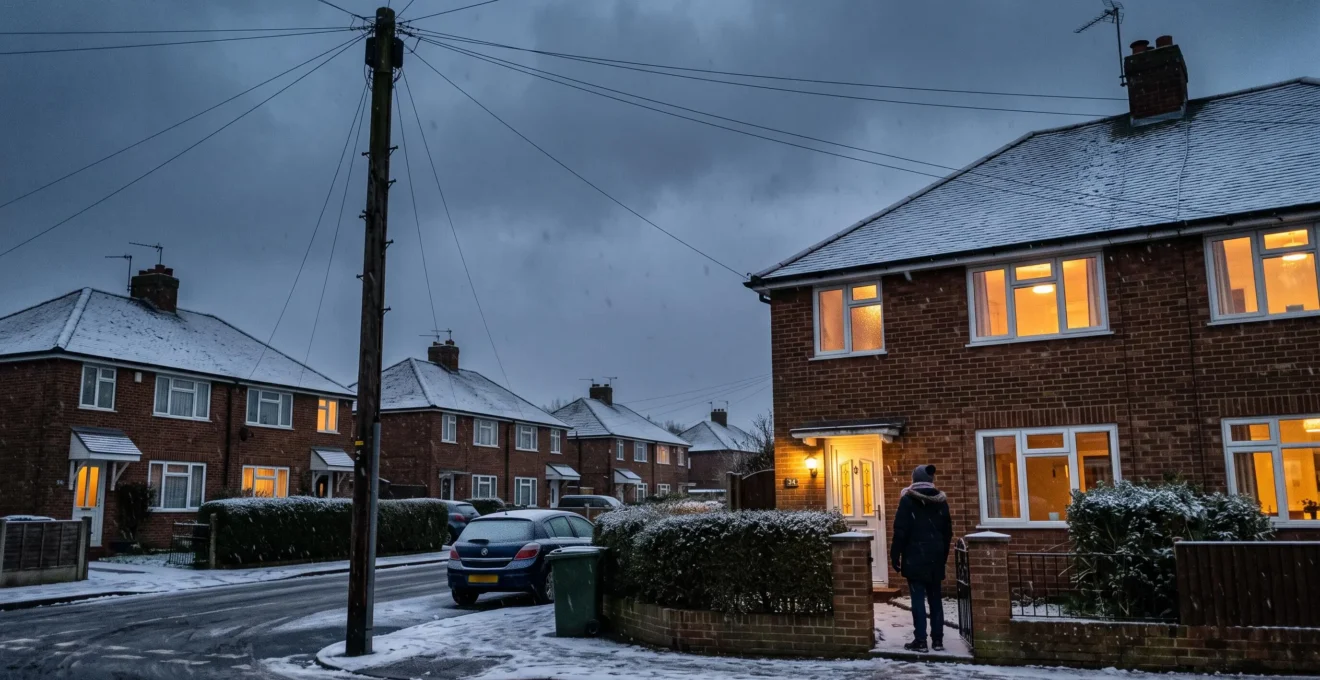
When temperatures plunge across the UK, conventional energy sources can appear to offer the safest guarantee of warmth and electricity. Gas-fired power stations respond to changing demand, gas boilers provide familiar heating, and established infrastructure supports millions of households. But does relying on conventional energy automatically make a home more resilient?
Not necessarily. Winter energy reliability depends on the whole electricity system, not simply the fuel used to generate power. Generation availability, network condition, electricity imports, storage and the ability to shift demand all influence what happens during a cold snap. A household can also have a reliable gas boiler that stops working during an electricity cut because its controls and circulation pump require power.
For most UK homes, the practical question is therefore not whether to abandon conventional energy immediately. It is how to protect essential comfort, limit exposure to expensive electricity periods and prepare proportionately for genuine outages without buying unnecessary backup equipment.
Cold-snap energy reliability: the essentials
- Conventional generation remains important, but winter security also depends on renewable output, storage, interconnectors and flexible demand.
- Changing electricity tariffs can address peak-period costs; properly configured battery backup addresses a different risk: losing supply.
- A measured critical-load plan, basic emergency supplies and periodic testing usually provide a better starting point than attempting to power an entire home independently.
- Why Does “Reliable Power” Depend on Flexibility, Not Just Big Power Stations?
- How to Build a Home Resilience Plan Without Relying on Fossil Backup?
- Battery Backup or Tariff Strategy: Which Protects You Better During Peak Events?
- The Over-Backup Mistake That Adds £3,000 for a Problem You Don’t Have
- When Should You Test Your Backup Setup to Avoid a Failure During a Storm?
- How to Convert “2 Days of Backup” Into kWh and kW Without Guesswork?
- Home Battery or Backup Generator: Which Keeps You Running During a 12-Hour Cut?
- Can You Run a UK Home Off-Grid Without Cutting Usage by 50%?
Why Does “Reliable Power” Depend on Flexibility, Not Just Big Power Stations?
Reliable electricity means matching generation and imports to demand at every moment while maintaining enough reserves to respond to unexpected changes. Large power stations contribute to that security, but their size alone does not guarantee reliability. Flexible generation, storage, interconnectors and adjustable electricity consumption all help the system cope with sharp winter demand peaks.
A cold evening illustrates the challenge. Households switch on lighting, prepare meals and demand more heating at similar times. The electricity system must meet that increased load even if wind generation is temporarily low or a power station becomes unavailable.
Gas-fired power stations remain particularly valuable because many can adjust their output to follow changes in electricity demand. This flexibility supports the system alongside wind, solar, nuclear generation, batteries and imported electricity. It does not mean gas is inherently immune to equipment failure, fuel constraints or other operational risks.
According to NESO’s Winter Watch electricity outlook, Great Britain’s forecast electricity supply margin for winter 2026/27 is 5.9 GW, approximately 9.5% above expected peak demand. This is a forecast rather than an observed outcome, and it does not predict whether individual streets will experience storm-related faults.
5.9 GW
Forecast electricity supply margin for Great Britain in winter 2026/27, equivalent to approximately 9.5% above expected peak demand. The assessment considers 30,000 scenarios involving weather, demand, renewable generation, power station availability and imports.
National Energy System Operator, Winter Watch, winter 2026/27 forecast.
Interconnectors provide another source of flexibility by allowing electricity to move between Great Britain and neighbouring systems when commercial and operational conditions permit. Batteries can respond rapidly, while demand flexibility reduces consumption during particularly demanding periods. These resources cannot eliminate every supply risk, but they reduce dependence on any single technology.
For households, three situations must remain distinct:
- Higher electricity prices: the household still receives power, but consuming it at certain times may cost more under a variable time-of-use arrangement.
- Voluntary demand-shifting events: participating customers may receive incentives to reduce or move consumption during specified periods.
- Actual power cuts: electricity stops reaching the property, requiring emergency precautions or a suitable backup system.
A tight national electricity margin is not the same thing as a blackout. Likewise, a local storm-related fault can interrupt household supply even when national generation is sufficient.
Once reliability is understood as a combination of available supply, delivery infrastructure and demand management, household preparedness becomes easier to design around actual risks.
How to Build a Home Resilience Plan Without Relying on Fossil Backup?
A household can improve its resilience without installing a fossil-fuel generator by reducing essential electricity demand, protecting warmth and preparing simple emergency supplies. The first step is identifying which appliances genuinely need power during an outage. Any battery or alternative backup should then be sized against those critical needs rather than normal whole-house consumption.
Begin with an audit of everything that uses electricity. Include appliances that operate continuously, equipment needed for heating and devices that provide essential communication.
Separate the results into three priorities:
- Critical loads: essential lighting, refrigeration, communication equipment and heating controls where maintaining them is necessary and technically possible. Medically necessary electrical equipment requires an individual contingency plan.
- Comfort loads: cooking appliances, supplementary heating and hot water where temporary alternatives or reduced use may be possible.
- Deferrable loads: laundry, dishwashing, non-essential electronics and electric vehicle charging.
Electrical heating deserves special attention. A gas boiler may require relatively little electricity for controls and pumps, but a heat pump can impose a substantially larger load while operating. Battery backup suitable for a boiler’s electrical components may be inadequate for maintaining a heat pump’s normal heating output.
Reducing heat loss also extends resilience without increasing battery capacity. Draught-proofing, insulation, closing curtains and concentrating occupancy in a suitable warm room can reduce the heat required to remain comfortable. These measures are especially useful when electricity is unavailable and normal heating cannot operate.
The right combination depends on the home’s location, occupancy and vulnerability. The following comparison separates low-cost preparedness from more involved electrical installations.
| Option | Cost and preparation | Practical protection |
|---|---|---|
| Portable lighting and phone power banks | Relatively low equipment outlay; straightforward preparation | Communications and lighting for a limited time, depending on stored charge |
| Warm-room preparation and draught reduction | Ranges from simple household changes to larger efficiency improvements | Helps retain warmth but does not generate electricity |
| Home battery with approved backup capability | Substantial equipment and professional installation requirements | Selected electrical circuits for a duration determined by usable capacity and demand |
| Neighbour or community support arrangements | Primarily advance coordination and communication | Potential access to alternative shelter or assistance; availability must be confirmed |
The UK Government power cut preparedness guidance recommends emergency lighting, essential supplies and measures to preserve warmth. Its recommendations include at least three days of emergency bottled water and non-perishable food, with water planning based on three litres per person per day.
For households with relevant health or accessibility needs, the Priority Services Register and a separate medical equipment contingency plan deserve particular attention. Registration provides access to additional support but does not guarantee uninterrupted electricity.
Build a practical household resilience checklist
- List every appliance needed during an outage and label its priority; produce a critical-load inventory.
- Record each critical device’s power demand and expected operating time; produce a daily electricity requirement estimate.
- Identify one room suitable for retaining warmth and prepare blankets, lighting and necessary supplies; produce a room preparation checklist.
- Confirm which circuits any existing battery actually supplies during a grid outage; obtain a circuit list or installation confirmation.
- Record emergency contacts, equipment instructions and household responsibilities; produce a readily accessible outage action sheet.
No resilience plan should depend entirely on a single battery or electronic control system. A charged phone, independent torch, warm clothing and an agreed fallback arrangement remain valuable even when more sophisticated equipment is installed.
Battery Backup or Tariff Strategy: Which Protects You Better During Peak Events?
A home battery and an electricity tariff strategy address different risks. A suitable battery can supply selected circuits during a power cut and shift electricity use between pricing periods. A time-of-use tariff can reduce bills when consumption moves to cheaper hours, but it cannot restore electricity during an outage. The better choice depends on whether your main concern is cost or continuity.
For a household experiencing expensive evening electricity but no significant outage problems, changing consumption habits or choosing an appropriate tariff may provide more immediate value than purchasing storage hardware.
Conversely, a property exposed to repeated local interruptions may benefit from a correctly configured backup battery, particularly where refrigeration, communication or heating controls must continue operating.
Energy Saving Trust explains in its battery storage advice that household batteries can store electricity from solar panels or charge from the grid during cheaper tariff periods. It gives an indicative price of approximately £4,600 for a 5 kWh battery system while cautioning that electricity savings do not always justify the investment.
The financial and practical differences are substantial.
| Decision factor | Home battery | Tariff strategy |
|---|---|---|
| Upfront spending | Equipment, installation and potentially electrical modifications | Typically no comparable hardware purchase, although eligibility or metering changes may apply |
| Protection against outages | Possible with appropriate backup equipment and isolated circuits | None |
| Protection against expensive peak hours | Can use stored electricity instead of expensive grid electricity | Can reduce costs by shifting consumption to cheaper periods |
| Duration | Limited by usable stored energy and appliance demand | Available whenever the tariff structure and consumption pattern make shifting worthwhile |
| Principal limitation | High initial cost and finite stored energy | Requires flexibility; the tariff may be worse when consumption cannot shift |
Both methods can work together. Imagine a household charging its battery overnight at a lower electricity rate, then using that stored power during the more expensive evening period. That arrangement can reduce exposure to peak electricity prices, subject to battery losses, tariff differences and installation costs.
However, a battery providing tariff savings does not automatically provide outage backup. Some grid-connected systems disconnect when mains electricity fails. Backup operation requires suitable equipment, safe electrical isolation and appropriate configuration.
Tariff comparisons must also account for standing charges, peak unit rates, off-peak windows and the household’s actual consumption. A family that cannot move cooking, heating or other significant electricity use away from expensive periods may achieve little benefit from a superficially attractive tariff.
The next decision is how much protection is worth purchasing. Without examining real outage exposure, households can easily pay for storage capacity they rarely need.
The Over-Backup Mistake That Adds £3,000 for a Problem You Don’t Have
Overspending on backup equipment happens when households size systems around normal whole-house electricity use rather than essential demand during a realistic outage. An additional £3,000 is an illustrative oversizing scenario, not a verified average loss. The mistake is purchasing extra batteries, prolonged backup duration or overlapping systems without evidence that those capabilities are necessary.
Consider two hypothetical purchasing choices. One household selects equipment to maintain refrigeration, communication and essential lighting. Another chooses enough storage to operate high-consumption cooking appliances, electric heating and other discretionary loads simultaneously.
If the second configuration costs £3,000 more, that extra amount may offer little practical resilience benefit when most local outages are brief and non-essential appliances can remain switched off. The difference is illustrative: actual prices depend on equipment, installation and electrical requirements.
There are three common causes of unnecessary spending:
- Whole-house sizing: treating normal electricity consumption as the minimum requirement during an emergency.
- Excessive duration: purchasing additional storage for prolonged interruptions without examining whether such events are a meaningful local risk.
- Duplicated protection: combining an oversized battery with another backup system without defining when each is needed.
Before requesting quotations, review the history of outages affecting your property. Your local distribution network operator may be able to provide useful information, although historical interruptions cannot establish exactly what future storms will bring.
It also helps to distinguish network reliability from generation adequacy. Ofgem monitors electricity distribution performance using measures such as Customer Interruptions and Customer Minutes Lost. Its 2024/25 electricity distribution report examines performance across 14 distribution network operators in Great Britain and identifies mixed outcomes during the first two years of the RIIO-ED2 period.
These network statistics can provide context, but they cannot establish the probability of a particular household experiencing a 12-hour outage. Local network conditions, exposure to severe weather and individual circumstances remain important.
Backup ownership can also introduce continuing costs. Battery systems experience energy losses and may consume electricity in standby operation. Fuel-powered generators need servicing, safe fuel arrangements and periodic checks. Money tied up in rarely used hardware cannot be spent on insulation, electrical safety improvements or other household priorities.
Illustrative backup purchasing decision
Suppose a household calculates that its essential devices require 3 kWh during an anticipated interruption. A salesperson proposes a larger installation intended to maintain most normal household activities, adding a hypothetical £3,000 to the project.
The household should compare the additional capability against documented needs, local outage exposure and the ability to defer non-essential tasks. A smaller system may be sufficient, provided it meets both energy capacity and power-output requirements. The scenario does not establish that a particular battery size or price is appropriate for every property.
Once a system is appropriately sized, its promised protection still needs to be checked in practice. Even carefully selected equipment can fail to perform as expected without testing.
When Should You Test Your Backup Setup to Avoid a Failure During a Storm?
Test a household backup setup after installation, before the winter heating season and whenever equipment, wiring or relevant operating settings change. The aim is not simply to confirm that a battery or generator switches on. A proper test must demonstrate that essential appliances receive power and that household members understand how to operate the system safely.
A newly installed battery might appear fully charged but still fail to support the intended sockets during a mains interruption. Similarly, a generator may start successfully without safely powering the household’s designated circuits.
Testing therefore has two components: technical operation and practical household readiness.
For technical operation, a qualified installer should establish the correct procedure for confirming that backup isolation and changeover equipment function as intended. Householders should not improvise electrical isolation, alter consumer-unit wiring or connect generators directly to household sockets.
For practical readiness, occupants should know which devices remain operational, what to switch off and where emergency supplies are stored.
A useful testing sequence includes:
- Confirm the system’s current state of charge or fuel readiness, and review any manufacturer warnings.
- Identify the circuits that are supposed to receive backup power.
- Follow the manufacturer’s or installer’s approved method for a simulated outage or supervised transfer test.
- Run the intended critical appliances for a sustained period within equipment limits, recording their energy consumption and any unexpected interruptions.
- Compare observed performance with the original duration estimate and update the household instructions.
Testing must reflect realistic winter conditions. Battery performance may vary with temperature, equipment design and installation environment. Software updates, changes to reserve settings or modifications to electrical circuits can also alter available backup performance.
The location of battery equipment matters because individual products have defined operating temperature ranges. A battery installed in an unheated outbuilding should be assessed according to its manufacturer’s specifications rather than assumptions drawn from indoor performance.
Household instructions should be tested too. Someone unfamiliar with the installation may need to locate emergency lighting, identify protected sockets or contact the network operator while the person who normally manages the equipment is absent.
For generators, all testing must follow the manufacturer’s instructions and take place in a safe outdoor position away from doors, windows and ventilation openings. Never run a fuel-powered generator indoors or in an enclosed space because of the risk of fatal carbon monoxide poisoning.
The most useful result is not simply a successful test. It is a documented understanding of which devices remain powered and for how long, allowing backup duration claims to be converted into meaningful figures.
How to Convert “2 Days of Backup” Into kWh and kW Without Guesswork?
To calculate two days of backup, multiply each essential appliance’s power in kilowatts by its daily operating hours, add the results and multiply by two. Then check the highest power needed simultaneously. Battery capacity in kWh determines the energy available over time, while inverter output in kW determines which appliances can operate together.
The distinction matters because a battery can contain sufficient stored energy yet still be unable to start or operate certain appliances. An electric kettle, immersion heater or other high-demand device may exceed an inverter’s power rating even when the battery has plenty of remaining charge.
Start by recording each essential appliance’s wattage and expected daily operating time. Where consumption varies or a device cycles on and off, use measured average energy consumption rather than assuming that its rated power is drawn continuously.
The basic calculation is:
Energy (kWh) = power (W) × operating hours ÷ 1,000.
For illustration, consider a hypothetical household that plans to operate the following devices during a power cut.
| Critical appliance | Assumed average power | Equivalent daily operating time | Daily energy |
|---|---|---|---|
| Refrigerator | 50 W | 8 hours | 0.40 kWh |
| Router | 10 W | 24 hours | 0.24 kWh |
| Essential LED lighting | 20 W | 5 hours | 0.10 kWh |
| Heating controls and pump | 100 W | 10 hours | 1.00 kWh |
| Phone and small-device charging | 20 W | 2 hours | 0.04 kWh |
| Total | — | — | 1.78 kWh |
All values in this table are hypothetical assumptions for demonstrating the calculation, not representative measurements or guaranteed appliance performance.
At 1.78 kWh per day, the assumed electricity requirement for 48 hours is 3.56 kWh. That is the estimated energy delivered to appliances, before allowing for inverter losses, battery reserve settings or changes in demand.
A nominal 5 kWh battery is not necessarily capable of delivering 5 kWh to household appliances. The relevant specification is its usable energy capacity under the intended operating conditions, including any limits imposed by backup reserve settings and conversion losses.
Next, calculate simultaneous demand. If every device in the illustrative table were drawing its assumed power at once, the combined load would be 200 W, or 0.20 kW. Actual equipment may need additional power during startup, particularly for motor-driven appliances.
The inverter’s continuous output rating and relevant startup capability must accommodate the equipment it is expected to supply. Otherwise, protective shutdown or failure to start appliances may occur despite sufficient stored energy.
Winter adds further uncertainty. Heating circulation may operate for longer, lighting demand can increase and stored energy may be reduced by reserve settings or temperature-related limitations. Battery ageing can also change available capacity over time.
Therefore, a supplier’s claim of two days of backup should always be linked to a stated load profile. Two days of emergency lighting and communications is not equivalent to two days of normal electrical heating and cooking.
Once realistic demand is established, it becomes possible to compare battery and generator options fairly for a prolonged interruption rather than relying on advertised runtime alone.
Home Battery or Backup Generator: Which Keeps You Running During a 12-Hour Cut?
For a 12-hour power cut, a correctly sized home battery can maintain selected electrical loads quietly without refuelling, but its runtime is limited by usable stored energy. A generator can continue operating while sufficient fuel is available, provided it can be used safely outdoors and is properly connected. The better option depends on household demand, safety constraints and local outage exposure.
A 12-hour outage is a useful stress-test scenario, not an assumption about the normal duration of UK power cuts. Government emergency guidance describes most outages as local and short-lived, while recognising that longer interruptions can occur.
Applying the earlier hypothetical calculation, a household using 1.78 kWh daily would require approximately 0.89 kWh of energy for 12 hours if consumption were spread evenly. That calculation does not include conversion losses, startup demands or differences between daytime and overnight use.
A battery with sufficient usable capacity and power output could cover that illustrative requirement, assuming its installation supports independent backup operation. However, running an immersion heater, electric oven or space heater would considerably change the calculation.
The choice also involves practical trade-offs beyond energy capacity.
| Criterion | Home battery with backup capability | Backup generator |
|---|---|---|
| Operating duration | Limited by stored energy and connected loads | Dependent on fuel availability, equipment capability and safe running conditions |
| Transfer to backup | May be automatic, with transfer characteristics depending on equipment | May require manual starting or a suitably installed automatic transfer system |
| Noise | Usually relatively quiet | Produces engine and exhaust noise |
| Fuel logistics | Requires a stored charge or an available means of recharging | Requires appropriately stored fuel and possibly refuelling |
| Indoor safety | Must be installed and operated according to electrical and fire safety requirements | Must never operate indoors or in enclosed spaces because of carbon monoxide risk |
| Maintenance | Equipment checks, settings and battery health monitoring | Mechanical servicing, fuel management and functional testing |
A hybrid arrangement can also make sense in some circumstances. A modest battery might maintain essential equipment during shorter cuts, while a correctly installed generator provides additional support if a prolonged interruption occurs.
However, this combination introduces greater expense, complexity and maintenance responsibilities. It is most defensible when there is credible evidence of repeated long-duration outages or a specific continuity requirement that simpler arrangements cannot meet.
Generator safety is non-negotiable. Never operate a petrol, diesel or gas-powered generator inside a home, garage, shed or other enclosed space. Exhaust must be kept away from occupied buildings and ventilation openings. Any connection to fixed household wiring requires suitable equipment and professional installation to prevent dangerous backfeeding.
For people who rely on electrically powered medical equipment, a household battery or generator should not be assumed to provide adequate protection without assessing the equipment’s requirements and arranging a medically appropriate contingency plan.
For most households, a right-sized backup strategy is more attainable than indefinite electricity independence. That distinction becomes particularly important when considering whether a UK home can realistically operate entirely off-grid.
Key takeaways before considering off-grid living
- Decide whether your objective is maintaining essential services during interruptions or permanently replacing grid electricity.
- Assess any proposed system against difficult winter conditions rather than favourable annual or summer generation figures.
- Compare additional generation, storage and demand reduction as separate costs before committing to full independence.
Can You Run a UK Home Off-Grid Without Cutting Usage by 50%?
Running a UK home entirely off-grid without major changes to energy use is technically possible in some circumstances, but it can require substantial generation, storage and backup provision. Low winter solar output and consecutive cloudy days create the greatest difficulties. A 50% reduction in consumption is not a universal requirement; the necessary reduction depends on the property’s measured winter demand and available generation.
The distinction between annual electricity production and reliable winter supply is fundamental. A solar installation may generate substantial energy across a year without producing enough during a sequence of cold, overcast December days.
Storage can move electricity from one period to another, but it cannot solve an extended generation shortage unless sufficient electricity was previously stored or additional generation becomes available.
To illustrate the scale, consider a hypothetical household using 20 kWh of electricity per winter day, including electrical heating. The figure is a calculation assumption, not a UK household average.
Three days at that consumption level would require 60 kWh delivered to appliances before accounting for conversion losses or reserve requirements. If the home reduces demand to 10 kWh per day, the equivalent three-day energy requirement falls to 30 kWh.
This is where a substantial reduction in consumption changes the economics. A lower winter load reduces both the amount of electricity that needs to be generated and the amount that must be stored for low-generation periods.
But the calculation does not establish that every household must cut electricity consumption in half. A well-insulated property, an efficient heating system, a different heating fuel or a household with relatively low winter electricity demand may have a very different energy profile.
There are also major differences between three possible objectives:
- Reducing grid purchases: using solar generation, tariffs and storage to lower the amount of electricity bought from the grid.
- Maintaining resilience: operating selected circuits for limited periods when grid electricity is unavailable.
- Achieving full independence: meeting all electrical demand throughout the year without relying on grid imports.
The first two objectives can often be pursued without designing a household around the worst possible winter generation conditions. Full independence requires far more demanding calculations involving seasonal production, storage autonomy, maximum simultaneous loads and acceptable lifestyle constraints.
Conventional energy sources still play a role in the broader electricity system because dispatchable generation helps balance variable supply and changing demand. Yet the availability of conventional power generation does not guarantee that an individual home will avoid local network faults.
For a UK household primarily concerned about remaining comfortable during cold snaps, staying connected to the electricity grid while improving insulation, managing tariff exposure and protecting essential circuits may offer a more proportionate approach than attempting total independence.
The practical next step is to measure winter consumption, review local outage history and request equipment proposals that specify usable storage, supported circuits and expected runtime. This creates a basis for comparing conventional supply, flexible tariffs and backup technologies without assuming that either fossil fuels or complete energy independence automatically guarantees reliability.
Will a gas boiler still heat my home during a power cut?
Most modern gas central heating systems depend on electricity for controls, ignition or circulation pumps. Consequently, gas availability alone does not guarantee that heating will continue during an electricity outage. A suitable backup arrangement may support the necessary electrical components, but compatibility, power requirements and safe installation must be established first.
Does a national electricity supply warning mean my home will lose power?
No. A warning about tighter electricity supply margins indicates increased pressure on the national system, not necessarily an imminent household outage. Network faults, voluntary demand reduction and emergency disconnections are different situations. NESO’s winter adequacy assessment concerns national electricity supply, whereas local distribution faults are a separate reliability risk.
Can solar panels keep supplying electricity when the grid goes down?
Not necessarily. Many grid-connected solar installations shut down during an outage for safety reasons. Continuing to power household circuits requires compatible equipment capable of operating independently of the grid, together with suitable isolation and backup arrangements. Solar panels and a battery alone do not guarantee that a property has this capability.
Should a household with medical electrical equipment rely on a home battery?
A home battery should not be the sole assumed safeguard without checking the equipment’s electrical requirements, expected duration, transfer characteristics and manufacturer guidance. Households should discuss contingency arrangements with the relevant healthcare or equipment provider and check eligibility for the Priority Services Register. Alternative support arrangements may be essential if backup equipment becomes unavailable.
Will switching to a fixed electricity tariff prevent cold-snap price increases?
A fixed-rate tariff may stabilise the agreed unit rates during its fixed term, subject to contract conditions, but it does not guarantee a fixed total bill. Using more electricity during a cold snap can still increase spending. Time-of-use tariffs introduce a different consideration because the price may vary by consumption period. Neither tariff type protects against an actual electricity outage.