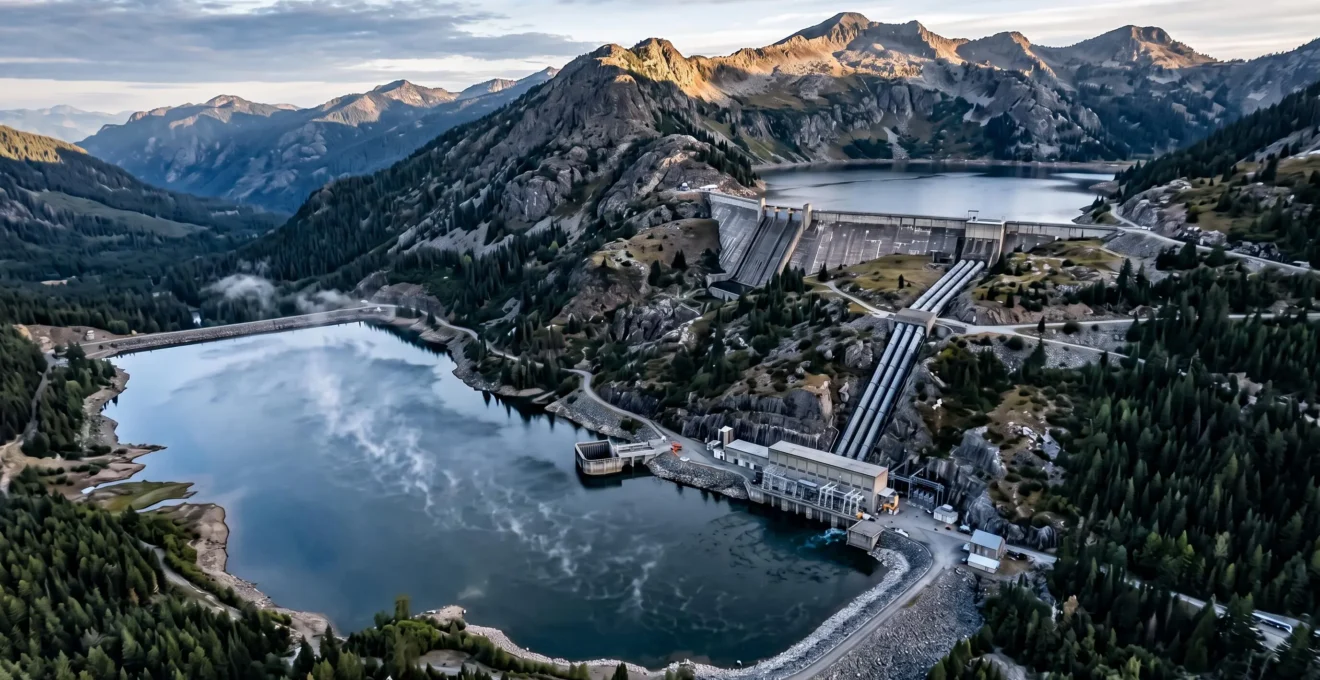
Pumped hydro can remain one of the lowest-cost options for storing electricity over 8–12 hours because its reservoirs, tunnels and other major civil structures can deliver energy for decades. Unlike lithium-ion batteries, increasing its storage capacity does not necessarily mean buying an equivalent quantity of additional electrochemical cells.
The principle is straightforward: electricity pumps water uphill when power is relatively cheap or abundant. The water is released through turbines when electricity becomes more valuable. Some energy is lost in the process, but a suitable site can store substantial quantities of electricity and provide dependable generating capacity over a long operating life.
That does not make pumped hydro universally cheaper than batteries. Construction costs, financing, geology, planning delays and competition from increasingly affordable battery systems can overturn its advantage. For a UK electricity system integrating more wind and solar, the meaningful question is therefore not which technology has the highest efficiency, but which delivers the required flexibility at the lowest whole-life cost.
Pumped hydro storage: the essential economics
- Lifetime matters: lower round-trip efficiency can be outweighed by long asset life, repeated cycling and comparatively low incremental energy-storage costs at suitable sites.
- Geography determines feasibility: reservoir volume, elevation difference, geology, environmental constraints and grid access often matter more than headline technology costs.
- Different durations need different solutions: pumped hydro is well suited to substantial daily energy shifting, while batteries, generators and other technologies can be more appropriate for faster or longer-duration needs.
- Why Can Lower Efficiency Still Win When the Asset Lasts 40+ Years?
- How to Estimate Stored MWh From Water Volume and Height Without Heavy Maths?
- Pumped Hydro or Battery Storage: Which Handles Peak Demand Better at Scale?
- The Site Constraint That Cancels Most Pumped Hydro Ideas Before Costing Starts
- When Does the Grid Actually Use Pumped Storage: Overnight or During Wind Surplus?
- Why Is Water Height More Important Than Flow Speed in Many Hydro Setups?
- Battery, Thermal Store, Hydrogen, or Generator: Which Works Best for 48–120 Hours?
- What Counts as Long-Term Energy Storage When You Need Power for Days, Not Hours?
Why Can Lower Efficiency Still Win When the Asset Lasts 40+ Years?
Pumped hydro can deliver cheaper electricity over its operating lifetime even when it loses more energy per cycle than a lithium-ion battery. The explanation is capital utilisation: expensive infrastructure may remain useful for several decades, spreading its initial cost across many years of electricity delivery. Whether this compensates for efficiency losses depends on construction costs, cycling frequency, financing and electricity prices.
Typical planning ranges place pumped hydro round-trip efficiency at approximately 70–85%, compared with roughly 85–95% for lithium-ion systems, depending on plant design and measurement boundaries. A pumped-storage facility returning 80% of its charging electricity must consume 100 MWh to deliver 80 MWh. A battery returning 90% needs approximately 89 MWh to supply the same output.
The battery clearly performs better on electricity losses. However, round-trip efficiency is not the same as lifetime storage cost.
For pumped hydro, reservoirs, tunnels, foundations and penstocks can remain in service for many decades with maintenance and periodic equipment refurbishment. Battery systems generally face capacity degradation and may require cell or equipment replacement over a shorter period, although actual replacement timing depends heavily on chemistry, use and operating conditions.
The International Energy Agency‘s Hydropower Special Market Report executive summary documents the long operating history of hydropower infrastructure while identifying high upfront investment, lengthy construction and uncertain revenues as major barriers to new projects. Evidence about the age of conventional hydropower plants should not be treated as a guaranteed lifetime for every pumped-storage component.
The economic comparison must therefore include construction expenditure, refurbishment, replacement batteries, charging electricity, operating costs, discount rates and the number of MWh actually delivered.
Illustrative comparison: efficiency versus lifetime
Consider two hypothetical storage assets delivering the same annual electricity output. One is a pumped-hydro installation with an assumed 80% round-trip efficiency; the other is a battery with an assumed 90% efficiency.
The pumped-hydro plant consumes more charging electricity. But if its infrastructure operates through several potential battery replacement periods, its annualised capital burden may be lower. This is an economic possibility, not a demonstrated result without project-specific capital costs, electricity prices and replacement schedules.
Efficiency becomes particularly important when charging electricity is expensive and the system cycles frequently. Longevity and energy-capacity economics become more valuable when a plant repeatedly shifts large quantities of electricity over decades.
Surplus renewable generation adds another dimension. Electricity that would otherwise be curtailed may have little immediate market value. Using it to pump water uphill can be worthwhile even after accounting for conversion losses, provided pumping creates enough later value to justify the equipment and grid costs.
For 8–12-hour storage, durability can be a powerful advantage. But longevity alone cannot rescue an expensive site with weak revenues, which makes the quantity of usable stored energy the next critical question.
How to Estimate Stored MWh From Water Volume and Height Without Heavy Maths?
To estimate pumped-hydro energy storage, multiply the usable water volume by the elevation difference between reservoirs and apply a simple conversion factor. One million cubic metres of water descending through 100 metres contains approximately 272.5 MWh of gravitational potential energy before turbine losses. The electricity actually delivered will be lower, depending on generating efficiency and operational constraints.
Stored energy comes from lifting a mass of water against gravity. For screening purposes, the relationship can be expressed as:
Theoretical stored energy (MWh) ≈ usable water volume (m³) × height difference (m) × 0.000002725.
This estimate uses water density of approximately 1,000 kg/m³ and standard gravitational acceleration. It is an engineering calculation rather than an empirical project-performance claim.
For every one million cubic metres raised by 100 metres, the theoretical potential energy is roughly 272.5 MWh, not 2–3 MWh. Confusing those figures would underestimate a project’s energy content by approximately two orders of magnitude.
Consider an explicitly hypothetical small upland reservoir containing 500,000 m³ of usable water, with a 200-metre elevation difference:
- Usable water volume: 500,000 m³.
- Gross head: 200 metres.
- Theoretical gravitational energy: approximately 272.5 MWh.
- Illustrative turbine and hydraulic conversion efficiency: 90%.
- Estimated electrical discharge: approximately 245 MWh, before additional operational adjustments.
If equipped with generating machinery capable of sustaining 25 MW, this hypothetical reservoir could theoretically support approximately 9.8 hours at that output. Actual duration would depend on changing reservoir levels, usable head, hydraulic losses and operating limits.
Three corrections prevent this simple estimate from becoming misleading.
- Usable reservoir volume: total reservoir capacity is not necessarily available for generation. Minimum operating levels, environmental requirements and structural limits can restrict the volume that moves between reservoirs.
- Conversion losses: turbine-generator efficiency affects discharge output. Round-trip efficiency additionally includes pumping and other losses, so it should not be applied again to electricity already adjusted using a discharge-efficiency factor.
- Changing effective head: the vertical distance between water surfaces can vary as reservoirs fill and empty. Calculating with a single maximum head may overstate deliverable energy.
Doubling either usable water volume or effective head doubles the theoretical energy estimate. Higher head may also reduce the water volume and hydraulic equipment dimensions required for a particular power rating. Yet it does not automatically halve civil-engineering costs: excavation, terrain, pressure requirements and reservoir construction remain site-specific.
These calculations provide an initial energy estimate, not a bankable design. The next question is how that usable energy compares with batteries when a grid needs substantial power through its evening peak.
Pumped Hydro or Battery Storage: Which Handles Peak Demand Better at Scale?
Pumped hydro can offer an advantage when a grid needs hundreds of megawatt-hours or several gigawatt-hours of storage across long peak periods. Batteries are easier to deploy across more locations and are exceptionally effective for fast response. Neither wins universally: the preferred option depends on discharge duration, usable capacity, installation cost, response requirements and the value of supporting grid services.
The central distinction is how each technology expands its energy capacity. A battery project generally requires additional cells to increase stored MWh. Pumped hydro may increase storage duration by expanding usable reservoir volume, provided its turbines and hydraulic infrastructure can support that configuration.
Additional reservoir capacity is not free. Excavation, land, water management, dams and environmental mitigation can make expansion expensive. Nevertheless, at favourable sites, energy capacity can grow without proportional expansion of the electrical generating machinery.
Four comparisons matter most when evaluating peak demand.
| Decision factor | Pumped hydro | Lithium-ion batteries |
|---|---|---|
| Discharge duration | Well suited to large multi-hour installations; duration depends on usable reservoir capacity | Flexible design, including longer-duration systems, with extra stored energy requiring more cells |
| Response speed | Rapid generation changes possible, subject to operating state and equipment | Very fast electronic response, especially useful for frequency control |
| Lifetime and degradation | Long-lived civil infrastructure; mechanical equipment still needs maintenance and refurbishment | Electrochemical degradation influences usable capacity, warranty and replacement decisions |
| Expansion constraints | Geology, reservoirs, water, permits and transmission connection | Battery supply, installation space, cooling, fire safety and grid connection |
| Project delivery | Potentially lengthy development and major construction requirements | Often modular and comparatively quick to install once permitted and connected |
A 100 MW plant providing 10 hours of full output needs 1,000 MWh of usable energy capacity, irrespective of technology. Pumped hydro must supply sufficient water volume and head; a battery installation needs enough usable electrochemical capacity, taking account of operating limits and degradation.
The International Energy Agency’s Electricity 2026 analysis of grid flexibility shows why old assumptions about batteries need revisiting. It reports substantial battery cost reductions and identifies storage procurement extending into eight-hour durations. This rules out any simplistic claim that lithium-ion batteries stop being technically or economically relevant beyond four hours.
Approximately 40%
The reduction in the battery storage project cost indicator reported by the IEA for 2024. This is a historical market indicator, not a 2026 battery price or a directly comparable lifetime storage cost.
International Energy Agency, Electricity 2026, flexibility analysis.
Grid planners also need to distinguish power delivery from ancillary services. Batteries can respond extremely quickly to frequency disturbances, while pumped hydro can supply sustained multi-hour output, rotating-machine inertia in suitable configurations and other stability services.
A hybrid system can therefore make economic sense: batteries handle very fast variations, while pumped storage manages extended peaks and larger energy transfers.
Mineral supply chains, manufacturing capacity and battery safety requirements influence one technology; geology, water rights and environmental permissions influence the other. The tightest local constraint can determine the outcome before any generic cost comparison does.
For the UK, pumped hydro is particularly relevant where large storage capacity and an appropriate site coincide. Without that site, the apparent economies of scale may never materialise.
The Site Constraint That Cancels Most Pumped Hydro Ideas Before Costing Starts
The biggest obstacle to pumped hydro is finding two suitable reservoir locations at different elevations, close enough to connect economically and supported by stable geology. A large elevation difference is not sufficient on its own. A viable project also needs usable water storage, hydraulic routes, acceptable environmental impacts, planning approval and a practical connection to the electricity transmission network.
A promising hillside may look ideal from a map but fail once the engineering constraints become apparent. The upper reservoir might require excessive excavation, the connecting tunnel may cross problematic rock, or the nearest high-capacity grid connection may be too distant.
The U.S. Department of Energy‘s pumped-storage hydropower overview distinguishes conventional open-loop installations from closed-loop systems without a continuing connection to natural waterways. This distinction matters because closed-loop designs can expand the range of potential locations, although they do not eliminate the need for water, suitable reservoirs and environmental assessment.
A sensible pre-feasibility review eliminates weak sites before paying for detailed design.
Five practical checks before commissioning a pumped-hydro feasibility study
- Measure elevation and separation: produce a topographic sketch showing candidate upper and lower reservoirs, approximate vertical head and connecting distance.
- Estimate usable water capacity: calculate a preliminary reservoir-volume range and record the corresponding theoretical MWh estimate.
- Screen geological risks: identify available geological maps, known faults, unstable slopes and potential tunnel obstacles; prepare a preliminary risk register.
- Review water and environmental constraints: identify water availability, likely environmental sensitivities and relevant planning issues in a documented constraints map.
- Check grid access: identify potential connection points and the questions requiring network-operator assessment; produce an initial grid-connection screening note.
These actions are screening steps, not substitutes for geological investigations, hydrological studies, consent applications or formal connection offers.
The sequence matters because some failures are decisive. A site requiring an exceptionally long tunnel may lose its economic advantage. Unfavourable geology can introduce substantial construction uncertainty. Limited water availability can constrain filling or operation, while environmental impacts may prevent permission altogether.
Several alternative configurations can relax the classic requirement for two natural lakes. Artificial closed-loop reservoirs allow greater siting flexibility. Former mines may offer existing underground spaces or elevation differences, although water management, structural integrity and equipment access introduce their own difficulties.
Seawater pumped-storage concepts have also been demonstrated, including in Japan, but corrosion, marine environmental effects and coastal engineering create additional challenges. None of these options removes the need for a project-specific engineering assessment.
For UK developers, long consent and construction periods also increase financing exposure. Even a technically viable location may be commercially unattractive if grid access, revenue arrangements or planning outcomes remain uncertain.
Good sites are scarce, which helps explain both the long-term value of existing pumped-storage assets and the difficulties of developing new ones. Once a project is built, however, its economics increasingly depend on when the electricity system actually needs it.
When Does the Grid Actually Use Pumped Storage: Overnight or During Wind Surplus?
Pumped-storage plants no longer need to follow a simple pattern of pumping overnight and generating during the evening peak. They respond to electricity prices, system demand, renewable output and reserve requirements. In a grid with significant wind and solar generation, pumping may be attractive during windy periods or sunny afternoons, while generation is valuable during expensive peaks or supply shortages.
Historically, pumped storage often used relatively cheap overnight electricity from conventional generation and supplied electricity during higher-demand daytime or evening periods. That remains possible, but greater renewable penetration changes the timing of low-price hours.
Wind output can rise overnight or during the day. Solar generation tends to concentrate around daylight hours, potentially reducing wholesale prices when production exceeds immediate demand. The economically attractive charging period therefore changes with weather, consumption and other flexible resources.
Price spreads, rather than the clock, determine the basic arbitrage opportunity.
Suppose a hypothetical plant has 80% round-trip efficiency, buys pumping electricity for £30/MWh and sells generated electricity for £100/MWh.
It needs 1.25 MWh of purchased electricity to deliver 1 MWh later. Its illustrative charging-energy cost is therefore £37.50 per MWh delivered. The £62.50 difference is a gross energy margin before network charges, operating costs, maintenance, financing and other market obligations.
That calculation gives a useful rule: at 80% round-trip efficiency, the later selling price generally needs to exceed the charging price divided by 0.8 before additional costs can be recovered. Real plant operation also depends on technical restrictions and the alternative value of stored water.
Sometimes a plant deliberately keeps its upper reservoir full rather than selling electricity at the first profitable opportunity. Its stored energy may be worth more during a forecast system shortage or a later high-price interval.
This introduces the distinction between energy arbitrage and capacity value. A storage asset can earn value from being available when needed, not merely from the number of MWh it cycles. Contract terms, balancing services and market design determine how that value becomes revenue.
Pumped hydro can also contribute to grid stability. Depending on its electrical configuration, it may provide synchronous inertia, reactive-power support, reserve capacity and black-start services. These capabilities are not identical across all plants and should be evaluated individually.
For Great Britain, the growing need to manage periods of renewable surplus and scarcity strengthens the rationale for flexible resources. It does not guarantee that an individual pumped-storage project will earn enough from market spreads alone to recover its capital cost.
The plant’s commercial strategy ultimately depends on power-system conditions. Its physical ability to store and release energy, however, begins with a more fundamental distinction between water height and water flow.
Why Is Water Height More Important Than Flow Speed in Many Hydro Setups?
Water height matters because it determines how much gravitational energy is available from each unit of water. Flow rate determines how quickly that energy can be converted into electricity. A large elevation difference allows a relatively modest water flow to deliver substantial power, while a low-head installation may require far more water to produce the same output.
Hydropower engineers call the effective vertical pressure-producing difference between upstream and downstream water levels the head. In a pumped-storage system, water gains potential energy when it is raised to the upper reservoir and releases that energy as it descends.
For a simplified turbine calculation:
Electrical power (kW) ≈ 9.81 × flow rate (m³/s) × net head (m) × generating efficiency.
The formula shows two independent ways to increase power: pass more water through the turbine or increase the effective head.
Consider two explicitly hypothetical turbines, each operating at 90% generating efficiency.
- A high-head turbine receives 10 m³/s of water with a net head of 300 metres. Its calculated electrical output is approximately 26.5 MW.
- A low-head turbine receives 50 m³/s with a net head of 30 metres. Its calculated output is approximately 13.2 MW.
The high-head example produces approximately twice the electrical power despite using only one-fifth of the water flow. This is why elevation can be more valuable than visually impressive quantities of moving water.
Flow speed inside a pipe or turbine is not interchangeable with flow rate. The usable hydraulic energy depends on the water’s pressure, elevation and movement through the system. A fast-moving stream does not necessarily offer the same recoverable energy as water descending under substantial head.
The engineering consequences extend beyond generation. For a specified power output, a higher head can reduce the necessary volumetric flow, potentially allowing smaller waterways, valves and turbine flow passages.
Yet increasing head also raises pressure requirements. Penstock materials, wall thickness, mechanical loading and surge protection may become more demanding. Higher elevation is therefore beneficial only when the additional construction and equipment costs remain acceptable.
In pumped hydro, the preference for head explains the arrangement of upper and lower reservoirs connected by steep, pressurised waterways. It also explains why flat regions generally face a more difficult siting challenge.
Water height is a central reason pumped hydro can be economical at appropriate sites, but geography also limits how much energy those sites can store. That boundary becomes important when electricity is required for several consecutive days.
Battery, Thermal Store, Hydrogen, or Generator: Which Works Best for 48–120 Hours?
For continuous electricity needs lasting 48–120 hours, no single storage or backup technology is consistently cheapest. Batteries offer high efficiency and fast response, but extended duration requires substantial energy capacity. Hydrogen can store energy for long periods but incurs conversion losses. Thermal storage is attractive mainly for heat demand, while generators depend on reliable fuel supplies and maintenance.
The first question is whether the user needs electricity, useful heat or guaranteed backup during an outage. These requirements are economically different, even when the required operating duration is identical.
A hospital requiring emergency electricity for several days cannot rely on the same decision criteria as a heat network storing thermal energy. Similarly, a national grid managing several days of unusually low wind generation needs capacity across an enormous system, not merely individual-site resilience.
For electrical supply, the key comparison is the cost of providing the required MW continuously over the full event, including replenishment, conversion losses and operational reliability.
| Technology | Most relevant use | Main limitation |
|---|---|---|
| Lithium-ion battery | Fast backup, short-term balancing and hybrid resilience | Large amounts of energy capacity may become costly for continuous multi-day discharge |
| Thermal storage | Heating, industrial heat and some cooling applications | Stored heat does not automatically provide economical electricity |
| Hydrogen storage | Potential multi-day or longer electricity backup where conversion and storage infrastructure are viable | Electrolysis, storage and reconversion losses; infrastructure and safety requirements |
| Fuelled generator | Emergency power for critical facilities | Fuel availability, emissions, maintenance and operating cost |
| Pumped hydro | Large-scale grid balancing where reservoirs hold enough usable energy | Multi-day operation requires unusually large energy capacity relative to power output |
Consider a hypothetical critical facility needing 1 MW continuously for 72 hours. The energy requirement is 72 MWh before allowing for conversion losses, battery operating limits or reserve margins.
A battery-only solution must have sufficient usable capacity to cover that requirement. A generator-based solution instead needs adequate generating capacity and a dependable fuel supply. A hybrid arrangement could use batteries to manage immediate interruptions while generators provide sustained output.
Hydrogen follows a different economic structure. Its energy-storage medium may be suitable for much longer holding periods, but electricity must first be converted into hydrogen and later converted back into electricity, with losses at both stages. These losses are particularly expensive when the plant cycles frequently using costly charging electricity.
Thermal storage can be much more compelling when the final requirement is heat. Converting stored heat back into electricity adds complexity and conversion losses, so thermal and electrical storage costs should not be compared without specifying the useful output.
Pumped hydro remains relevant when an existing or feasible site has sufficient water volume for extended discharge. But a plant sized for 10 hours at full output cannot automatically sustain the same power for 72 hours. Achieving that would require much greater stored energy, reduced output, replenishment or another supporting resource.
The 48–120-hour problem illustrates why storage duration must be defined explicitly. It also reveals the limits of treating every technology capable of holding energy as an interchangeable solution.
Key takeaways before choosing a storage duration
- Specify both the required power in MW and the total usable energy in MWh; neither figure can replace the other.
- Distinguish routine daily cycling from rare multi-day supply shortages, because their charging patterns and economics differ substantially.
- Evaluate a portfolio of complementary resources where reliability requires electricity through several different timescales.
What Counts as Long-Term Energy Storage When You Need Power for Days, Not Hours?
Long-term energy storage should be defined by how long a system can supply its rated power, not simply by how much energy it contains. Storage for seconds or minutes solves a different problem from daily energy shifting, multi-day renewable shortfalls or seasonal balancing. Pumped hydro is particularly well established for large-scale, multi-hour storage, but days-long reliability often requires additional technologies.
The most useful technical measure is discharge duration at rated power. Divide usable energy capacity in MWh by electrical output in MW to obtain the number of hours the system can operate at that output, assuming the stated usable energy is deliverable.
For example, a hypothetical system rated at 200 MW with 2,000 MWh of usable energy provides 10 hours of full-power discharge. Increasing its energy capacity to 4,000 MWh, without changing its power rating, increases that duration to 20 hours.
For planning purposes, storage requirements can be grouped into four broad classes. These are practical categories rather than universally binding engineering definitions.
| Duration class | Typical timescale | Primary system need |
|---|---|---|
| Power quality and rapid balancing | Seconds to minutes | Frequency control, fast reserves and voltage-related support |
| Daily energy shifting | Approximately 4–24 hours | Moving electricity between renewable surplus periods and daily peaks |
| Multi-day storage | Approximately 2–7 days | Managing extended renewable shortfalls and prolonged resilience events |
| Seasonal storage | Weeks to months | Balancing prolonged or seasonal mismatches between supply and demand |
The multi-day category presents a particularly demanding economics problem. A grid experiencing several days of low wind output needs not only sufficient generating power but also enough stored energy to sustain that output for the required period.
For illustration, 1 GW of continuous generation for three days requires 72 GWh of usable electricity. That figure follows directly from 1,000 MW multiplied by 72 hours, before accounting for losses or reserve requirements.
A system sized for an ordinary evening peak may contain only a fraction of the energy necessary for such an event. Longer duration can therefore change the preferred technology, even if its power output requirement stays the same.
Storage is also only one flexibility option. Demand response, interconnection, dispatchable generation, electricity-network improvements and diversified renewable resources can all reduce the amount of dedicated storage required. Their relative value depends on system conditions and reliability standards.
For Great Britain, the distinction matters particularly during periods of prolonged low wind generation combined with high electricity demand. Pumped hydro can help bridge daily and extended peak periods, but the contribution of any single installation is limited by its usable reservoir energy and available pumping opportunities.
The portfolio approach is more robust than choosing a universal winner. Fast-response batteries, pumped hydro, demand-side flexibility and other firm resources can each cover different portions of the reliability requirement.
The practical next step is to define a project’s required MW, MWh, annual cycling pattern, reliability obligation and site constraints. Comparing technologies against those same requirements reveals where pumped hydro is genuinely economical—and where another solution is better.
Is pumped hydro cheaper than lithium-ion batteries for 10-hour storage?
It can be, particularly at favourable sites with long operating lives and substantial energy capacity. However, there is no universal cost crossover at 10 hours. Battery prices, construction expenditure, project financing, cycling frequency, replacement requirements and market revenues must all be included in a consistent lifetime comparison.
Can pumped hydro operate without a natural lake?
Yes. Closed-loop pumped-storage systems can use engineered reservoirs without an ongoing hydrological connection to natural waterways. Suitable terrain, sufficient usable water, engineering stability and environmental permissions are still required. The absence of natural lakes does not automatically make an artificial-reservoir project economical.
Does pumped hydro store renewable electricity without emissions?
Pumped hydro does not need to burn fuel during normal pumping and generation, but it consumes electricity and has infrastructure-related environmental impacts. Its overall emissions depend on the electricity used for charging, construction, reservoir characteristics and operation. Charging from otherwise-curtailed low-carbon generation can improve its system-wide environmental value.
Does pumped storage always need cheap electricity at night?
No. Pumping can be attractive whenever electricity prices and operating conditions justify storing energy for later use. In systems with substantial renewable generation, low-price periods can occur during sunny afternoons or windy intervals. Operators must also consider reserve commitments, reservoir levels and the expected value of future generation.
What is the biggest financial risk in a new pumped-hydro project?
There is no single dominant risk for every project, but construction uncertainty, high upfront costs, extended development schedules and uncertain long-term revenue can be particularly important. Geological conditions and delayed grid connections may increase costs, while insufficient market remuneration can undermine investment returns even when the finished facility would operate efficiently for decades.